From Colt's first revolver to the pistol on a modern police belt — and the single gunfight that rearmed America.
Gunpowder is twelve hundred years old, but the story that actually matters for the weapon a police officer wears today begins in 1836, when a young man named Samuel Colt made the repeating handgun cheap enough to change the world. What follows that patent is a two-century argument about one deceptively simple question: how do you reliably stop a determined man with a gun small enough to hold in one hand? The answer kept changing, and once, in Miami, it was decided in under five minutes.
c. 850Chinese alchemists discover gunpowder while hunting for an elixir of life
1288The Heilongjiang hand cannon — oldest confirmed firearm
c. 1400sMatchlock arquebus: the first shoulder-fired long guns
c. 1500sWheellock makes a one-hand pistol practical
1836Samuel Colt patents the first practical revolver
1847The Colt Walker and the Texas Rangers rescue Colt from ruin
1857Smith & Wesson Model 1 — the first cartridge revolver
1873Colt Single Action Army, the “Peacemaker”
1899S&W .38 Military & Police — the cop's revolver for 80 years
1904Thompson–LaGarde tests demand a .45 after the .38 fails in the Philippines
1911Browning's M1911 and the .45 ACP are adopted by the Army
1935The .357 Magnum — the most powerful handgun of its day
1970Newhall: four CHP officers killed; police training is rewritten
1986FBI Miami shootout — the fight that ended the police revolver
1990The .40 S&W arrives and sweeps American law enforcement
1997North Hollywood: armored rifles put AR-15s in patrol cars
2014–15The FBI circles all the way back to the 9mm
Prologue · how the gun got small enough for one hand
Twelve hundred years in four steps
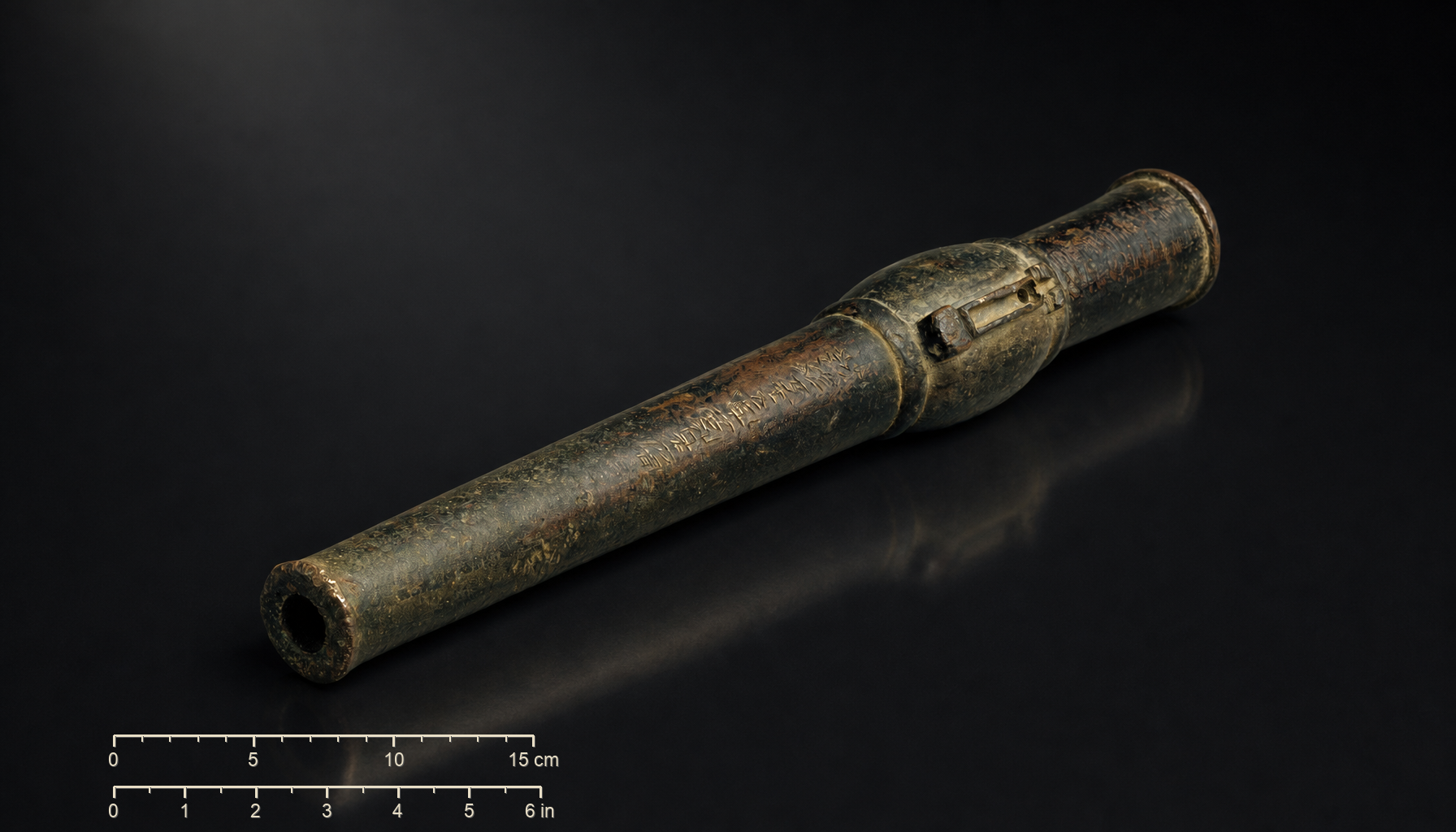
Around the ninth century, Chinese alchemists chasing an elixir of life combined saltpeter, sulfur, and charcoal and produced its opposite. By 1044 the recipe was in a military manual; within two centuries it was propelling projectiles down the first metal tubes, the hand cannons, the oldest datable example being Chinese from about 1288. Gunpowder was Chinese for roughly four hundred years before European firearms grew formidable.
A Chinese bronze hand cannon, dated 1424 — about 35.7 cm (14 in) long. The oldest firearms of this type are Chinese, from around 1288.
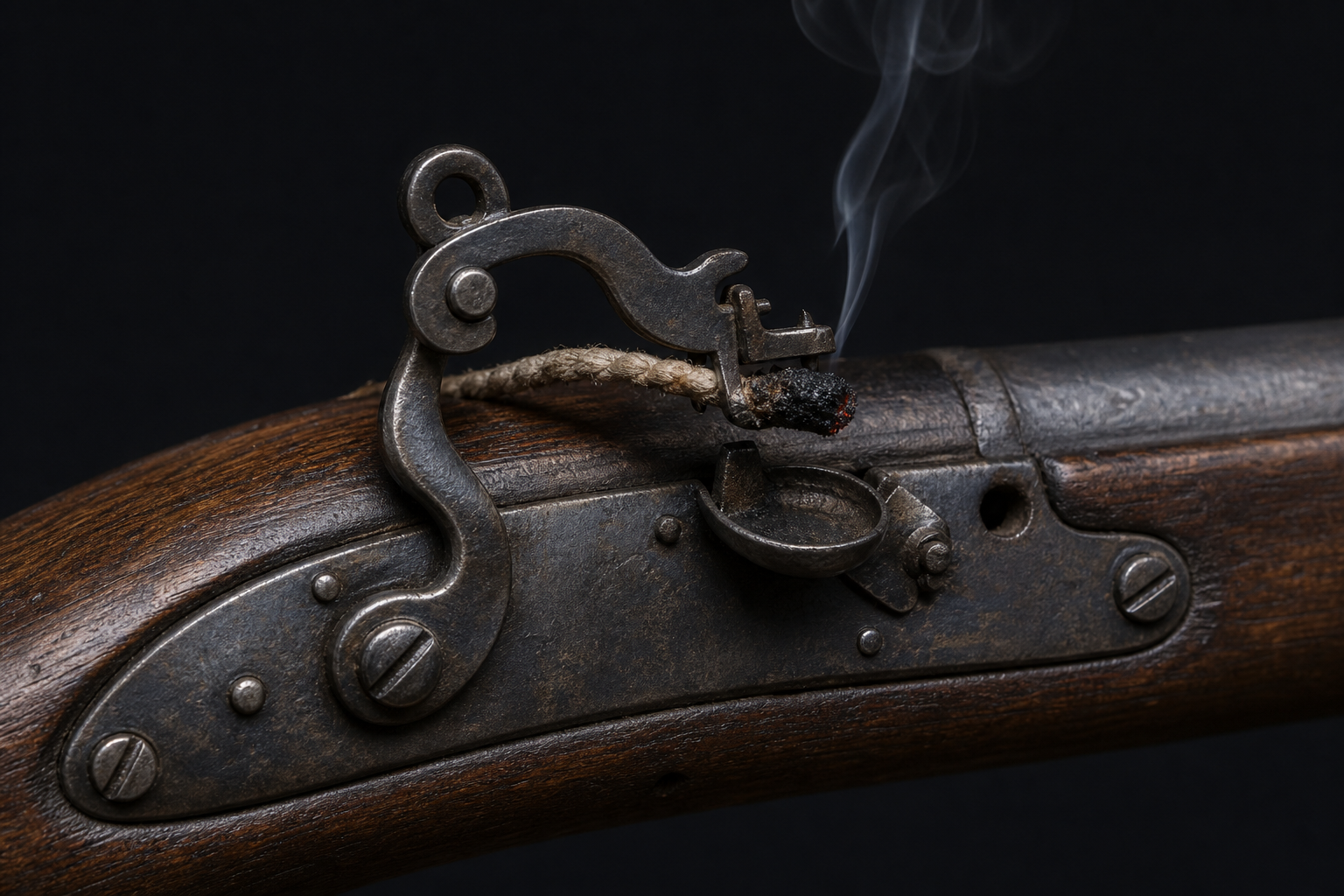
A hand cannon kicks and won't aim, so the first real guns were long, braced against the shoulder: the matchlock arquebus of the early 1400s, whose trigger-dropped smoldering cord let a shooter keep both hands and both eyes on the target.
The matchlock, early 1400s: a smoldering cord dropped into the pan by the first true trigger.
Lock, stock, and barrel: the entirety of a thing. the firing lock, the wooden stock, and the barrel — the three parts that make up the whole gun.
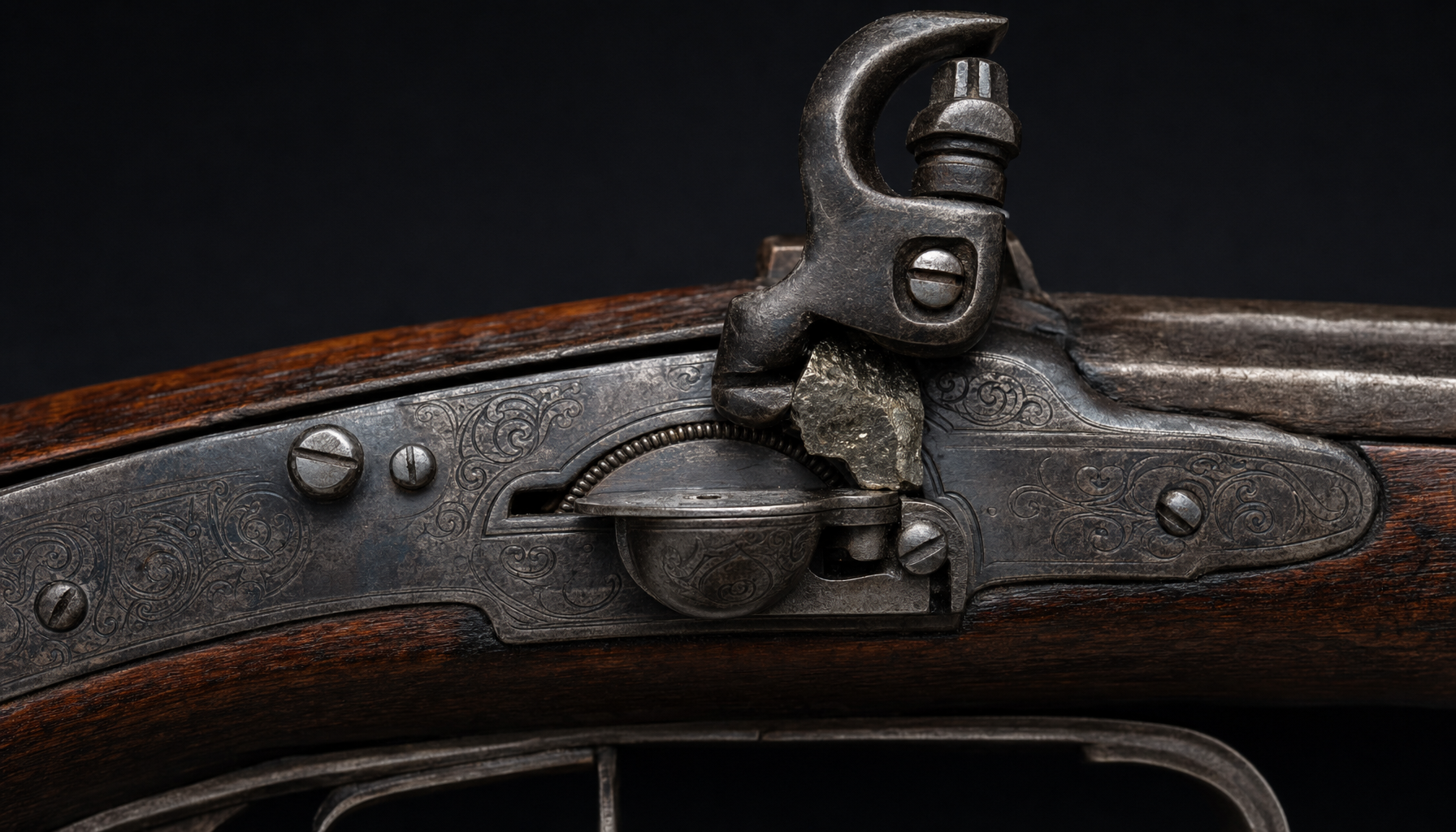
The pistol had to wait for an ignition that needed no babysitting. The wheellock of the early 1500s, a spring-wound wheel throwing sparks off iron pyrite, could be carried loaded and fired instantly with one hand, and that is the exact capability a pistol requires. So the long gun leads the practical pistol by roughly a century.
The wheellock, early 1500s: a spring-driven wheel throwing sparks off pyrite, the first self-igniting lock.
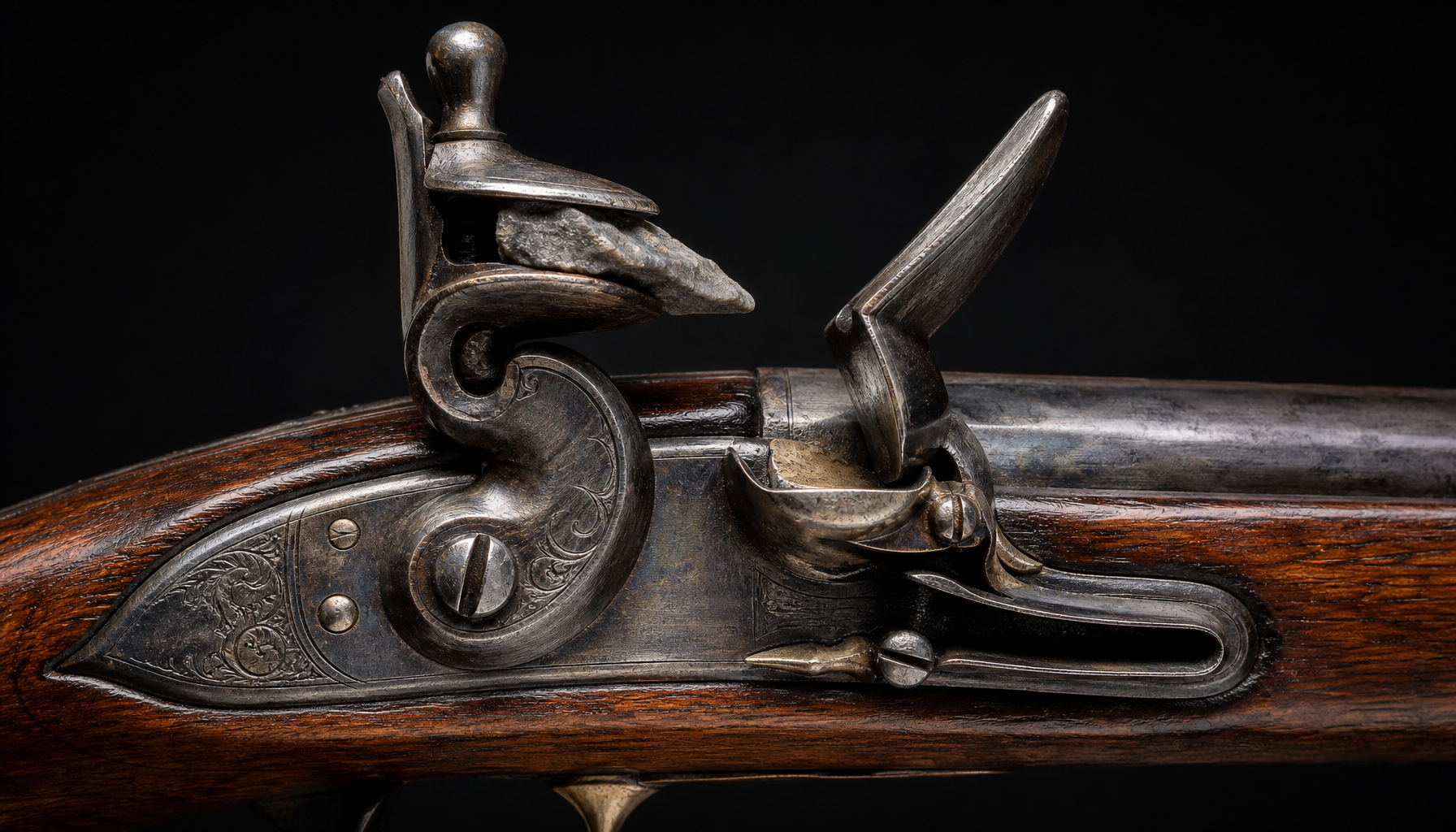
Then came the simpler flintlock of the 1600s, flint striking steel — the standard for the next two centuries.
The flintlock, 1600s: flint striking steel, the standard for two centuries.
A flash in the pan: a bright start that fizzles to nothing. the priming powder flares in the pan but fails to set off the main charge.
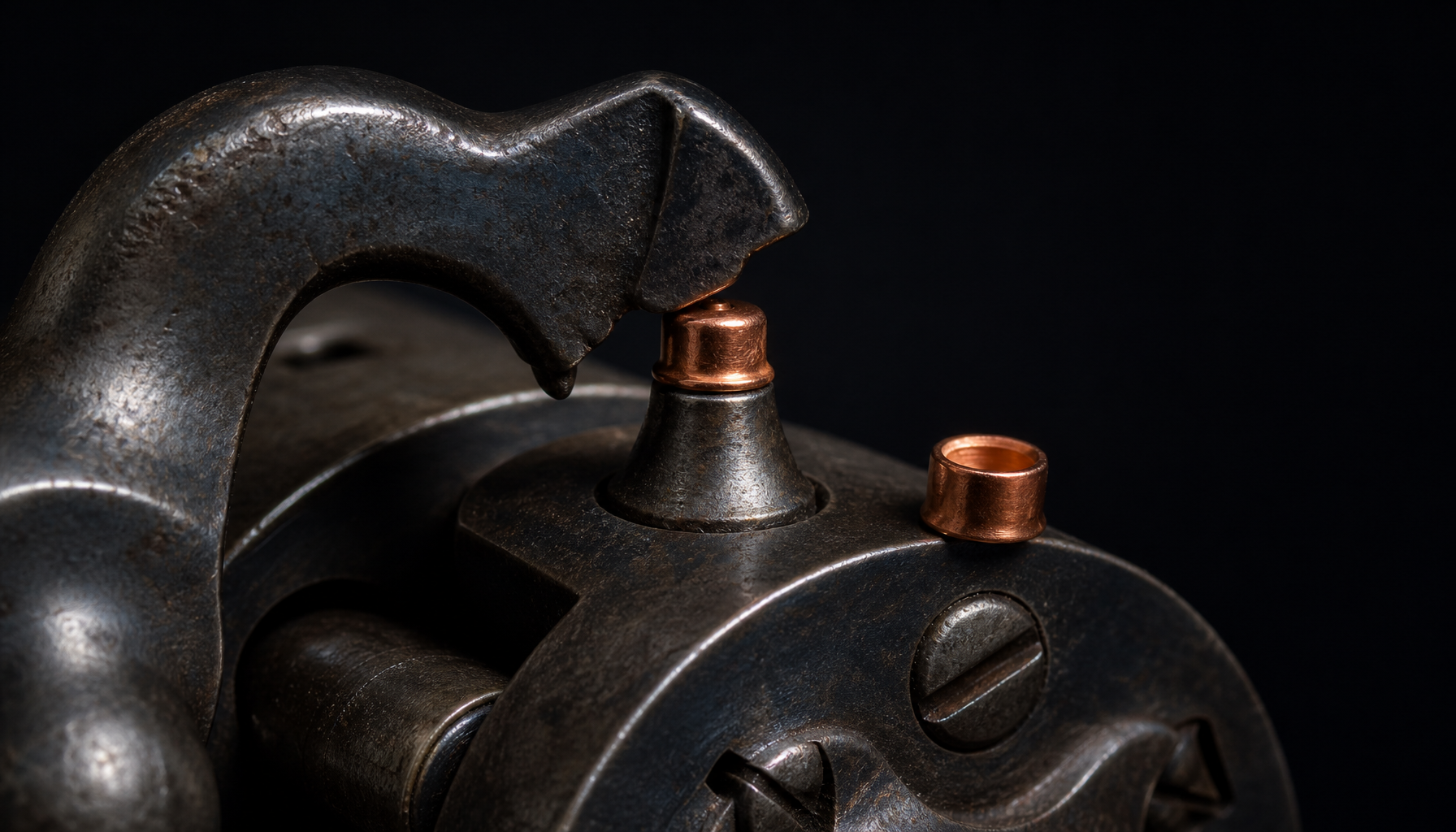
Finally, around the 1820s, the percussion cap, a tiny copper cap of shock-sensitive compound, made compact handguns reliable in weather at last. With dependable ignition solved, one question remained: how to fire more than once?
The percussion cap, c. 1820s: a copper cap on the nipple, crushed by the falling hammer to ignite the charge.
Hang fire: to stall or hesitate. a dangerous pause between the trigger and the discharge.
Part I · the revolver, 1836–1900
Colt didn't invent the revolver. He made it inevitable.
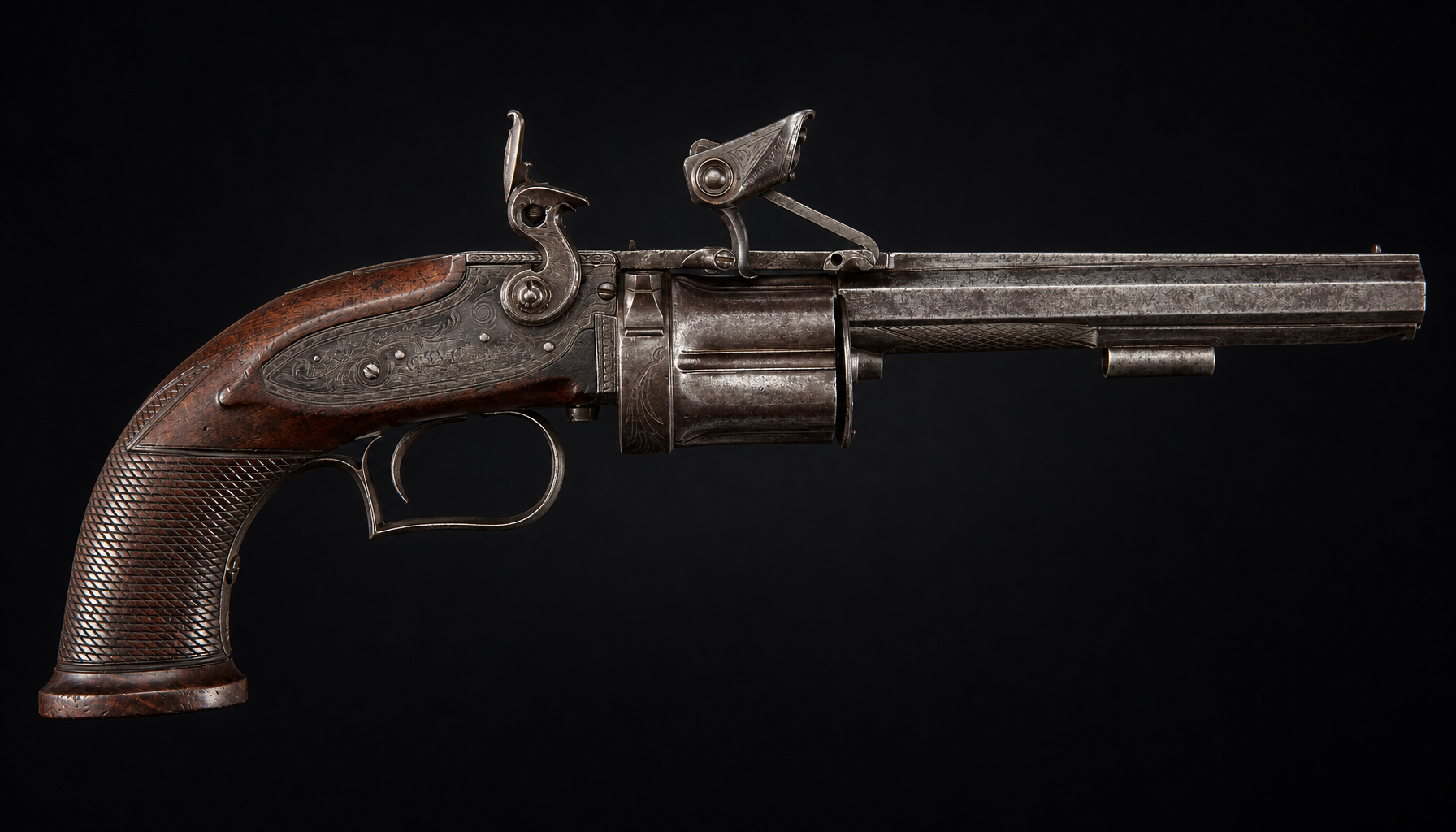
The idea of a rotating cylinder of chambers, each stepping behind a single barrel, was old. Elisha Collier patented a flintlock revolver in 1818, and crude revolving matchlocks date to the 1500s. What nobody had done was make the thing cheap, reliable, and identical a thousand times over. That was the work of a Connecticut showman-inventor who, as legend has it, whittled the concept from a wooden model while working a ship's wheel at sea.
Elisha Collier's 1818 flintlock revolver, an ancestor of Colt's.
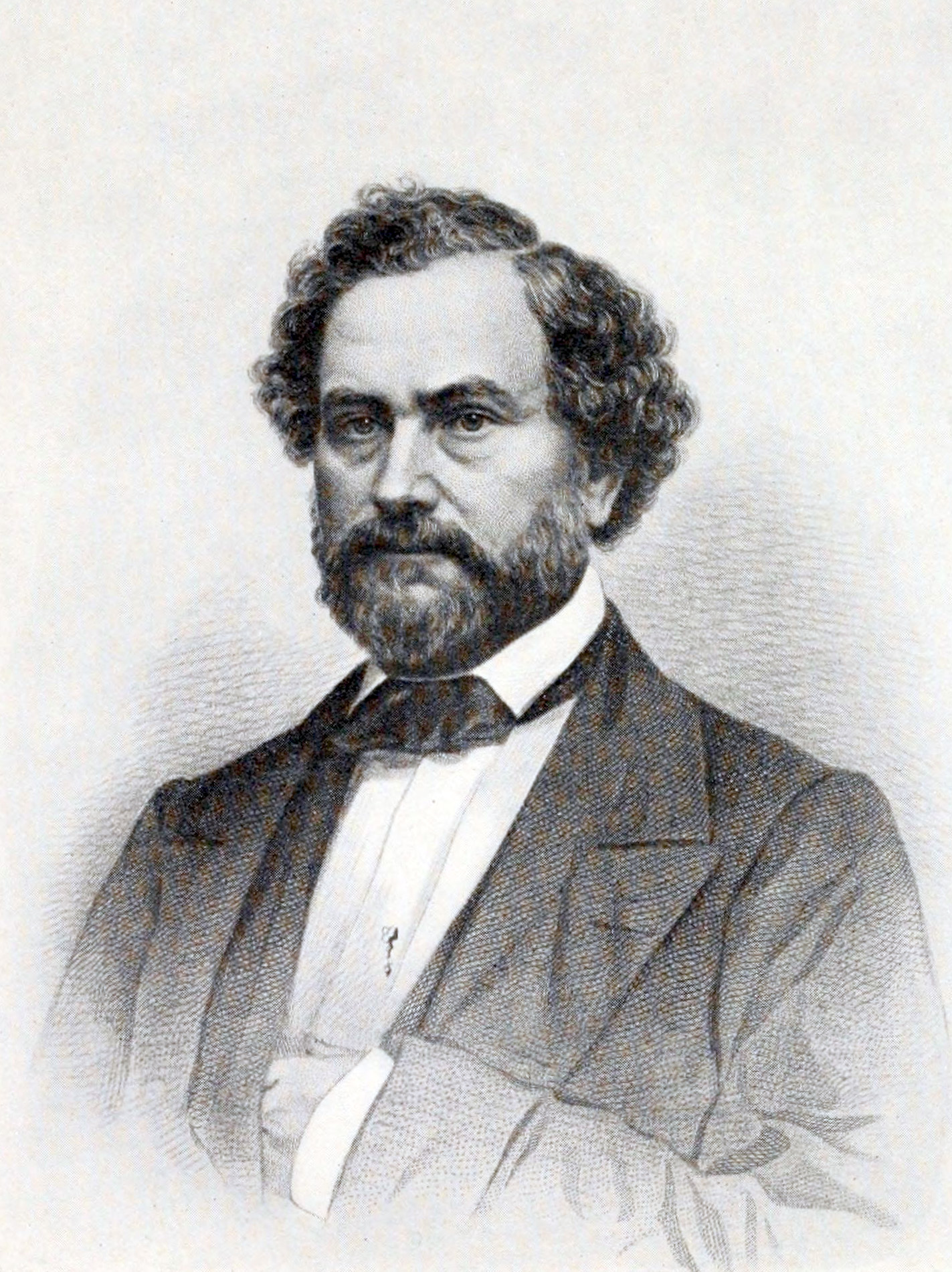
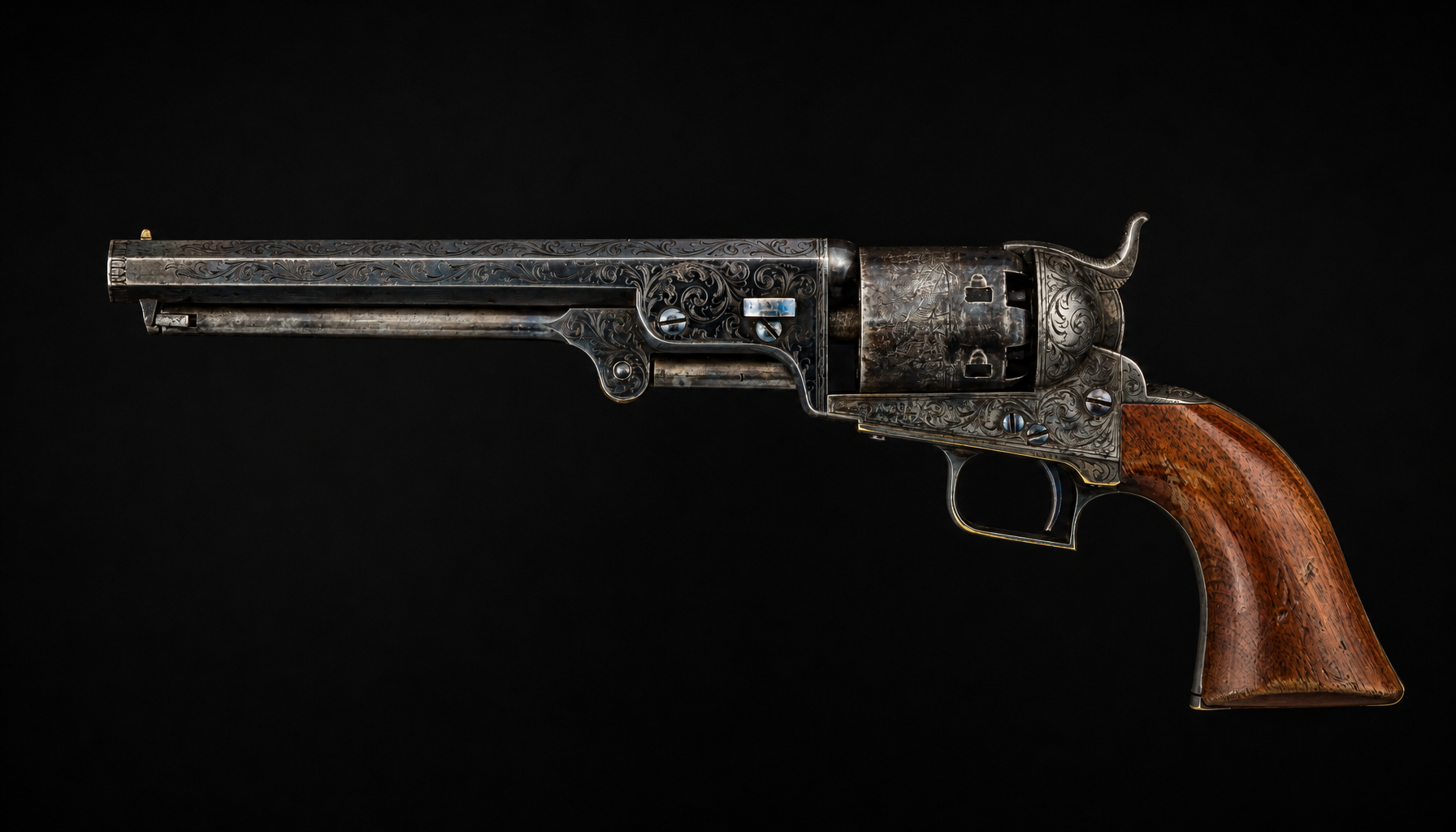
Samuel Colt's U.S. patent of February 25, 1836 produced the Colt Paterson, the first practical revolver: five shots, a folding trigger, a percussion cap on each chamber. Colt's genius was less the gun than the factory. He built it from interchangeable parts on machines, the emerging “American System” of manufacture, so that any part fit any gun and any worker could be trained to a station. It was arms-making as mass production, decades before Ford.
Samuel Colt (1814–1862), who industrialized the revolver.The 1836 Colt Paterson: the first practical revolver, five shots.
On the frontier the Paterson was a revelation. Its trigger folded up into the frame until the hammer was thumbed back, when it dropped down ready to fire; the earliest models wore no trigger guard at all. What mattered was the arithmetic of a fight: a soldier with a single-shot horse pistol had one shot before the gun became a club, while a rider carrying a pair of five-shot Patersons had ten. Against mounted Comanche bowmen, who could loose arrows faster than a man could reload a musket, that was the difference between prey and predator.
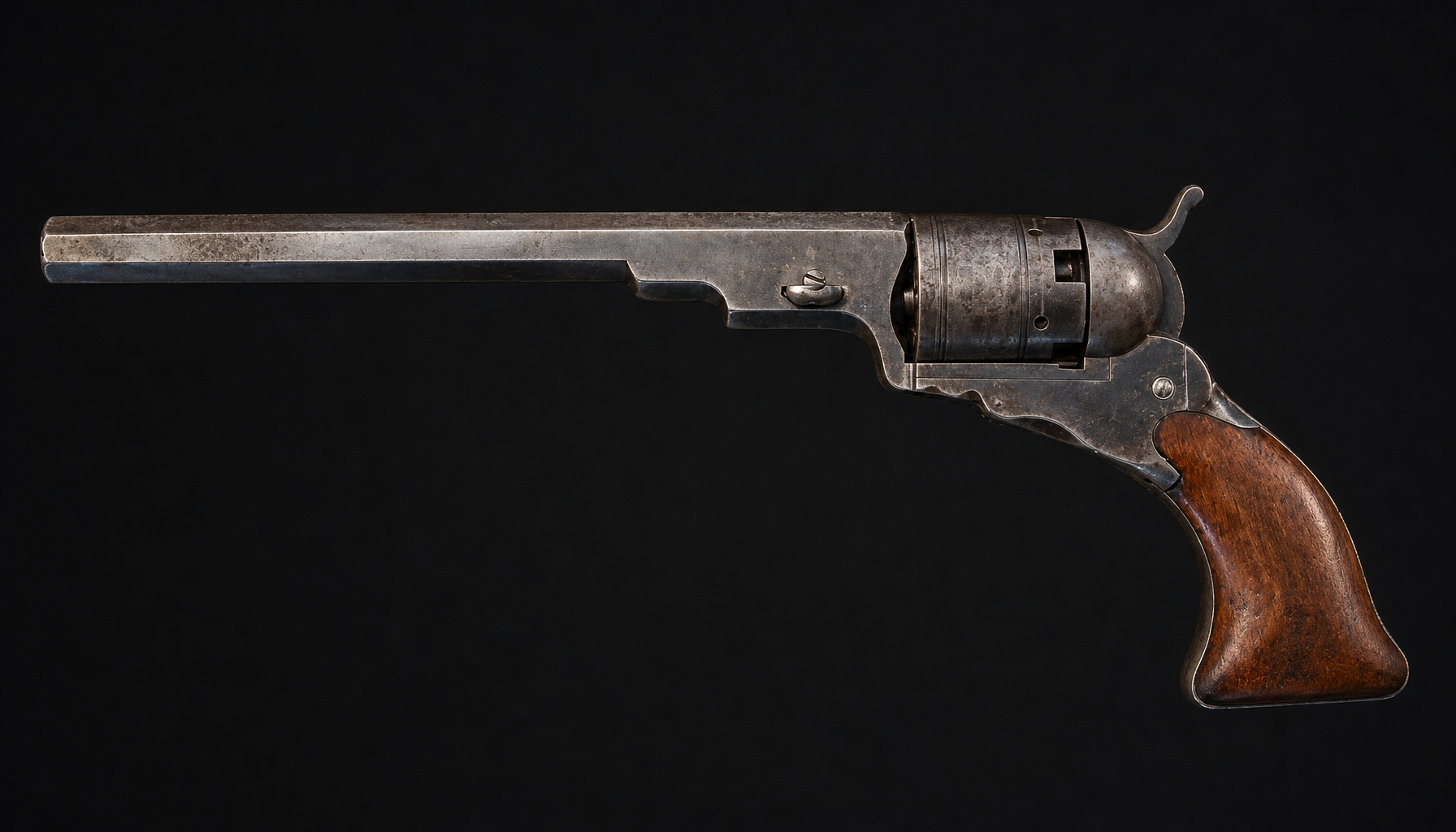
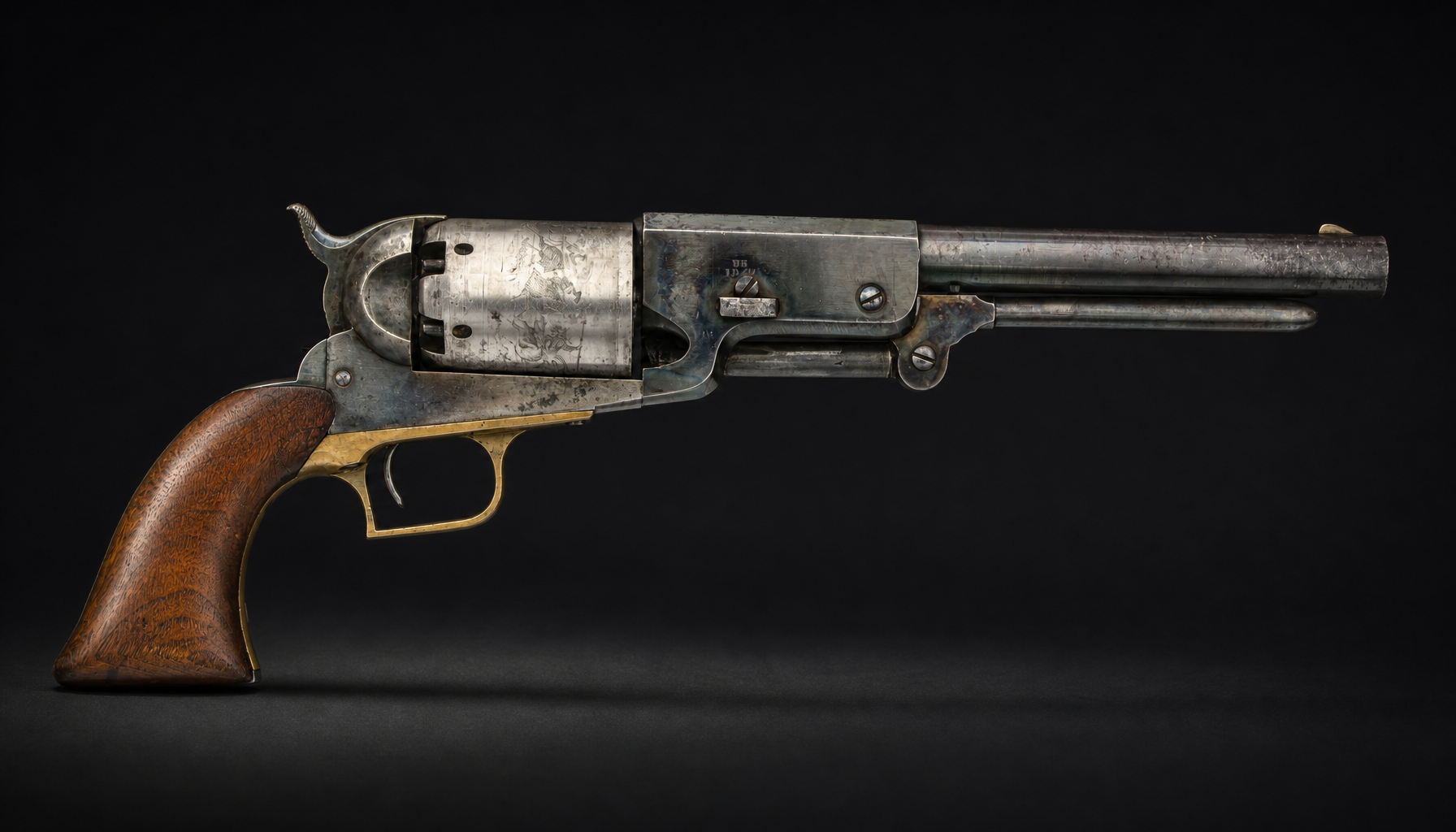
It also went broke. The Paterson was fragile and expensive, the Army wasn't buying, and Colt's company failed in 1842. What saved him was a war and a Texas Ranger. In 1846, Captain Samuel Walker, who had used Patersons fighting Comanches and knew what a repeater was worth against mounted attackers, sought Colt out and helped him design a monster: the Colt Walker of 1847, a nine-inch, four-and-a-half-pound, six-shot .44 so powerful it remained the hardest-hitting handgun made until the .357 Magnum arrived eighty-eight years later. A U.S. government order for a thousand of them resurrected Colt, and this time he stayed rescued.
The 1847 Colt Walker: a 4.5-pound .44 that revived Colt's fortunes.
Caliber.44Shots6Weight4.5 lbBarrel9 inMade1847
The Ranger who saved Colt
The Texas Ranger of the story was Samuel H. Walker. In June 1844, at Walker's Creek, he had been one of about fifteen Rangers under Captain Jack Hays who used five-shot Paterson revolvers to break a Comanche war party several times their number — the first fight ever decided by repeating handguns from the saddle. Walker never forgot what those guns were worth.
When he and Colt designed the big .44 two years later, Colt no longer owned a factory, so the first thousand “Walkers” were built in Eli Whitney Jr.'s armory at Whitneyville, Connecticut. The powder charge was so heavy that some early cylinders burst.
Walker carried a pair into the Mexican–American War and was killed leading a charge at Huamantla in October 1847, only months after the gun bearing his name appeared — but the government's thousand-gun order had already brought Colt back from ruin for good.
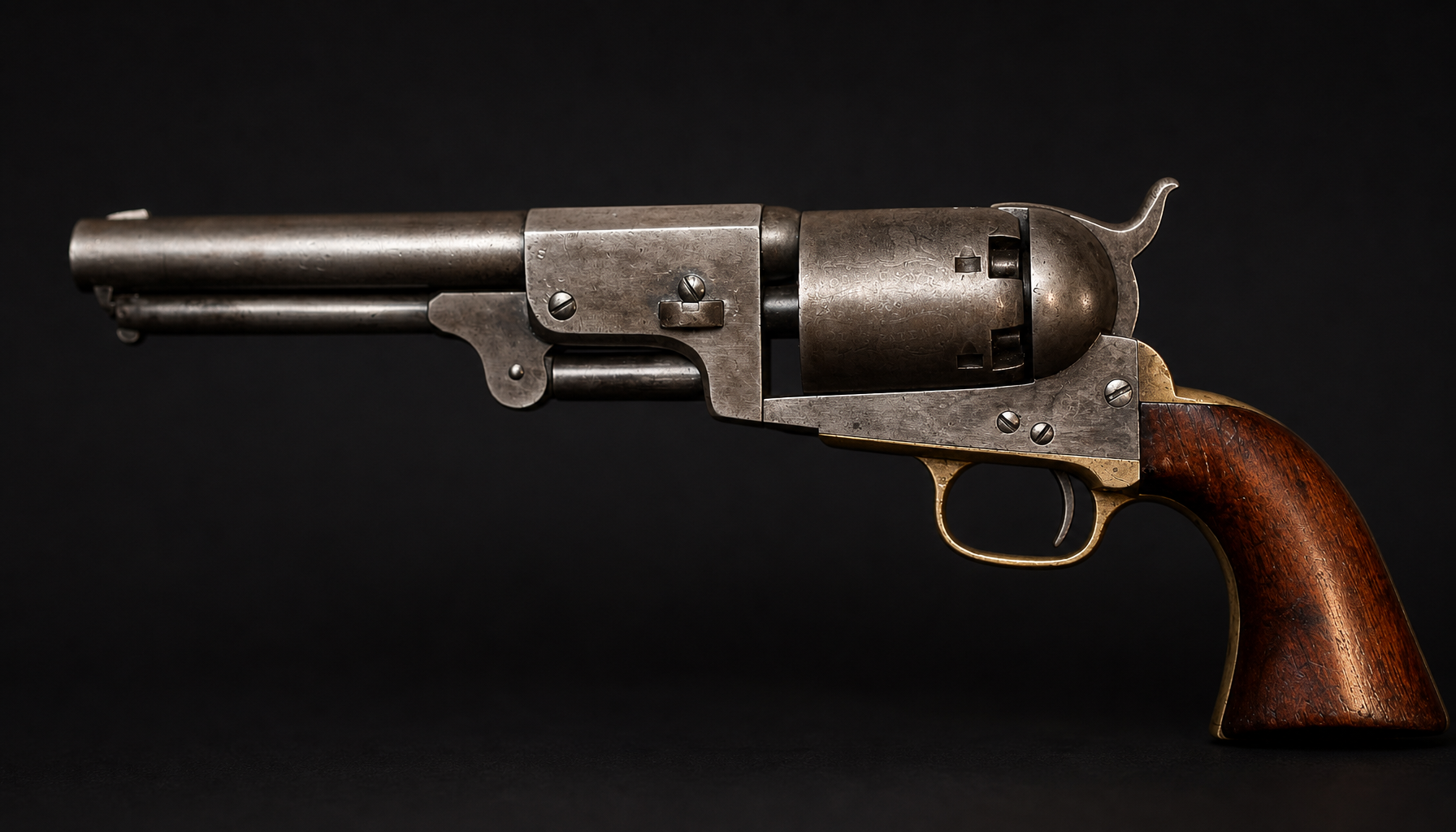
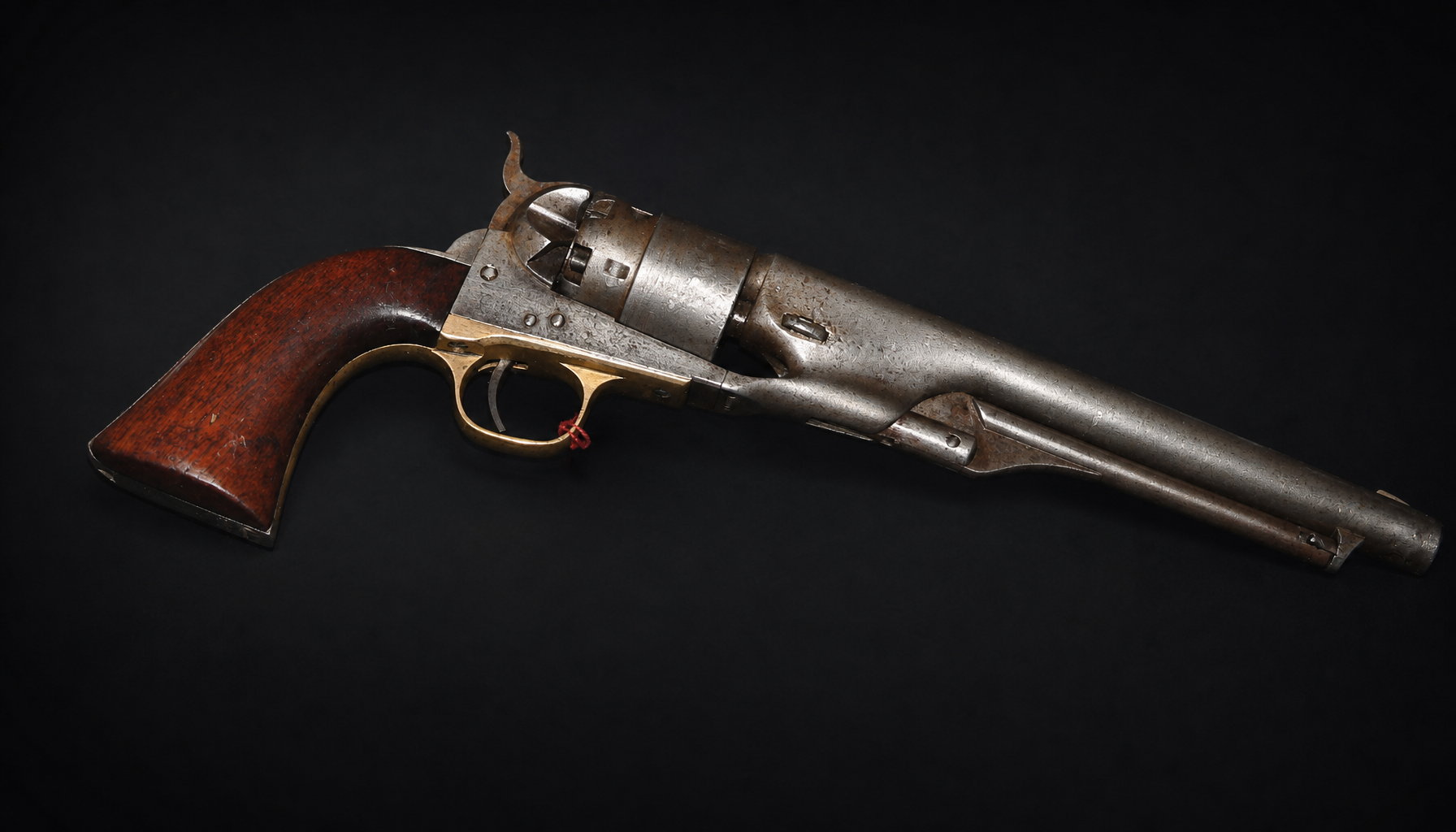
The revolvers that followed armed the frontier and the Civil War: the lighter Dragoons, the elegant 1851 Navy in .36, the 1860 Army in .44 that was the Union's iconic sidearm.
The Colt Dragoon (1848), a refined successor to the Walker.
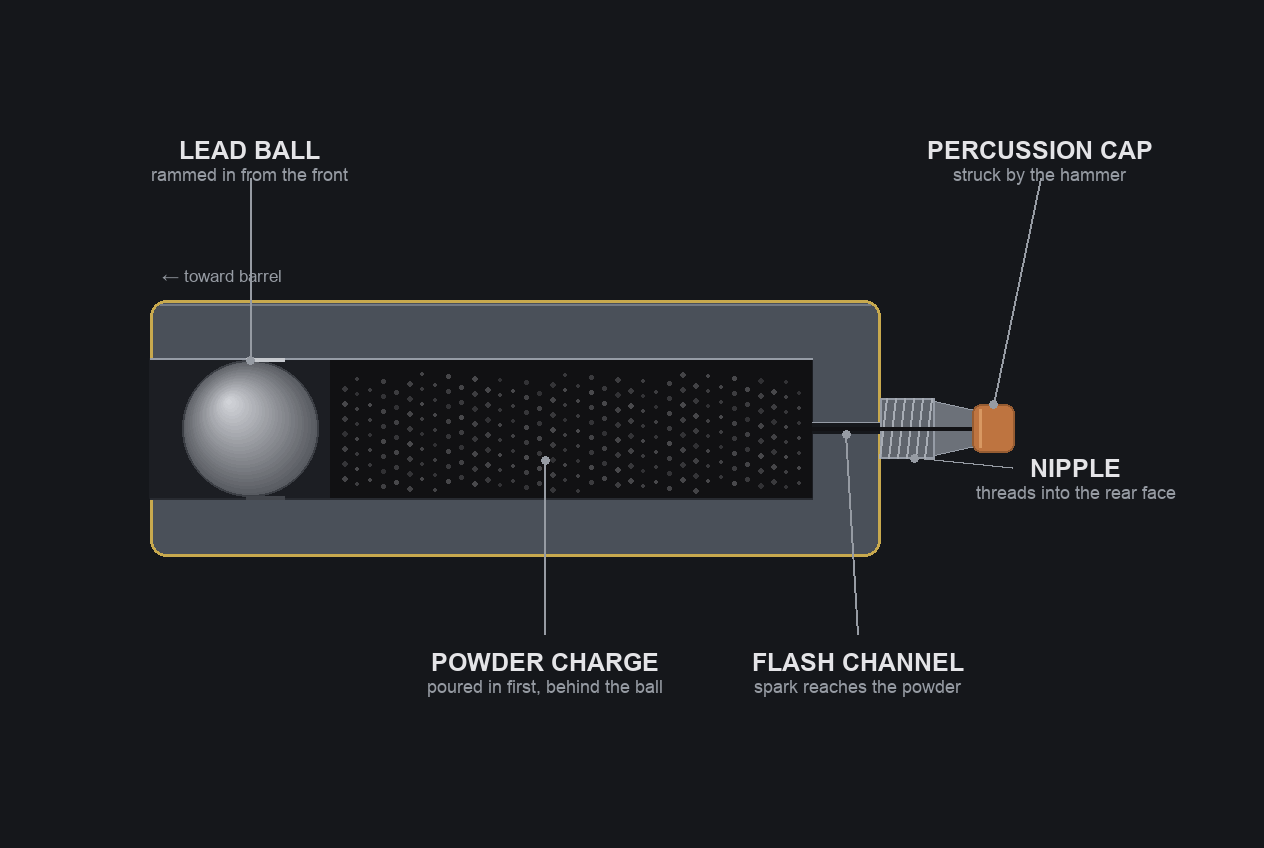
All of them shared one tedious flaw. They were cap-and-ball: to reload, a shooter poured loose powder into each chamber, rammed a lead ball on top, and pressed a percussion cap onto each nipple, six times over. A revolver gave you six fast shots and then a slow, fiddly, weather-sensitive minute of reloading. The next revolution was not about firing. It was about loading.
Loading a cap-and-ball revolver (the percussion era, 1830s–1870s): powder poured into each chamber, a lead ball rammed on top, and a percussion cap pressed onto the nipple at the rear.
Collector's note · loading a percussion revolver, and the dreaded chain-fire
The drill rewarded care. Trickle a measured charge of black powder into each chamber, set a slightly oversized lead ball at the mouth, and swing the loading lever under the barrel down to ram it home — the ball shaves off a thin ring of lead as it seats, sealing the chamber airtight. Then cap the six nipples at the rear, and only then.
The nightmare was a “chain-fire”: the flash of one shot leaking into the neighboring chambers and touching them all off at once, sometimes wrecking the gun and the hand around it. The guard against it was to smear grease over each seated ball and fit the caps snugly — front and back both sealed. And since reloading took a slow minute, the real “fast reload” of the era was to carry a second loaded cylinder, or simply a second gun.
Keep your powder dry: stay ready. damp black powder will not fire.
The metallic cartridge: the real revolution
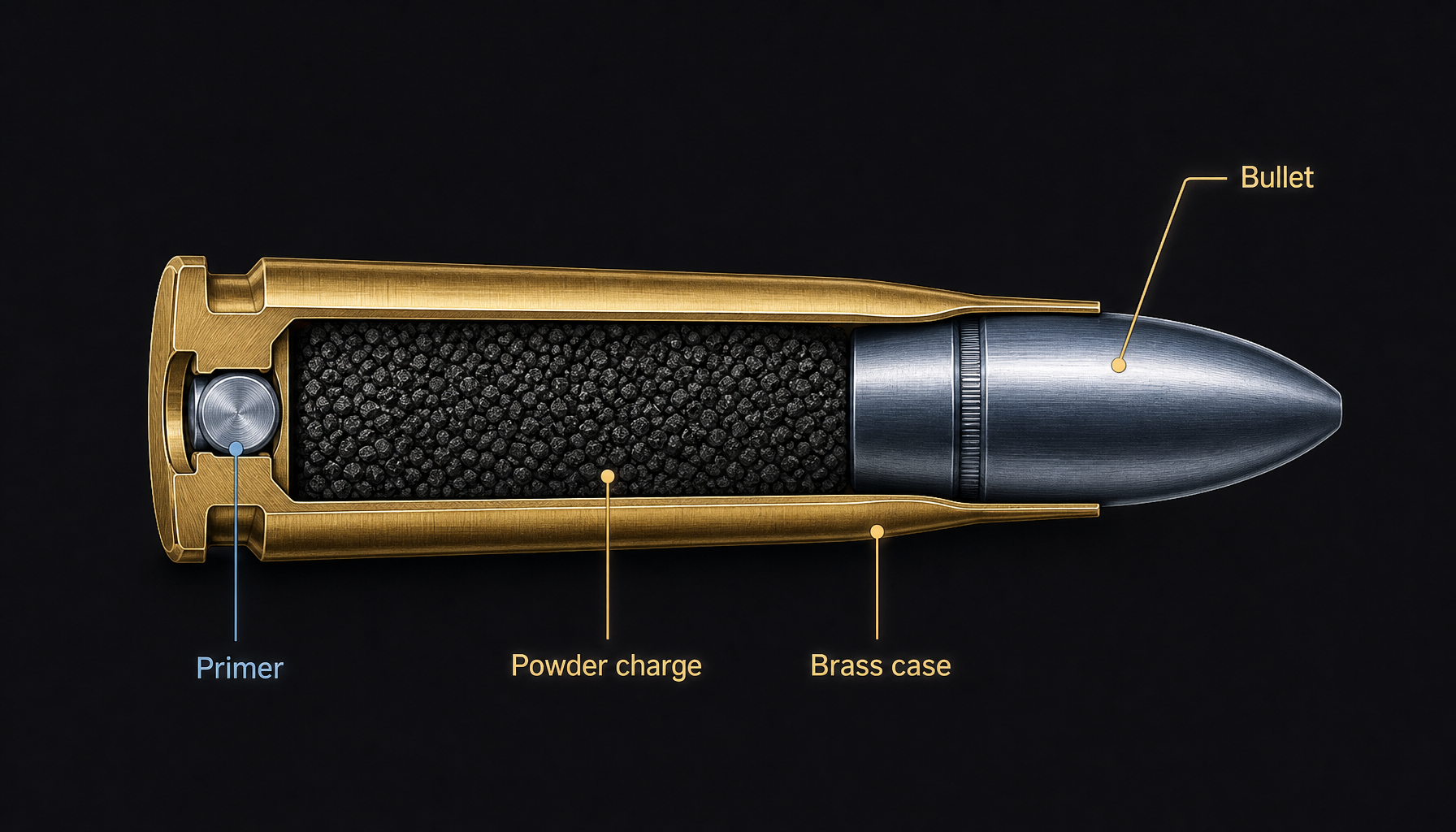
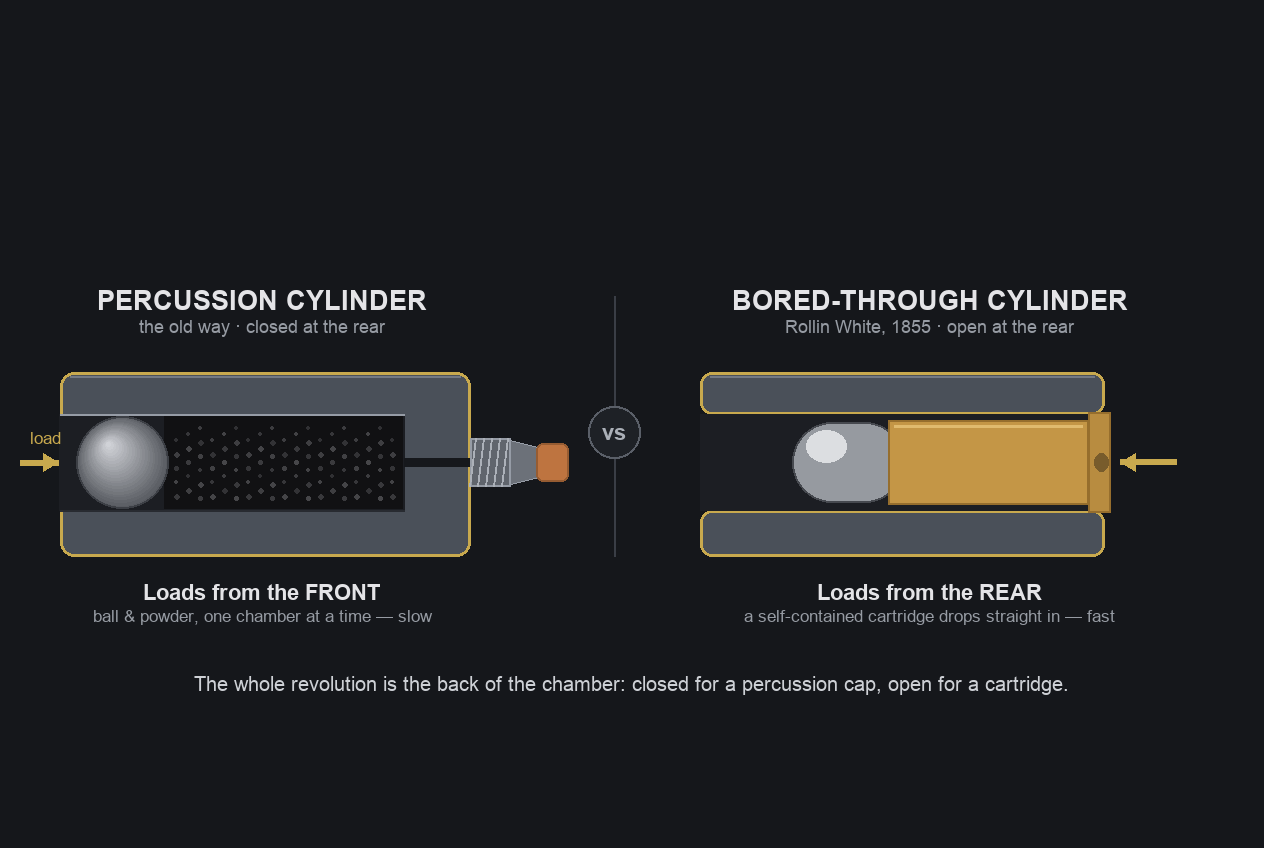
The fix was to package primer, powder, and bullet inside a single brass case: the self-contained metallic cartridge. Drop it into the back of a chamber, fire, extract the empty, repeat. It made loading fast, clean, and reliable in the rain, and it is essentially the ammunition we still use today. But putting cartridges into a revolver required a cylinder bored all the way through so rounds could load from the rear, and one man owned that idea.
The self-contained metallic cartridge (from the 1850s–60s): primer, powder charge, brass case, and seated bullet in a single unit.
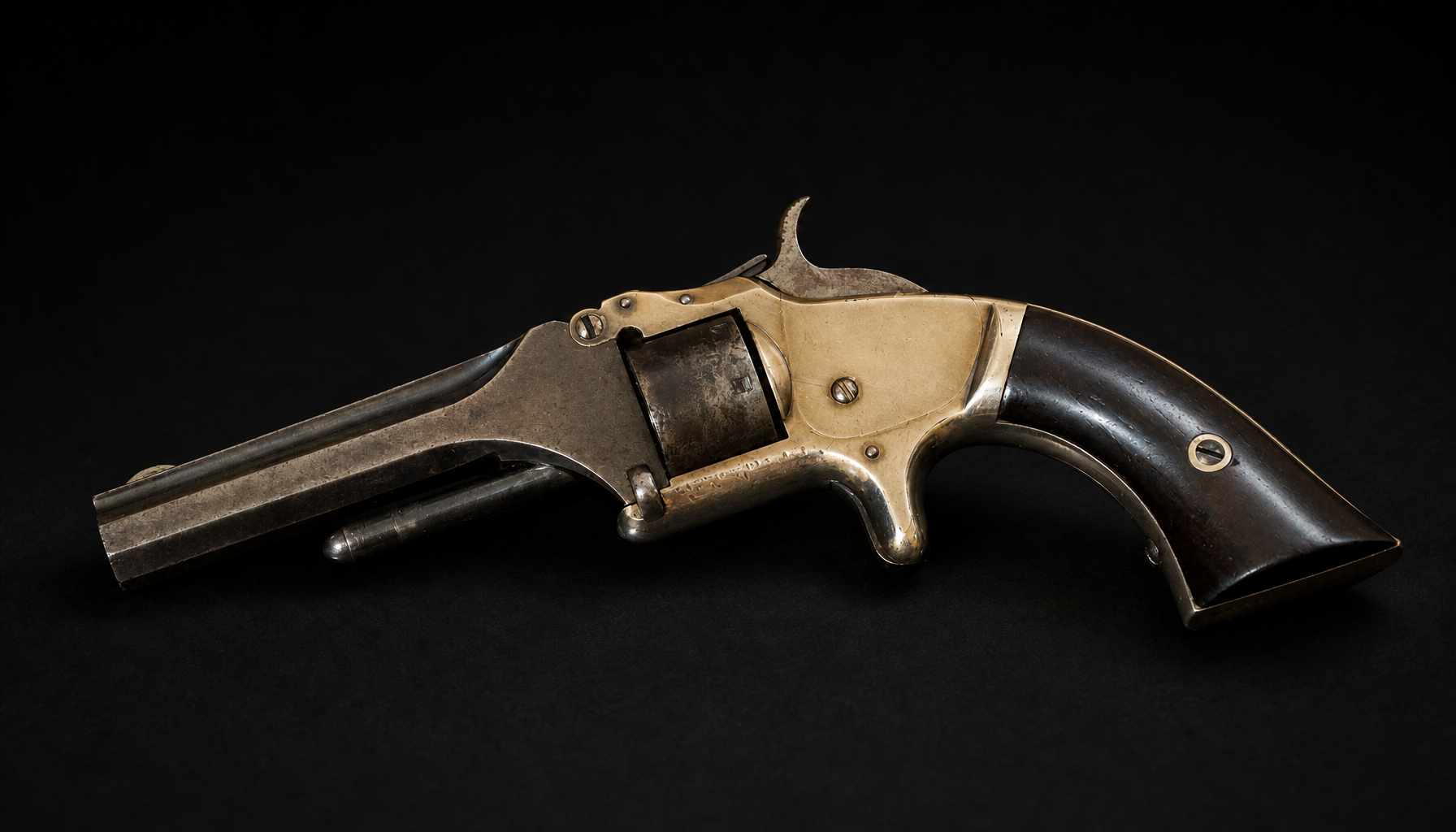
Rollin White patented the bored-through cylinder in 1855. He had worked for Colt and offered it to the boss first; Sam Colt waved it off as a novelty. Smith & Wesson did not. They licensed White's patent exclusively, paid him a royalty of twenty-five cents a gun, and in 1857 released the S&W Model 1, the first commercially successful cartridge revolver. For more than a decade that patent was a wall: it locked Colt and everyone else out of the cartridge-revolver business in America. Only when White's patent lapsed, around 1869–1870, could Colt answer.
Rollin White's bored-through cylinder (patented 1855), which let cartridges load from the rear.The 1857 S&W Model 1, the first commercially successful cartridge revolver.
Caliber.22 ShortShots7Weight~11 ozBarrel3.2 inTriggerspur, no guardMade1857–82
Collector's note · the spur trigger
Look under the frame: there is no trigger guard, only a bare spur trigger the finger finds by feel. On a revolver built to ride in a coat or vest pocket, a guard was needless bulk and a snag hazard, so the trigger was left naked and the gun made single-action — cocked deliberately for each shot. (Colt's Paterson solved the same problem the opposite way, with a trigger that folded up into the frame until the hammer was thumbed back.)
The Model 1 loads by a tip-up barrel: release the catch, the barrel pivots up, the cylinder lifts off its pin, and seven .22 rimfire rounds drop into the rear of the chambers — Rollin White's bored-through cylinder doing its work.
Spur-trigger pocket revolvers became their own collecting world. The cheap knockoffs that flooded the 1870s–90s earned the grim nickname “Suicide Specials,” but a genuine early Smith & Wesson tip-up like this one is a different animal — prized as America's first cartridge revolver and graded by collectors into First, Second, and Third Issues.
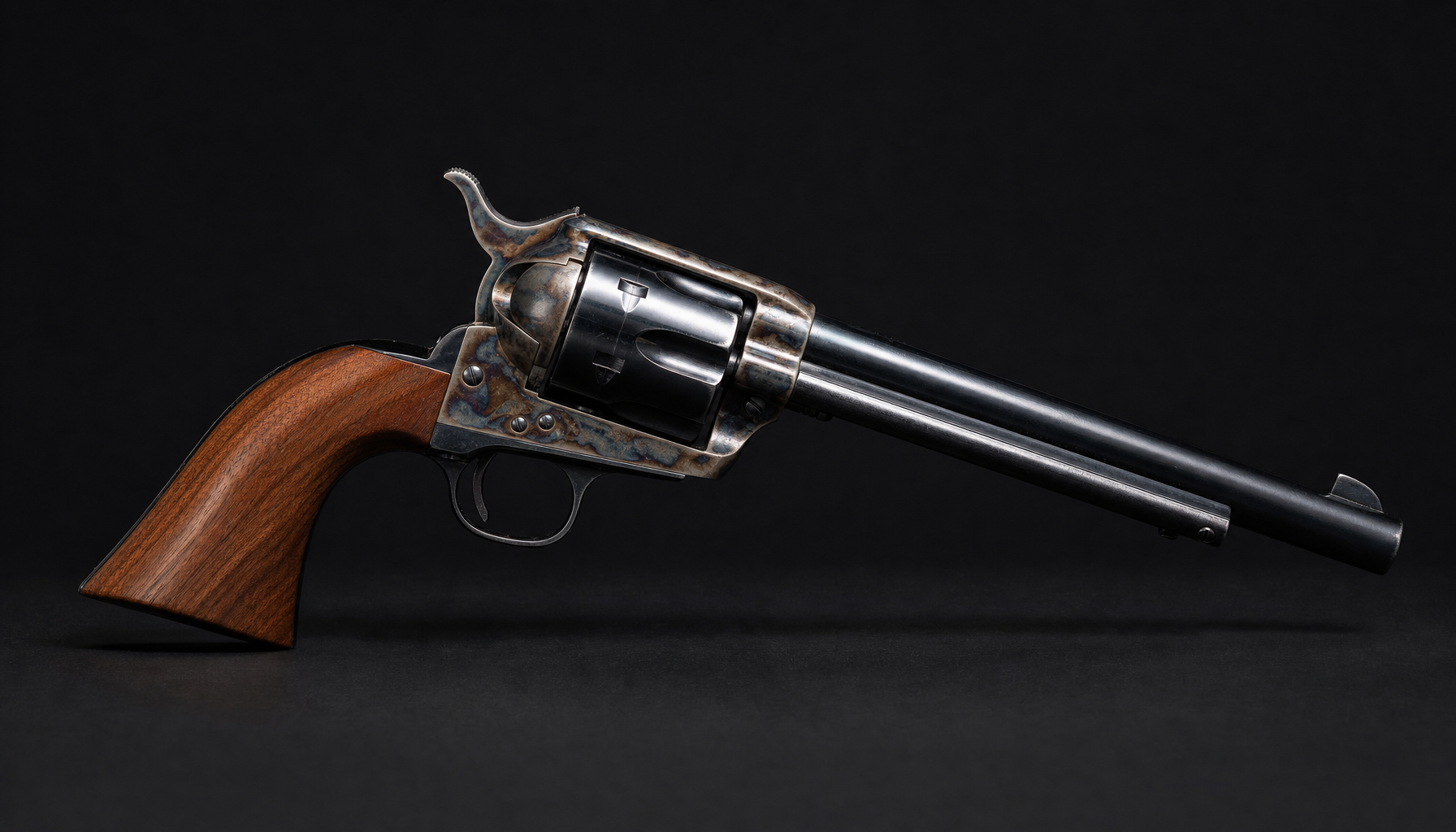
Answer it did, with the most famous handgun ever made. The Colt Single Action Army of 1873, the “Peacemaker,” chambered in the potent .45 Colt, became the U.S. cavalry sidearm and the revolver of a thousand Westerns. It is a single-action: the shooter thumbs the hammer back for each shot. That is the gun the phrase “God made men, Colt made them equal” was minted for.
The 1873 Colt Single Action Army, the “Peacemaker.”
The single-action has a ritual. To load, thumb the hammer to half-cock so the cylinder spins freely, flip open the loading gate on the right side, and feed cartridges one at a time as you rotate the cylinder; spent cases are punched out the same gate with the ejector rod under the barrel.
Because the original design has no transfer bar, a knock on the hammer can fire the round beneath it — so the Peacemaker is safely carried with five rounds, not six, the hammer resting on an empty chamber. The old drill: “load one, skip one, load four, then cock and lower.”
Collectors read the SAA by barrel length: the 7½″ “Cavalry,” the 5½″ “Artillery,” and the 4¾″ “Gunfighter” (or Quickdraw). First-generation guns (1873–1941) command the highest prices, especially documented Cavalry issues.
Going off half-cocked: acting rashly, before you're ready. the hammer's half-cock notch was meant as a safety — let it slip and the gun fired too soon.
Toward the modern revolver: double-action and the swing-out cylinder
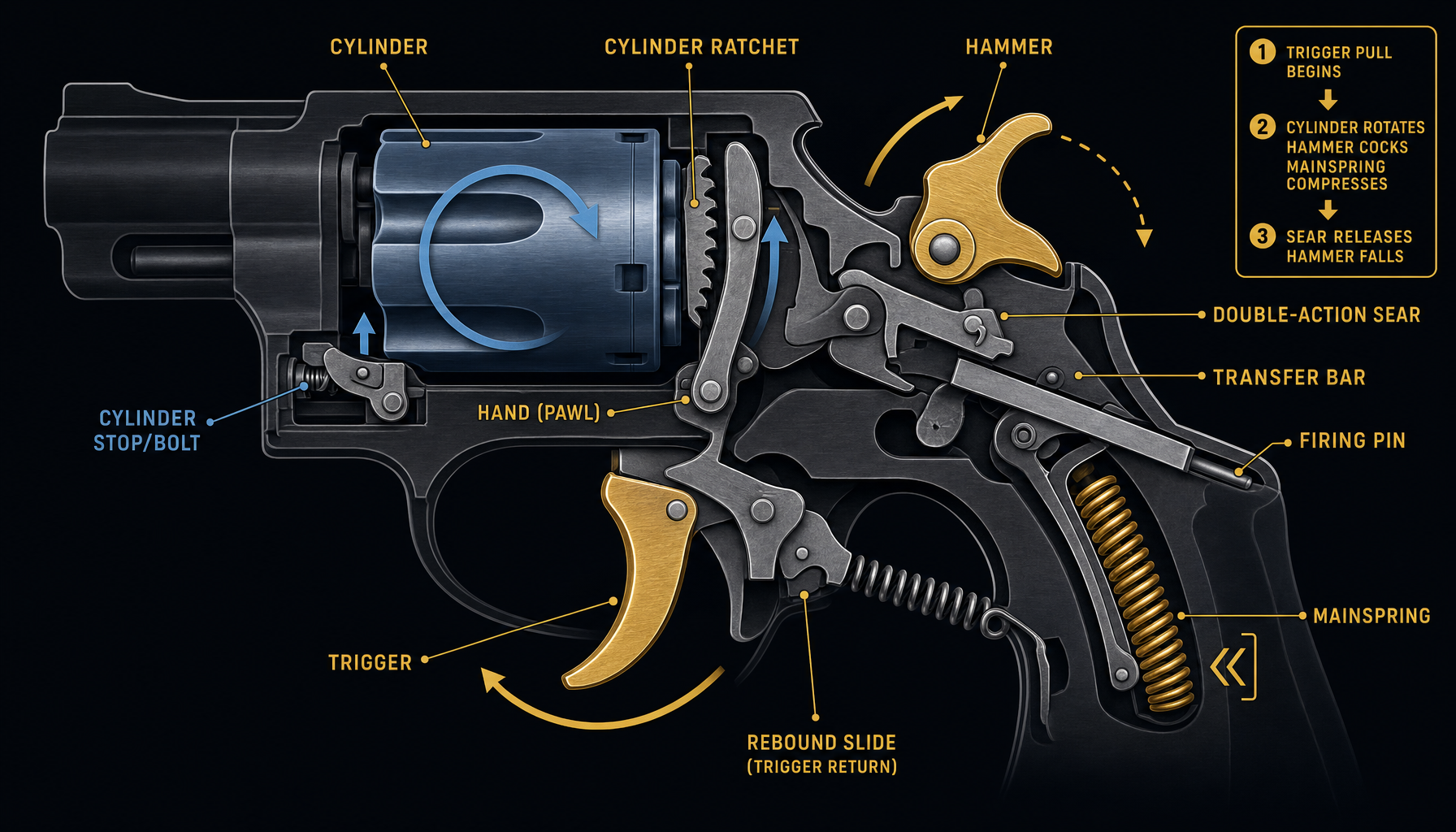
Two refinements produced the revolver a twentieth-century cop would recognize. The first was the double-action mechanism, where a single long trigger pull both rotates the cylinder and drops the hammer, so the gun can be fired as fast as the trigger can be pulled, without thumb-cocking. The second was the swing-out cylinder: Colt's Model 1889 and Smith & Wesson's “Hand Ejector” of the 1890s hinged the whole cylinder out to the side, so a single push of the ejector rod dumped all six empties at once and the gun could be reloaded in seconds.
Double-action lockwork (from the 1850s): one long trigger pull rotates the cylinder, cocks the hammer, and releases it.The swing-out cylinder (Colt 1889, S&W 1890s), hinged out on its crane: one push of the ejector rod clears every chamber at once.
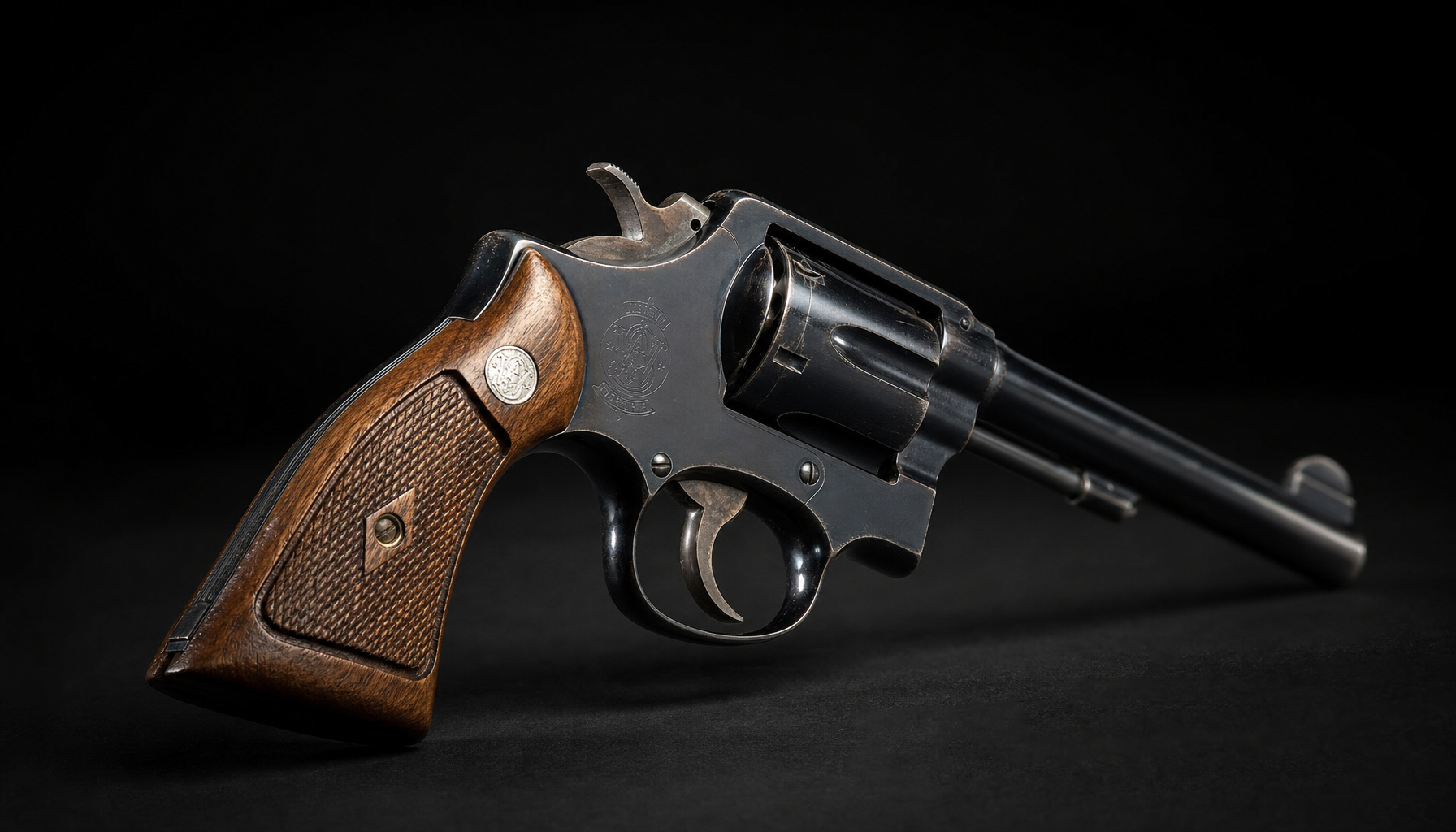
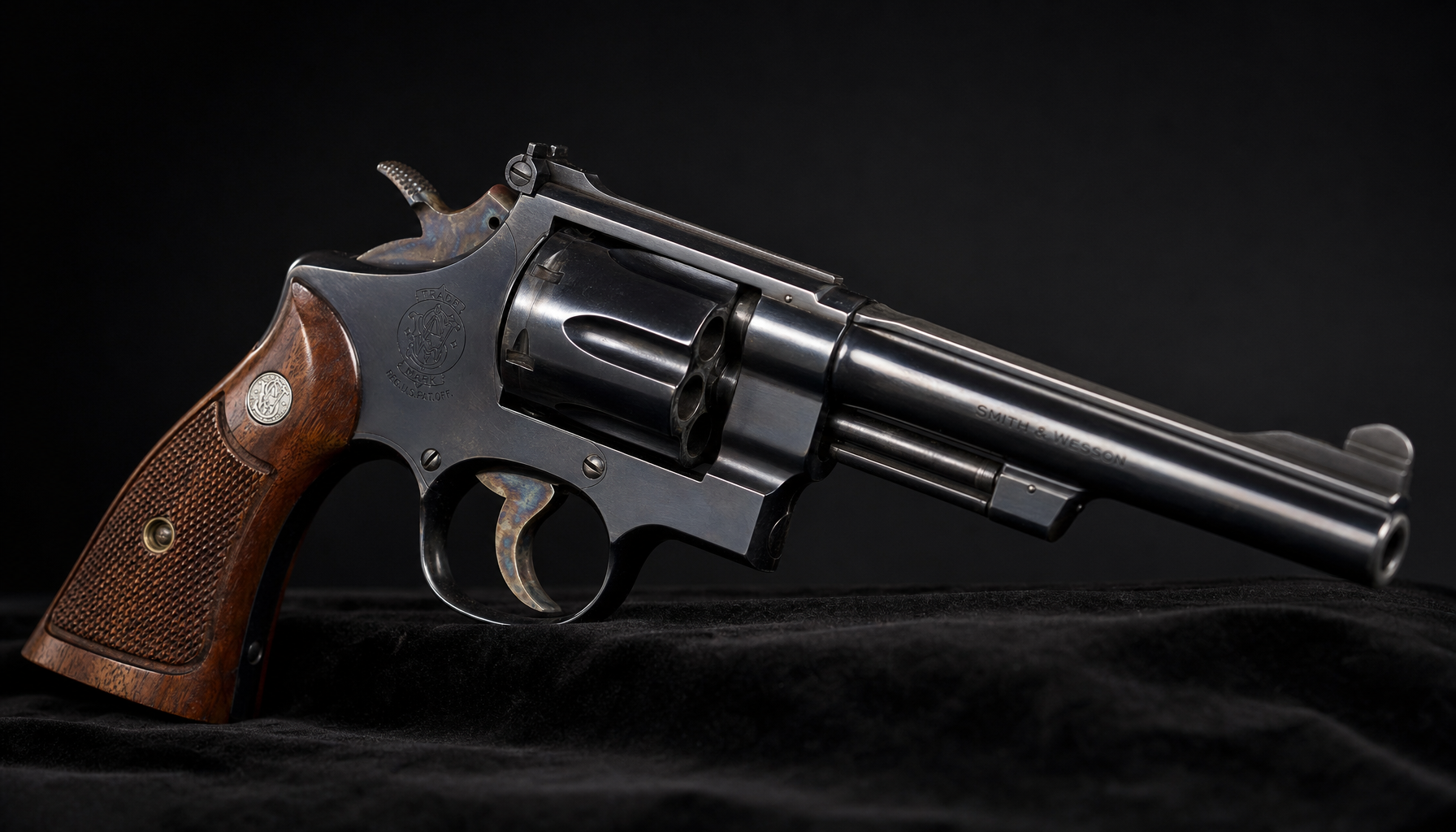
The cartridge that rode this design into history arrived in 1899: Smith & Wesson's .38 Military & Police revolver, soon chambered for the .38 Special. Six shots, utterly reliable, easy to train, mild to shoot. Under the later name Model 10 it would sit on American police hips for the better part of a century. In 1935 came its magnum sibling, the .357 Magnum, a lengthened, far more powerful .38 that was, briefly, the most powerful handgun cartridge in the world. Those two cartridges are what the FBI would carry onto a Miami street in 1986.
The S&W Model 10 (1899) .38 Special, the American police revolver for generations.
Look at the chip: the .38 Special's bullet is actually .357 inches across, not .38. The name is a holdover from the old heeled bullets and outside-lubricated cases of the black-powder era, where “.38” described the outside of the case, not the bore. That quirk is why the .38 Special and the .357 Magnum share a bore — and why a .357 revolver will happily also fire the milder .38 Special, a handy fact for practice.
There is a deeper irony here. This mild, beloved police .38 is the close cousin of the .38 Long Colt that failed so badly against the Moros a few pages on. Smith & Wesson's .38 Special was the lengthened, harder-hitting answer to exactly that anemia — yet the Army, burned once, concluded that no .38 was enough and demanded a .45. Two branches of the same little cartridge: one armed American police for eighty years, the other got a .45 adopted.
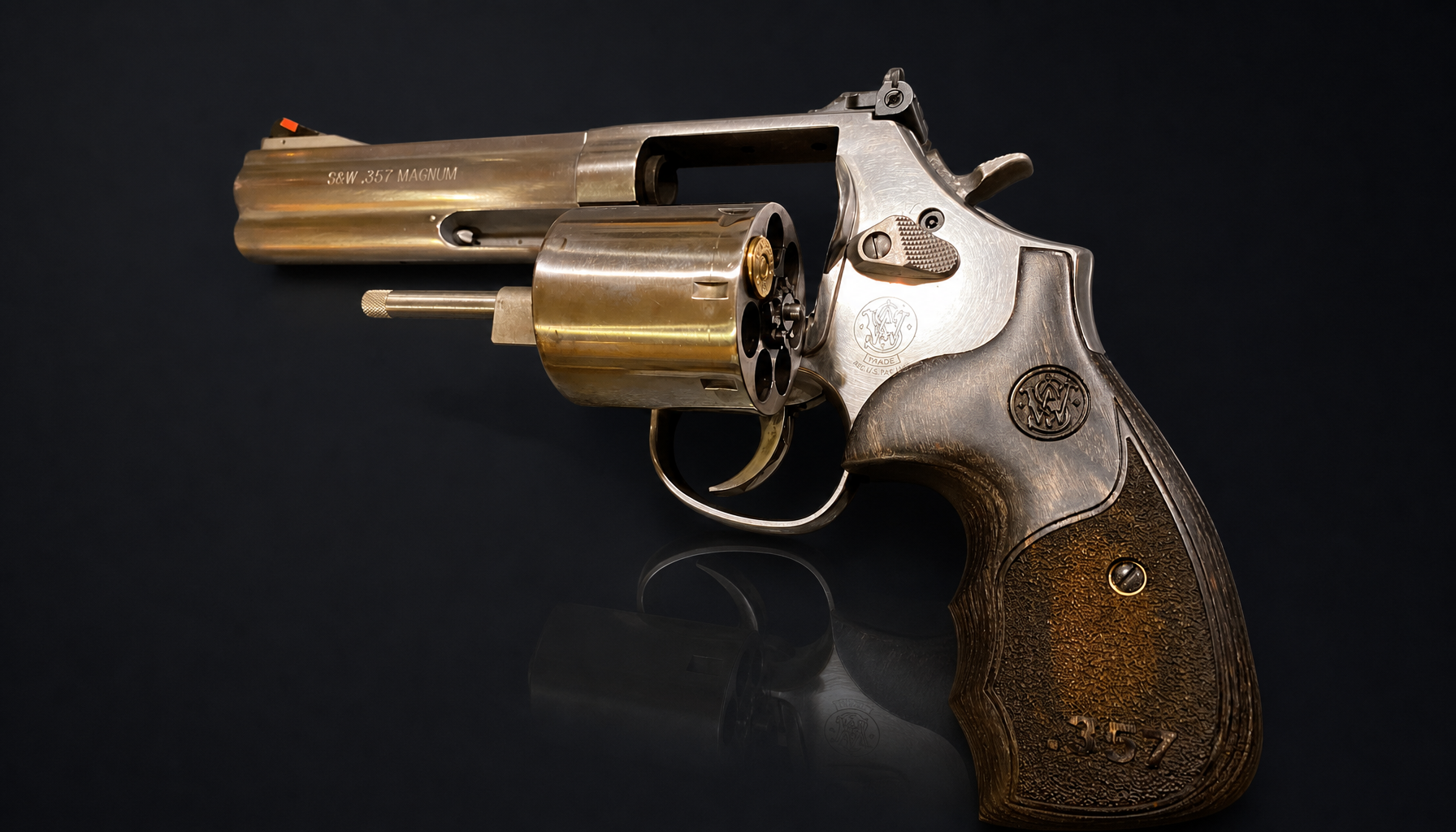
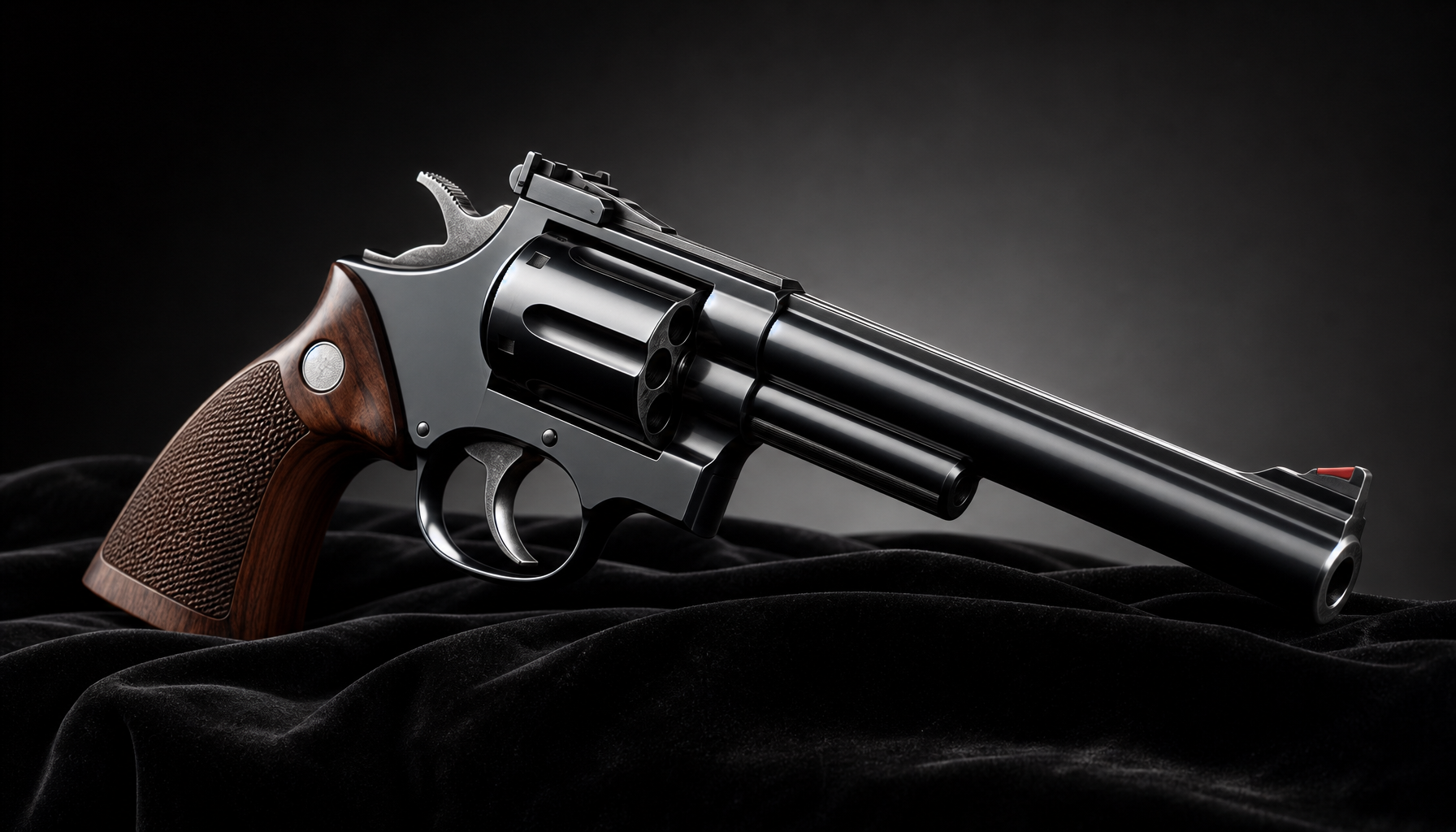
The .357 Magnum (1935), briefly the most powerful handgun on earth.
Smith & Wesson built the .357 with Winchester and two ballistics experimenters, Elmer Keith and Phil Sharpe, driven by S&W's own Douglas Wesson. The case is a .38 Special lengthened by about an eighth of an inch — not for the extra powder alone, but so the hotter round physically cannot chamber in a weaker .38 revolver.
The first guns, from 1935, were hand-fitted “Registered Magnums,” each built to the buyer's order and shipped with a registration certificate and serial-numbered to a ledger. Doug Wesson toured the country hunting big game with one to sell the idea, and Registered Magnum No. 1 went to FBI Director J. Edgar Hoover. Documented early Registered guns are among the most sought-after S&W revolvers there are.
“The most powerful handgun” — a title that kept moving
The .357 held the crown only briefly. In 1955 Smith & Wesson and the same experimenter, Elmer Keith, went bigger still with the .44 Magnum and the Model 29 to fire it — a round carrying far more muzzle energy than the .357 (compare the chips below), built for handgun hunting. It was a specialist's tool selling in modest numbers until 1971, when Clint Eastwood pointed one down a lens and called it “the most powerful handgun in the world” in Dirty Harry. Demand exploded overnight; Model 29s vanished from shelves and traded at double list price for years.
The line kept climbing — the .454 Casull, the .500 S&W Magnum — but notice the fork in the road. This ever-more-powerful hunting revolver is a branch away from the story this book is really telling. The gun on a police belt was about to go the other direction entirely: not more power per shot, but more shots, milder recoil, and better bullets. Power was never the thing that won gunfights.
The S&W Model 29 .44 Magnum (1955) — “the most powerful handgun in the world,” and a branch away from the duty pistol's story.
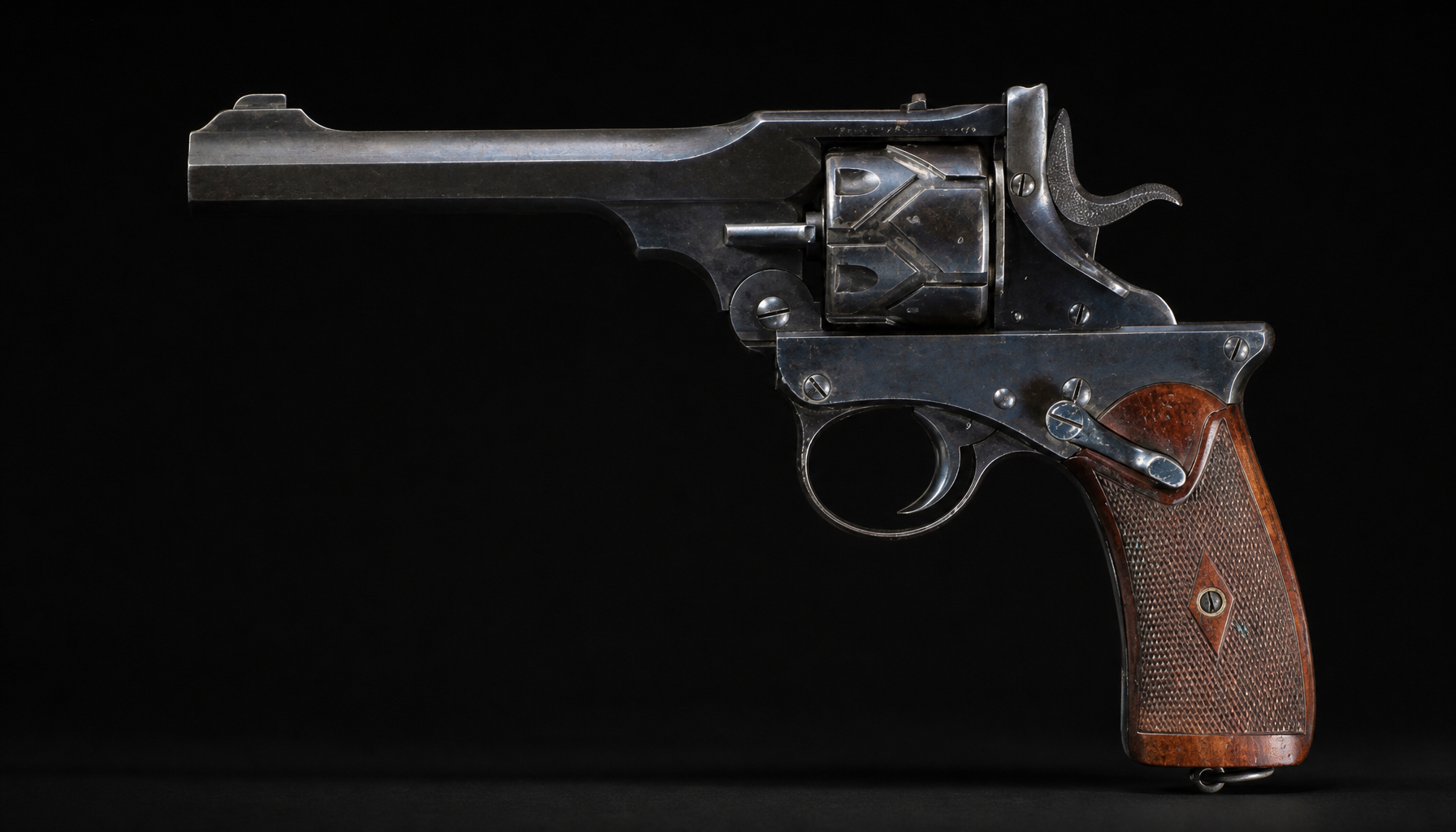
A standard revolver is cycled by the shooter's hand, not by the shot. In a single-action, thumbing the hammer back rotates the cylinder and locks the next chamber; in a double-action, one long trigger pull does both at once. The energy comes from the thumb or finger, which is exactly why a revolver shrugs off a dud: it never relied on the last shot to advance. The oddball exception is the Webley-Fosbery Automatic Revolver (1901), whose barrel-and-cylinder assembly really did slide back on recoil to index the cylinder. Famous, collectible, an evolutionary dead end.
The Webley-Fosbery (1901), the rare recoil-cycled “automatic revolver.”
Collector's note · the revolver that cocked itself
Colonel George Fosbery, a Victoria Cross winner, cut zig-zag grooves into the outside of the cylinder. On firing, the whole barrel-and-cylinder unit slides back on the frame; a fixed stud rides those grooves and twists the cylinder a half-turn, indexing the next chamber and cocking the hammer — a true single-action trigger every shot, with no long double-action pull.
Target shooters loved that light, consistent pull, and some British officers carried the .455 version into WWI. But the open grooves that made it work also jammed solid with trench mud, and it needed full recoil to cycle — so firing from an awkward brace could short-stroke it. Dashiell Hammett gave it a cameo in The Maltese Falcon. A brilliant blind alley, and a prize on any revolver shelf.
Part II · the self-loader, 1893–1985
The semi-automatic: let the shot do the work
The revolver made you cycle the gun. The next leap made the gun cycle itself. In a semi-automatic pistol, the fired cartridge's own energy ejects the empty case, cocks the mechanism, and strips a fresh round from a spring-fed magazine in the grip. One trigger pull per shot, no manual cycling, and a reload is a fresh magazine slapped home rather than cartridges thumbed in one at a time.
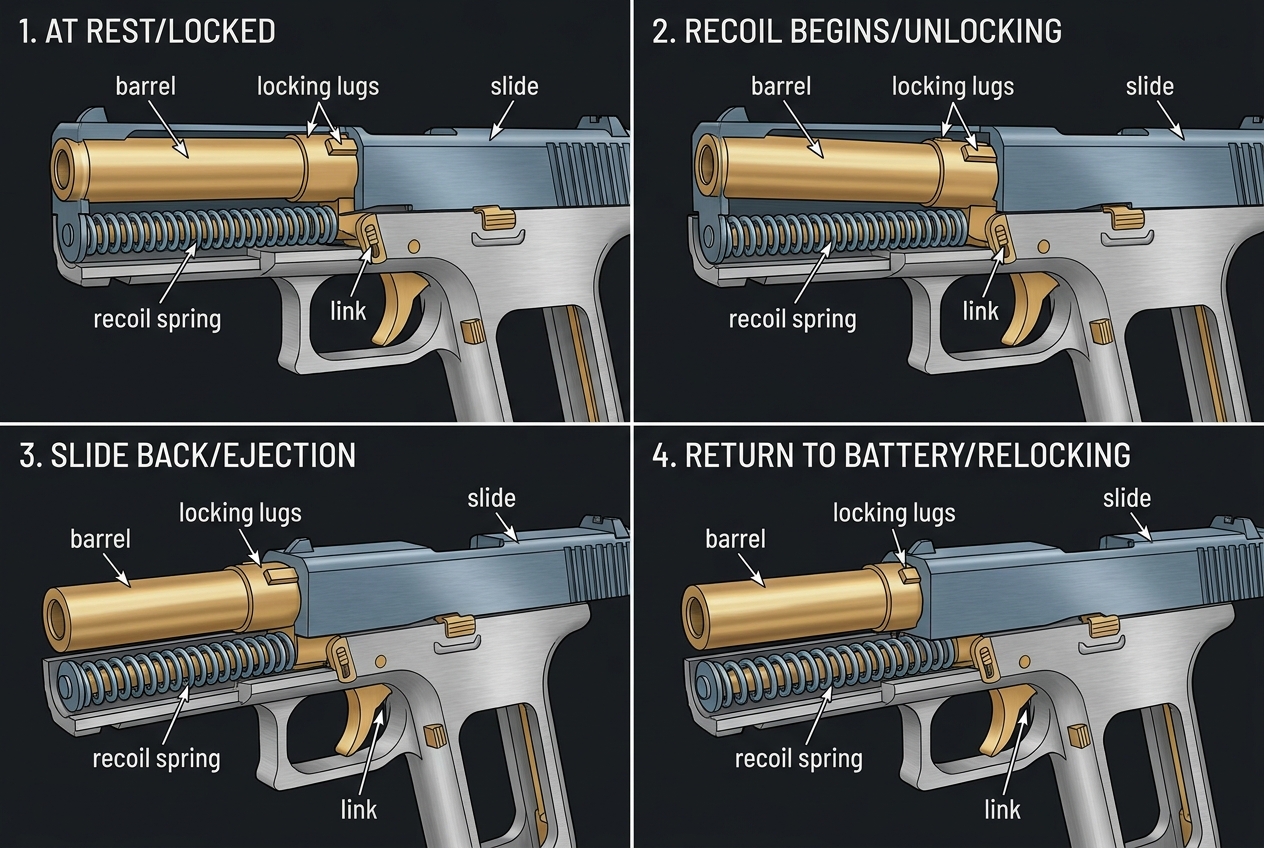
The semi-automatic cycle (Browning's short-recoil system, 1900s): locked at rest, the barrel unlocking as the slide recoils, the case ejecting, and the action returning to battery.
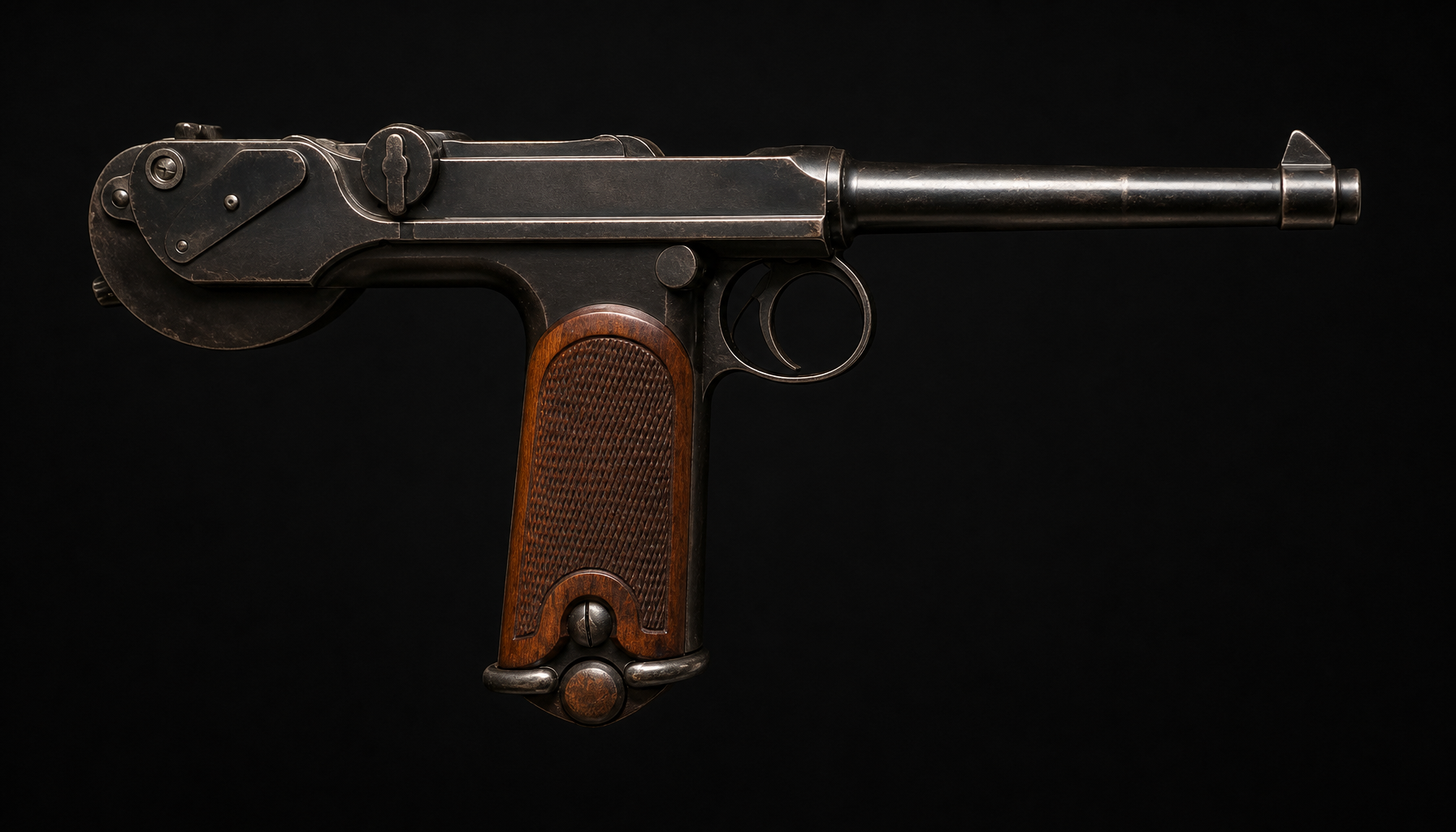
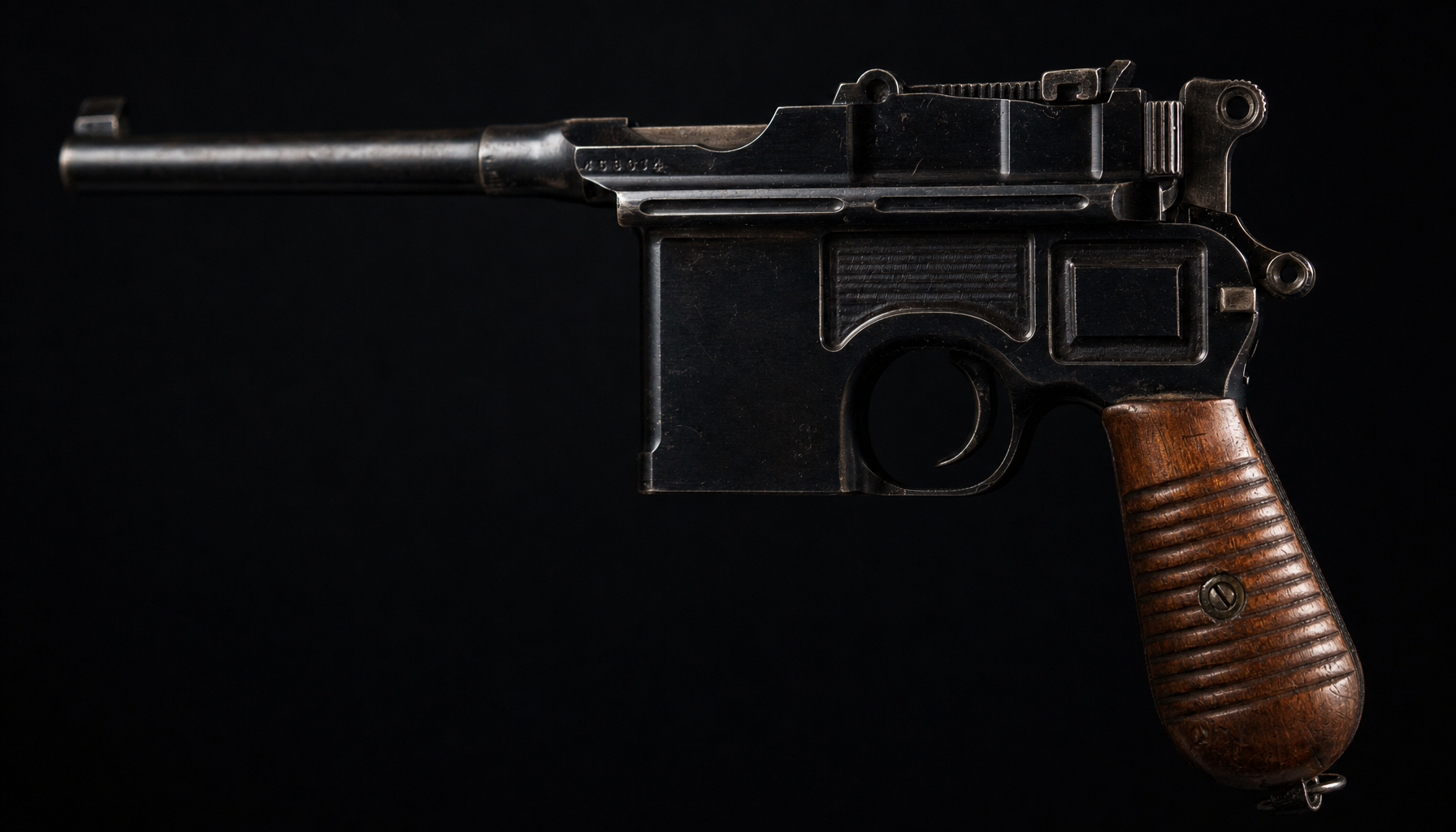
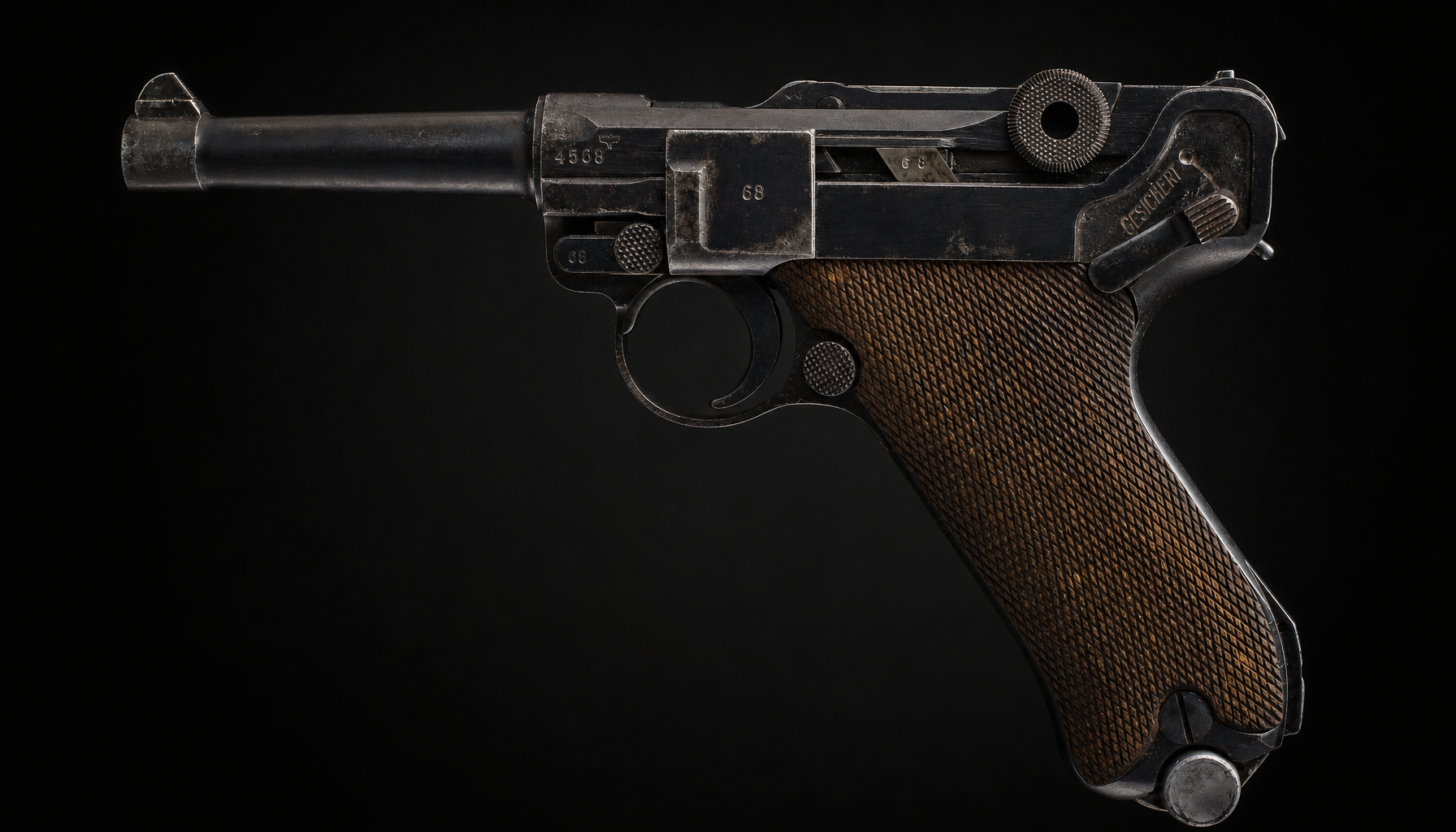
Despite a persistent belief, the Colt 1911 was not the first semi-automatic pistol. The first successful self-loaders were European and beat it by fifteen to twenty years: Hugo Borchardt's C93 (1893) with its distinctive toggle-lock, the Mauser C96 “Broomhandle” (1896), and Georg Luger's elegant P08 (1900). John Browning was building self-loaders in the 1890s. What made the 1911 matter was not that it was first but that it was right, and the reason it exists at all is a bloody lesson learned in the jungle.
The 1893 Borchardt C93, an early self-loader with a toggle lock.
The round grip gave the C96 its nickname, but its cleverest feature is the wooden holster that doubles as a shoulder stock: clip the hollow holster to the grip frame and the pistol becomes a stable little carbine, useful well past normal pistol range.
The fixed ten-round magazine sits ahead of the trigger and loads like a rifle — open the bolt and press a stripper clip of 7.63mm down into it. A wartime variant chambered in 9mm Parabellum had a large “9” carved and painted red into the grip so no one fed it the wrong ammunition: the famous “Red 9.”
Churchill carried a Mauser at Omdurman in 1898, countless Chinese-made copies exist, and a dressed-up C96 became Han Solo's blaster — all of which keeps original German-proofed examples in steady demand.
Collector's note · the toggle and the birth of 9mm
The Luger doesn't use a sliding slide. It locks with a jointed toggle that, on recoil, buckles upward like a bending knee to unlock, then snaps flat again over a fresh round — unmistakable, elegant, and famously fussy about its ammunition.
To feed it, Georg Luger necked up his earlier 7.65mm round and created the 9×19mm Parabellum around 1901–02. The name is from the Latin si vis pacem, para bellum — “if you want peace, prepare for war” — and that cartridge is now the most widely used pistol round on earth.
Value lives in the markings: the chamber date, the maker code (DWM, Erfurt, later Mauser's “byf”), unit stamps, and above all matching serial numbers on every small part. The long-barreled Artillery Luger with its 32-round snail drum is a prize.
Brilliant as they were, these first self-loaders stayed niche. They were expensive and intricate, their toggle and broomhandle layouts felt alien in the hand, and most fired small, fast bullets that horrified an Army fresh from the Philippines. What the market wanted was a self-loader as simple and hard-hitting as a revolver — and it would take Browning, and a lesson written in blood in the jungle, to build it.
Why the Army wanted a .45: the Moros and the failure of the .38
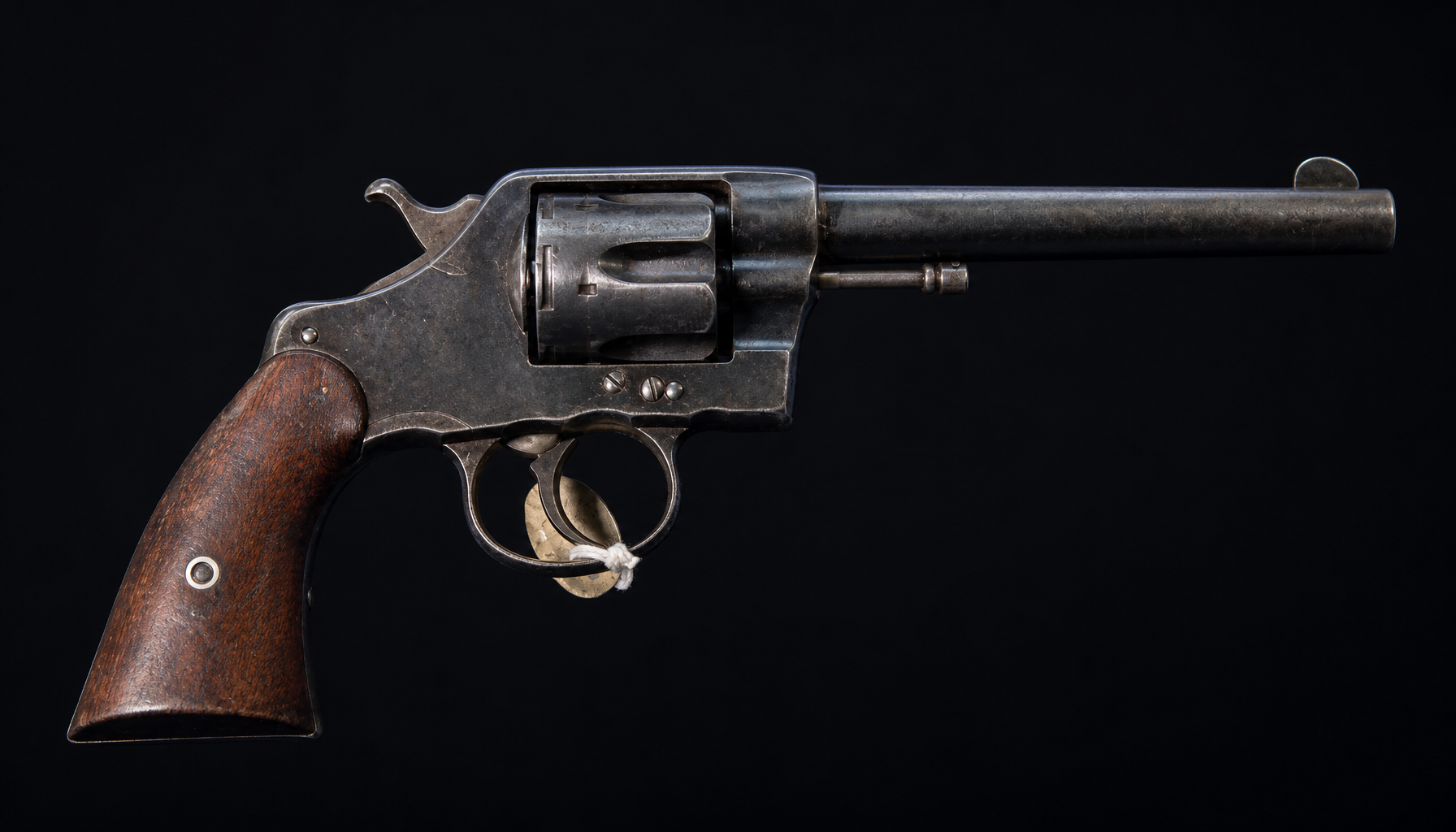
At the turn of the century, U.S. troops fighting the Moro Rebellion in the Philippines were carrying the Colt M1892 revolver in .38 Long Colt. Against charging juramentado warriors, sometimes drugged against pain and bound to fight to the death, the little .38 repeatedly failed to stop a man even at point-blank range. The complaints ran straight up the chain, and in 1904 the War Department ran the Thompson–LaGarde tests in a Chicago stockyard, firing service calibers into live cattle and human cadavers. Their conclusion: the Army needed the punch of the old .45 Colt in a modern cartridge. That requirement, a .45, is the reason Browning's pistol was born in the caliber it was.
The Colt M1892 in .38 Long Colt: the revolver that failed in the Philippines.
Caliber.38 Long ColtShots6Weight~2 lbBarrel6 inMade1892–1908
Point-blank: blunt and direct; at very close range. close enough to aim dead level, with no arc to allow for.
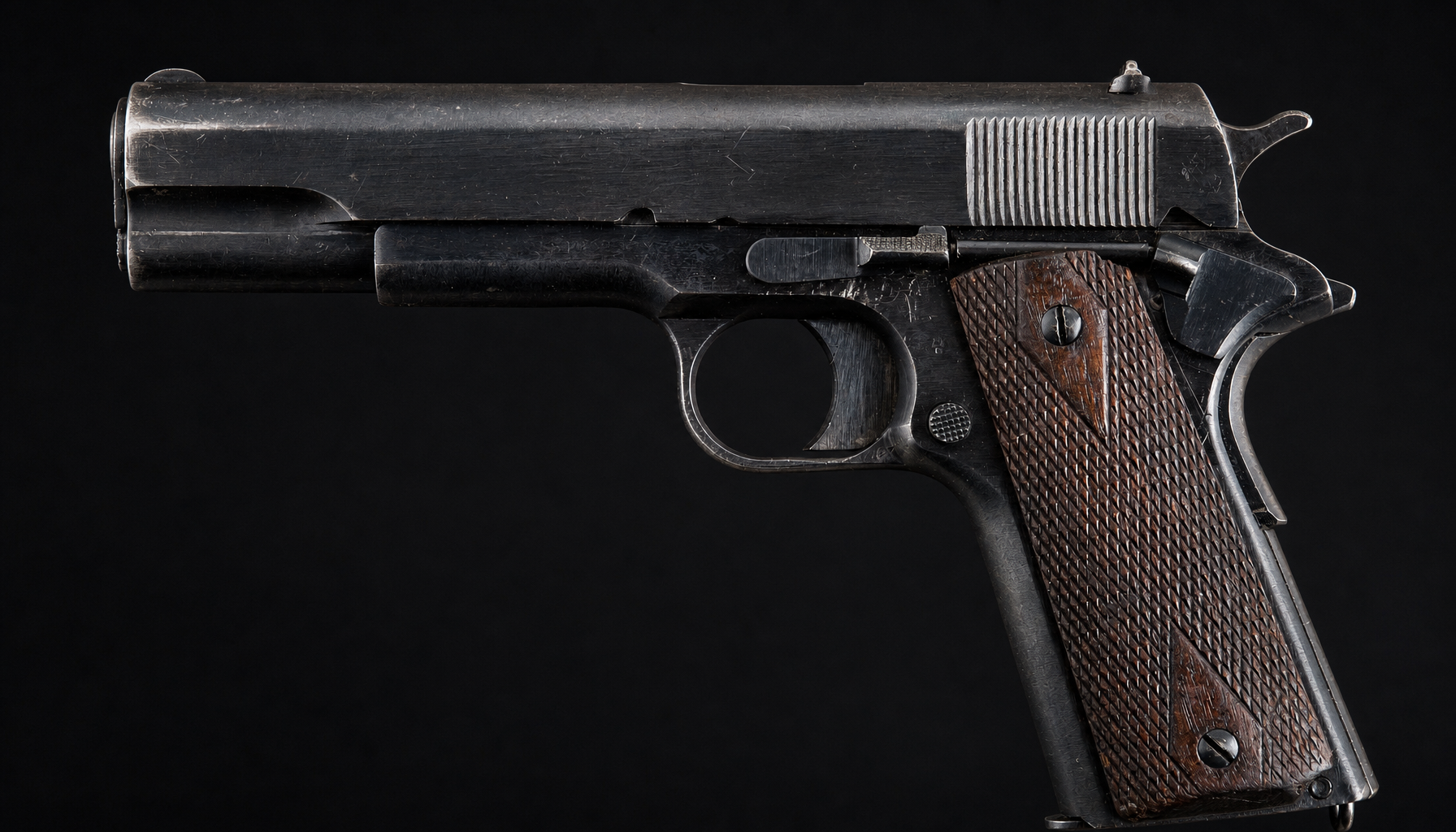
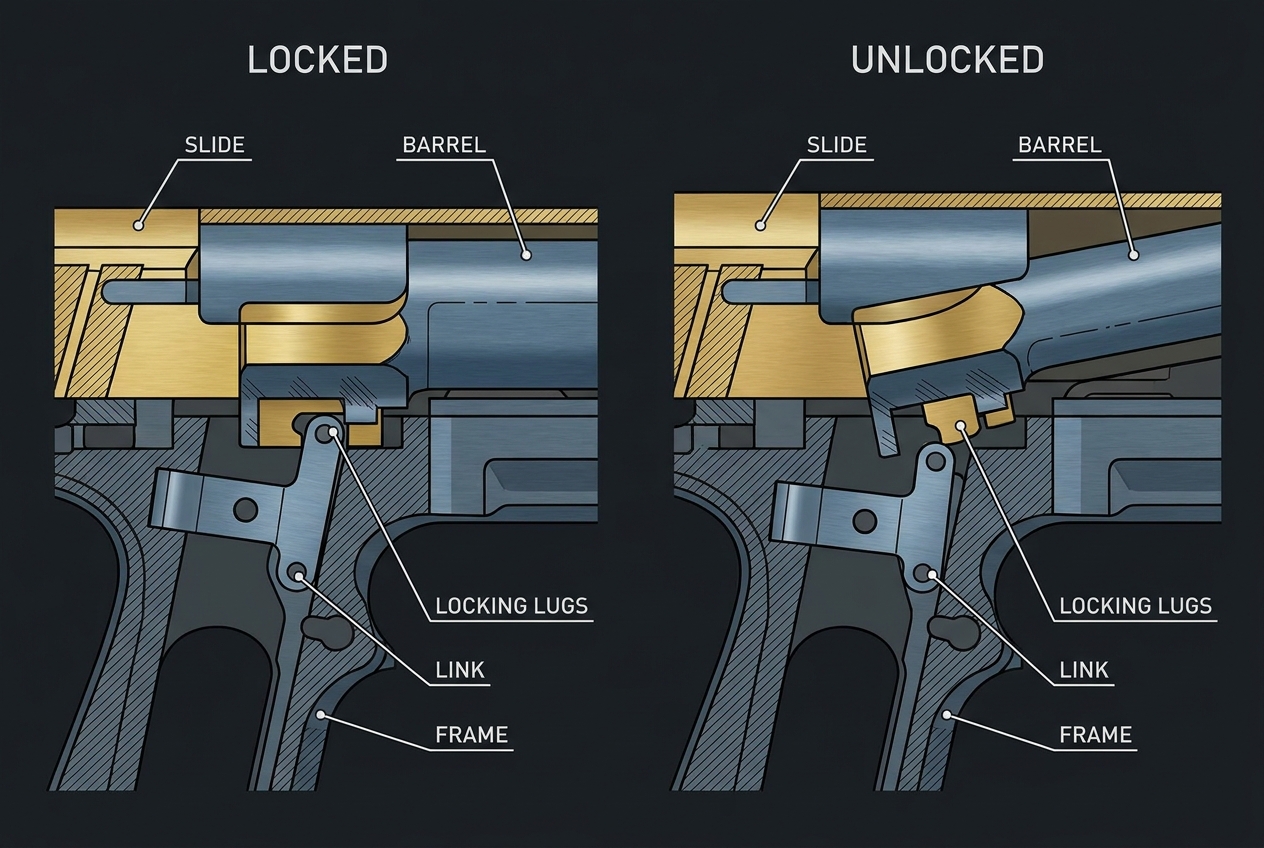
Browning delivered. The M1911 perfected the short-recoil, tilting-barrel locked breech: on firing, barrel and slide recoil together, locked; after a few millimeters the barrel tilts down and unlocks; the slide runs back, flinging out the empty and cocking the hammer; a spring then drives it home over a fresh round. That mechanism is still inside almost every centerfire pistol built today. A Glock, a SIG, a modern Smith are all, mechanically, the 1911's grandchildren. The Army adopted it on March 29, 1911, it fought through two world wars and Korea and Vietnam, and it served as the standard U.S. sidearm until 1985, seventy-four years, when the 9mm Beretta M9 replaced it.
The Colt M1911, Browning's .45: the U.S. sidearm for 74 years.
Collector's note · two safeties and “cocked and locked”
The 1911 carries two safeties: a grip safety on the backstrap that the hand must depress to fire, and a thumb safety that locks the sear with the hammer cocked. Together they allow “cocked and locked” (Condition One) carry — hammer back, thumb safety on — ready for an instant but deliberate first shot.
The “A1” update of 1924 is what most people picture: an arched mainspring housing, a shorter trigger, a longer grip-safety spur, and relief cuts behind the trigger.
For collectors the maker is everything. Beyond Colt, WWII contracts went to Remington Rand, Ithaca, and Union Switch & Signal — and the roughly 500 pistols built by the Singer sewing-machine company in 1941 are among the most valuable production handguns in the world.
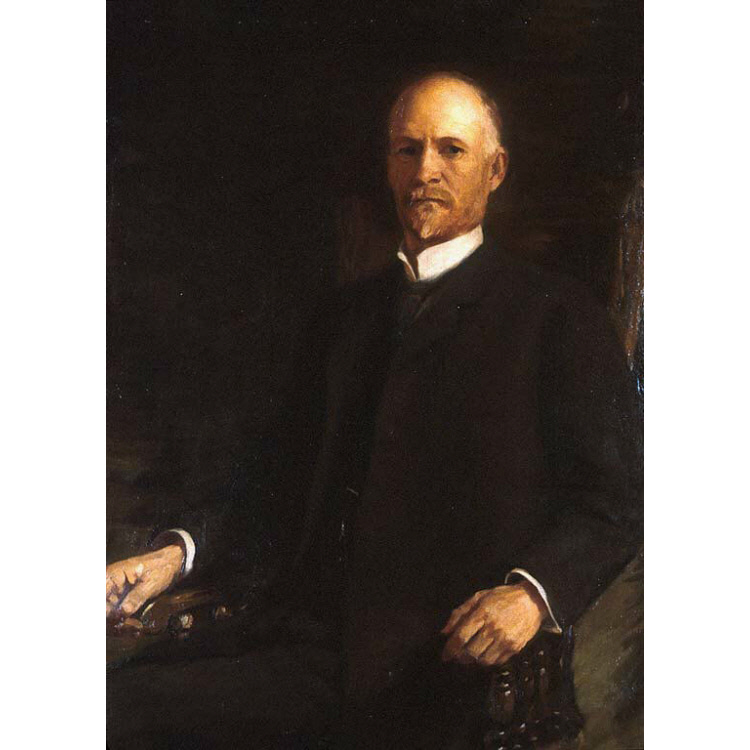
Browning's short-recoil lock (patented 1897): barrel and slide held together by locking lugs, then the barrel tilting down on its link to unlock.John Moses Browning (1855–1926), the most influential gun designer in history.
Six thousand rounds, zero failures
The 1911 earned its name in a single brutal test. In the U.S. Army's 1910 trials, Browning's Colt was fired 6,000 rounds over two days. Whenever the pistol grew too hot to handle, it was simply plunged into a bucket of water and kept firing.
It finished with zero malfunctions — a clean sheet no service pistol had ever posted, while the competing Savage stumbled dozens of times. The Army adopted the Colt on March 29, 1911, and Browning's design went on to serve as the U.S. sidearm for seventy-four years.
The cartridge: .45 ACP
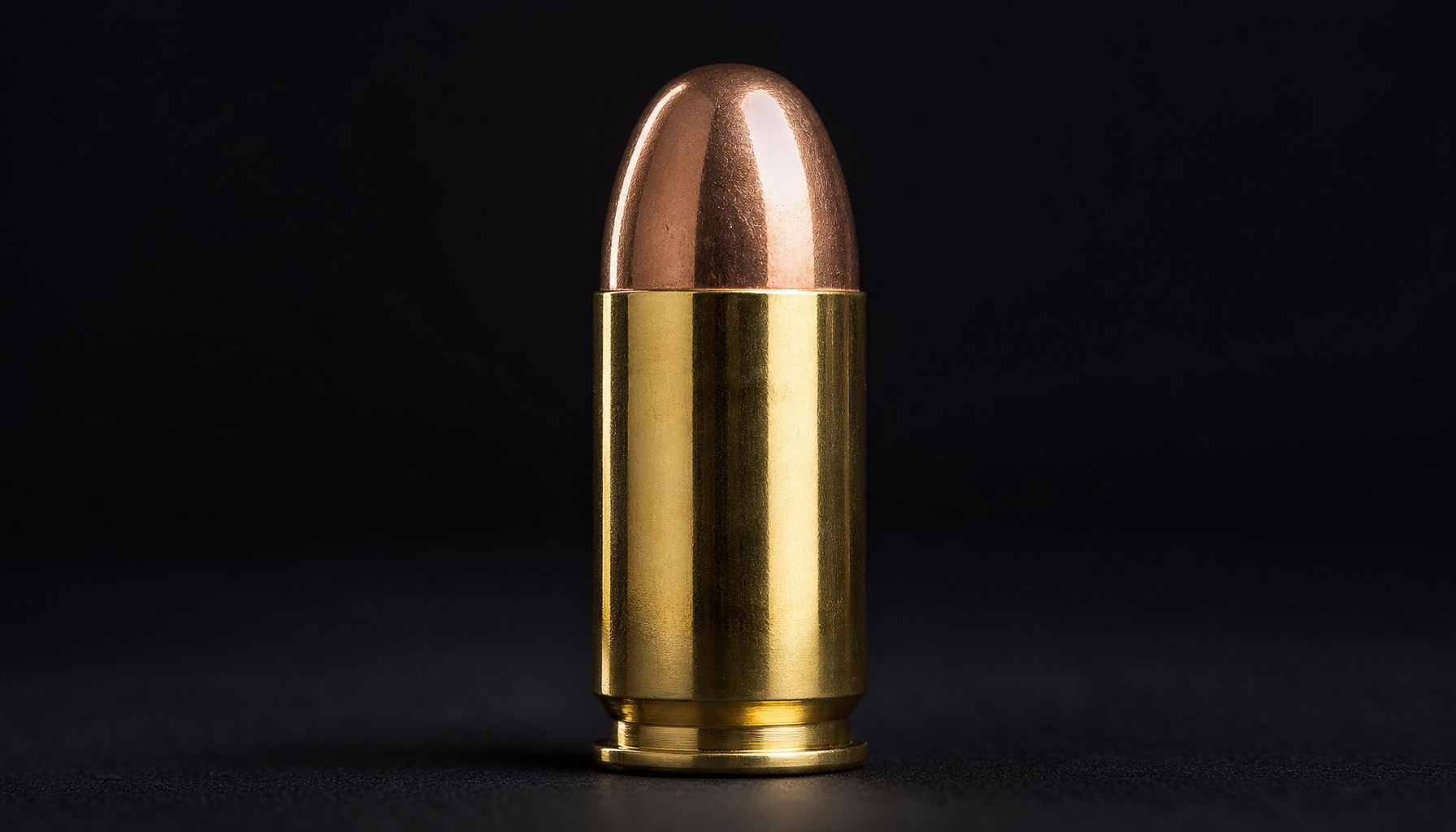
Browning designed the round to match, in 1904: the .45 ACP, Automatic Colt Pistol (not “Package”), one of a family he drew up alongside the .25, .32, and .380. Its key trick is that it is rimless: a straight case with no protruding rim, so rounds stack and feed from a box magazine without their rims snagging (the jam called “rim-lock”). That rimless geometry is a large part of what made dependable self-loading possible in the first place.
The .45 ACP (1905): rimless, so it feeds cleanly from a magazine.
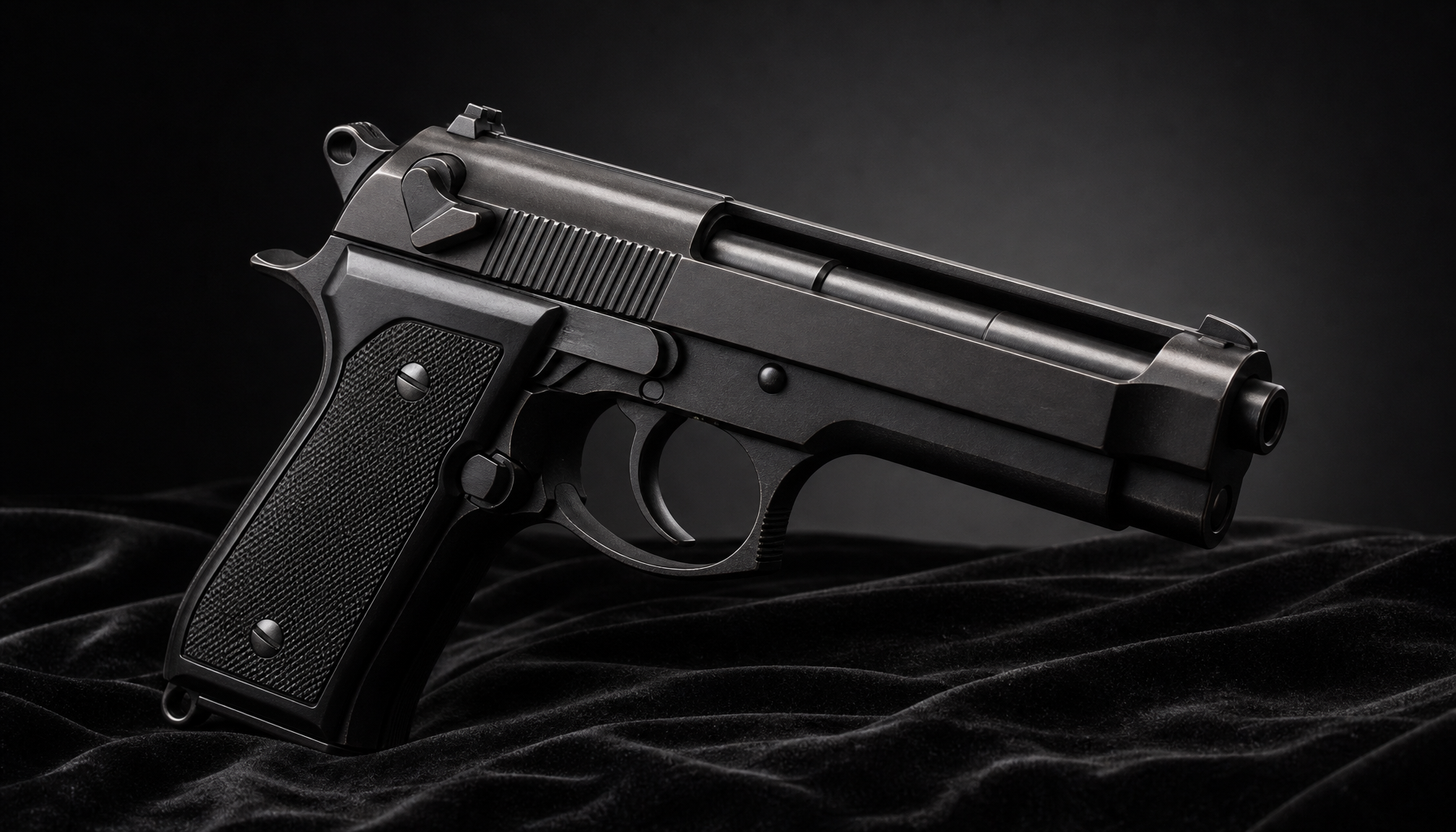
When the seventy-four-year reign ended in 1985, the pistol that won the contract was not American and not a .45. After a long, contentious trial, the U.S. military adopted the Beretta 92F as the M9: a 9mm, double-action/single-action, all-steel service pistol holding fifteen rounds to the 1911's seven. The switch was as much about NATO as ballistics — the alliance had standardized on 9mm, and doubling a soldier's onboard ammunition mattered. The M9 would carry U.S. troops through the Gulf, the Balkans, Iraq, and Afghanistan, serving as the standard sidearm until the striker-fired SIG M17/M18 replaced it in 2017.
The Beretta M9 (adopted 1985): the 9mm that ended the .45's long reign — note the open-top slide, the Beretta signature.
Collector's note · the open slide, and “Lethal Weapon”
You can spot a Beretta 92 across a room by the open-top slide: a long cutout leaves most of the barrel exposed, an unusual look that aids ejection and lets you see the chamber. Its locking system — a falling locking block under the barrel — comes straight from the wartime Walther P38, not from Browning's tilting barrel.
Hollywood adopted it fast: it was Martin Riggs's pistol in Lethal Weapon and John McClane's in Die Hard, which fixed the M9's silhouette in the public eye as firmly as the 1911 before it. The early-1990s scare over a handful of slide failures in high-mileage guns was traced to specific ammunition and metallurgy and corrected; the design's reliability was never seriously in doubt afterward.
The quiet revolution: polymer and the striker
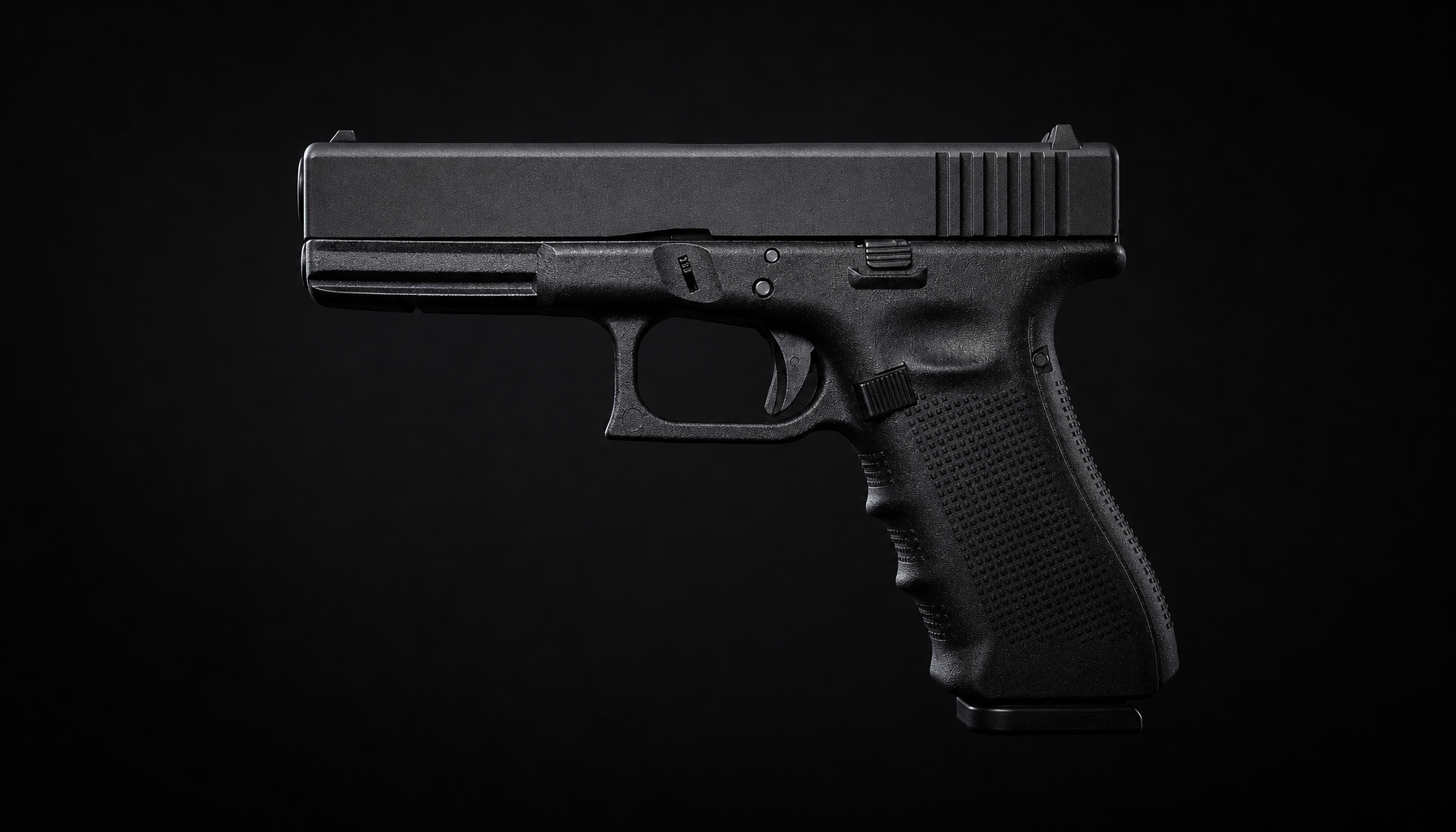
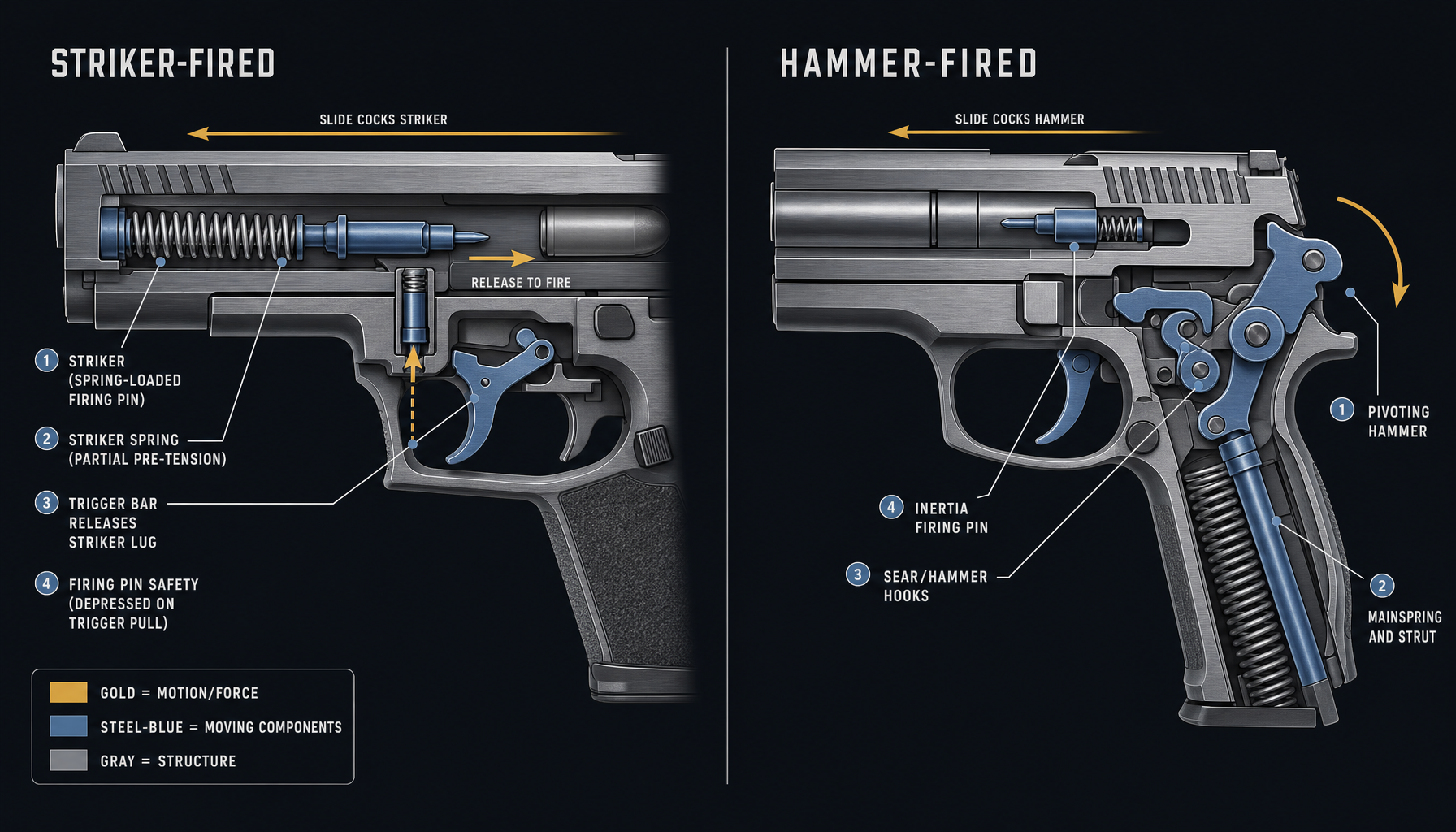
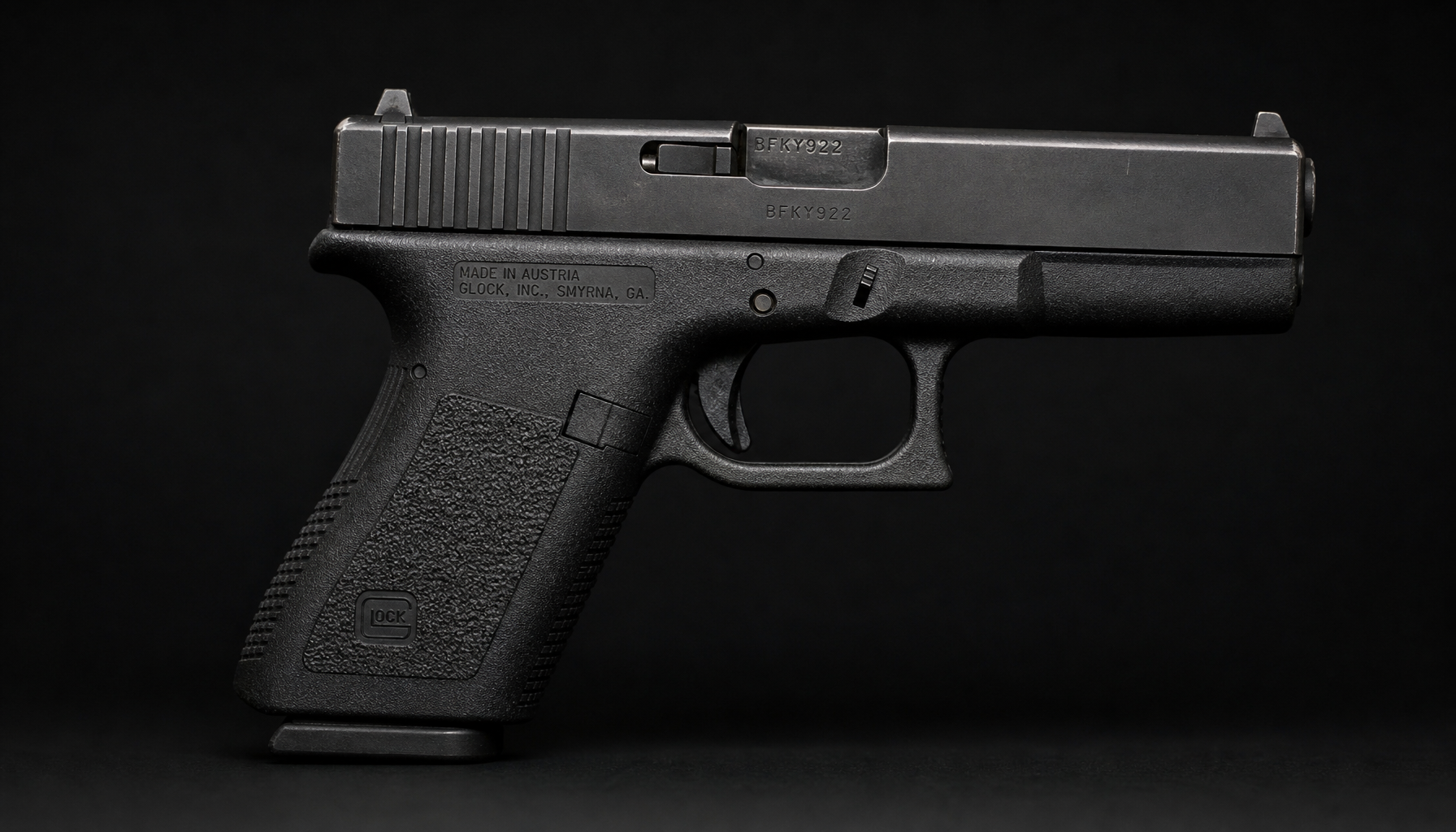
For seventy years the semi-auto meant steel and, usually, a hammer. Then in 1982 an Austrian engineer who had never built a gun won a military contract with one. Gaston Glock's pistol, the Glock 17, had a frame of injection-molded polymer, almost no external controls, a striker instead of a hammer (a spring-loaded firing pin, cocked by the slide and released by the trigger), and a seventeen-round magazine. It had roughly half the parts of a 1911, was cheaper to make, nearly impossible to wear out, and forgiving of neglect. Police administrators noticed the price and the capacity; officers noticed that it simply worked. Within twenty years the polymer, striker-fired pistol was the default sidearm of American law enforcement, and it remains so. Almost every duty pistol today is a variation on Glock's template.
The 1982 Glock 17: polymer frame, striker-fired, seventeen rounds.
Ask where the safety is and the answer is: on the trigger. Glock's “Safe Action” system has no manual safety lever — instead three internal safeties (a small lever in the face of the trigger, plus firing-pin and drop safeties) all release only when the trigger is deliberately pulled. Fewer controls, fewer things to forget under stress.
Collectors track generations: the 1982 Gen 1 with its smooth “pebble” frame and early Tupperware box, through the finger-grooved Gen 3 and 4, to the grooveless Gen 5. Clean Gen 1 Glock 17s, once nearly disposable, now bring real money.
Striker-fired (mainstream since 1982) versus hammer-fired: a spring-loaded firing pin held under partial tension, released by the trigger bar.
The “plastic gun” scare, corrected
When the Glock reached America in the 1980s it triggered a panic, amplified by Die Hard 2, that a “porcelain” or all-plastic pistol could slip through airport metal detectors. It never could. A Glock's barrel, slide, and springs are ordinary steel, well over a pound of it. The frame is polymer; the gun is not. The myth outlived the facts by decades.
Part III · the fight that rearmed America
April 11, 1986: four minutes in Miami
For most of the twentieth century the American police officer carried a .38 Special revolver. Six shots, simple, dependable, the badge's gun for generations. What ended its reign was not a study or a trend. It was a single firefight on a suburban Miami street that lasted under five minutes and has been dissected, round by round, ever since.
The FBI was hunting two men, Michael Lee Platt and William Russell Matix, behind a string of armored-car and bank robberies. Both were former Army, physically hard, calm under fire, and neither had a criminal record before the spree. On the morning of April 11, 1986, a rolling stakeout of eight agents in five unmarked cars spotted the suspects' stolen vehicle in the Pinecrest area and forced it off the road.
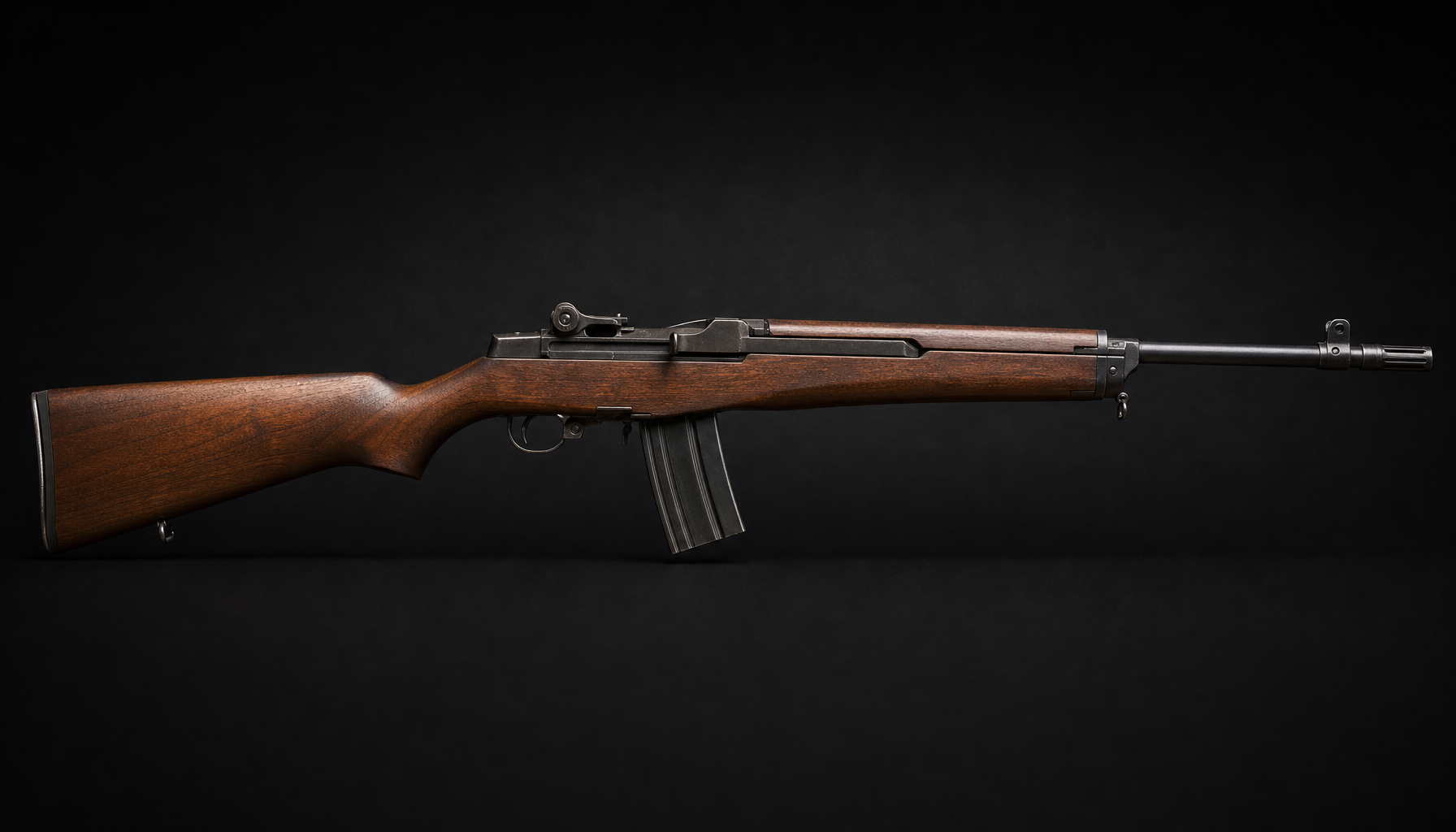
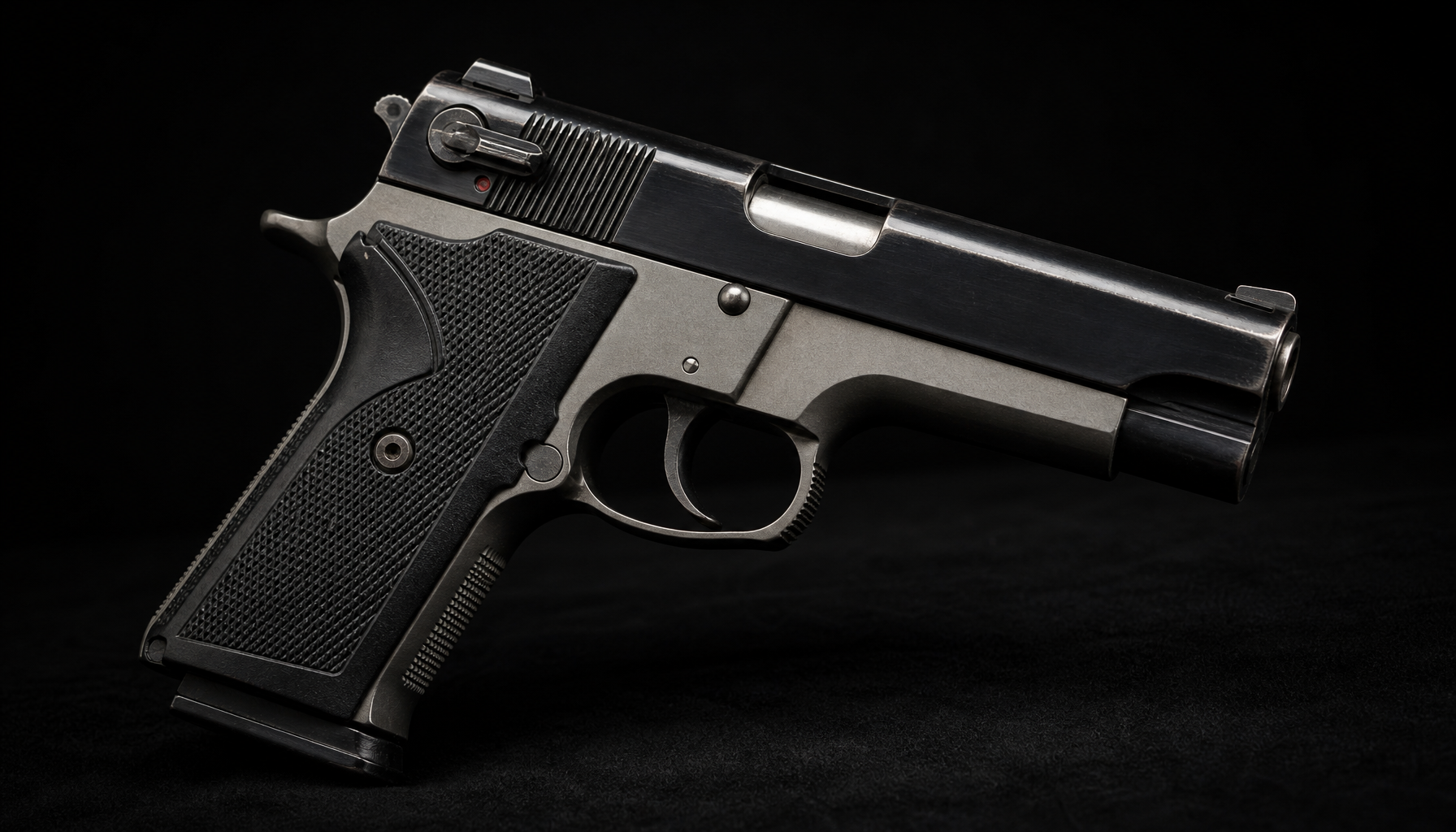
The armament was badly mismatched, and not in the FBI's favor. The agents carried mostly .38 and .357 revolvers, three S&W Model 459 9mm pistols, and two shotguns. Platt came out with a Ruger Mini-14, a .223 semi-automatic rifle. A rifle round travels two to three times the speed of a pistol round and carries far more energy, and Platt, wounded early and repeatedly, kept working that rifle. In roughly 145 rounds exchanged over those few minutes, most of the damage to the agents came from one man with one rifle.
The Ruger Mini-14 .223, which dominated the 1986 Miami shootout.
Bill Ruger and L. James Sullivan built the Mini-14 in 1973 as a scaled-down M14/Garand — the same rotating bolt and gas op-rod, shrunk to the .223 cartridge. With its wood stock and blued steel it reads as a ranch or hunting rifle, not a “black rifle,” which is much of why it dodged the political heat the AR-15 drew.
That ordinary look is part of the Miami story: Michael Platt's Mini-14, fed with 20-round magazines, did most of the damage to eight FBI agents armed mainly with revolvers and 9mm pistols.
The S&W Model 459, the 9mm an agent used at Miami in 1986.
Early in the fight, Special Agent Jerry Dove, with his 9mm, put a round into Platt that should have ended it. It passed through Platt's right upper arm and into his chest, and stopped roughly one inch short of his heart. The autopsy later found the wound had collapsed a lung and filled his chest with more than a liter of blood. It was, in the medical language, non-survivable. It was also, in the only sense that mattered on that street, not enough. Platt did not go down. He kept fighting for several more minutes, and in those minutes he killed the very agent who had shot him.
The bullet that killed Platt and the bullet that failed to stop him were the same bullet. That paradox is the whole story of the next thirty years of American ammunition.
When it was over, two agents were dead: Benjamin Grogan and Jerry Dove. Five more were wounded, several gravely. It was one of the most badly injured groups of agents in the Bureau's history. The end came from a man who could barely stand. Special Agent Edmundo Mireles Jr., his left forearm shattered by a rifle round, worked a shotgun one-handed and then, as Platt and Matix tried to escape in an agent's own car, walked up and emptied his .357 revolver into them at close range. His last shots killed both men.
The last minutes belonged to a wounded man
A rifle round had shattered Special Agent Edmundo Mireles Jr.'s left forearm early in the fight. Pinned and bleeding, he loaded and fired a Remington 870 shotgun one-handed, working the pump by bracing it against his body between shots.
When Platt and Matix climbed into an agent's own car to escape, Mireles stood, walked toward them, and emptied his .357 revolver through the glass at close range. Those shots ended the fight and killed both men. He was later awarded the FBI's Medal of Valor.
The reckoning: from “stopping power” to a penetration standard
The Bureau's after-action study was unsparing, and it fixed on Dove's round. If a good hit from a service pistol could leave a mortally wounded man fighting for minutes, then the gun and the cartridge were not doing their job. The finding was blunt: their sidearms lacked stopping power, and their revolvers had lost on capacity and reload speed to a man with a magazine-fed rifle.
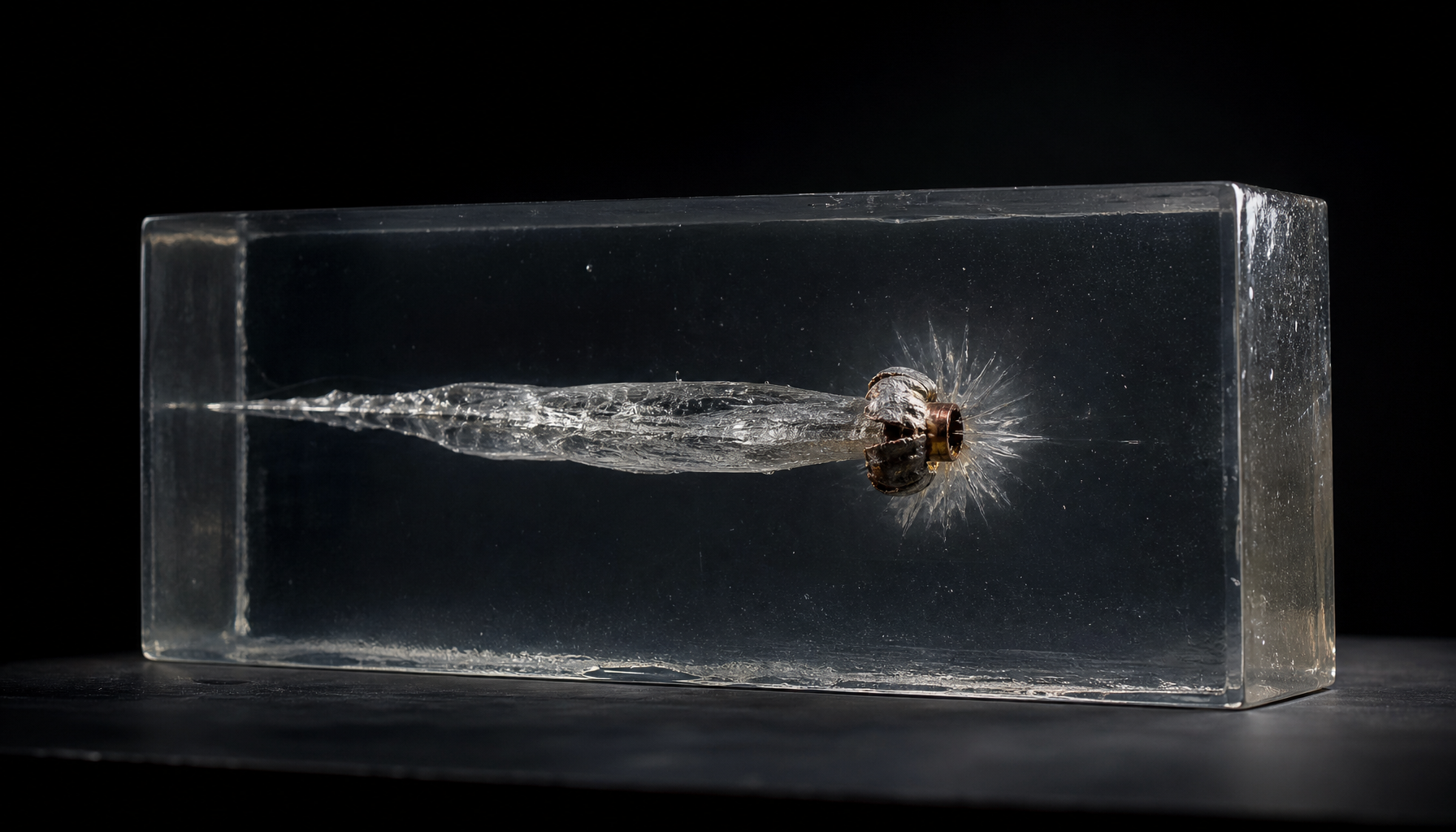
What the FBI did next mattered more than the gunfight itself, because they refused to argue about it by anecdote. They built a laboratory discipline. Working with wound-ballistics researchers, the Bureau established a ballistic testing protocol: fire candidate rounds into calibrated ten-percent gelatin, through barriers like heavy clothing, glass, and sheet metal, and measure how deep the bullet drives and how reliably it expands. The now-famous benchmark that emerged was penetration of roughly 12 to 18 inches, deep enough to reach vital organs from any angle, not so deep it passes through and endangers bystanders. Dove's round had expanded well but stopped short; the lesson the FBI drew was that penetration, reaching the vitals, was the property that had been missing.
The FBI's answer (from 1987): ballistic gelatin and a 12-to-18-inch penetration standard.
That pointed them at a bigger, harder-hitting cartridge, the 10mm Auto, and this is where the popular story goes slightly wrong.
The 10mm didn't “recoil too much.” The FBI wanted it softer on purpose.
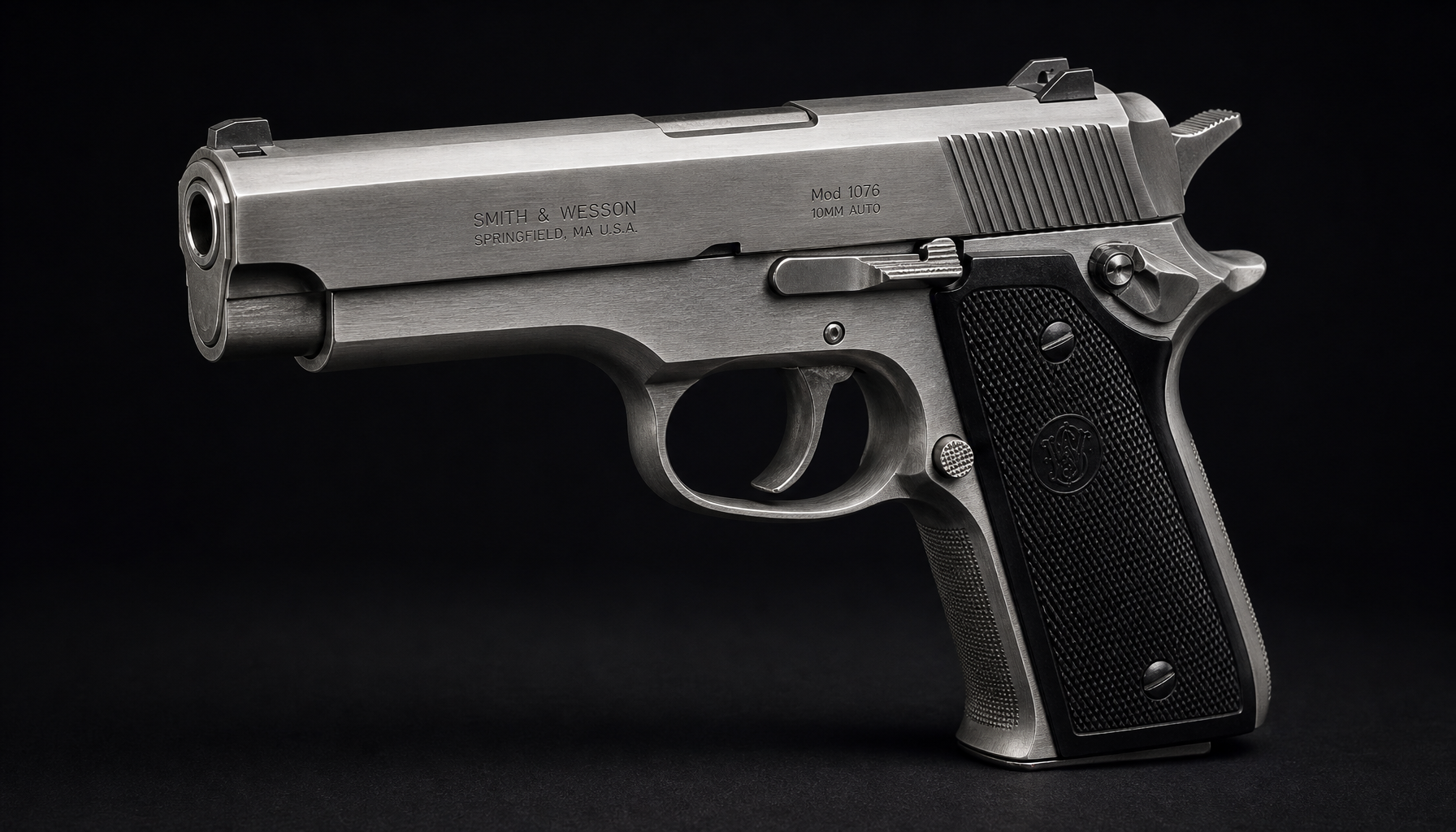
The legend says the FBI adopted the full-power 10mm, found it brutal to shoot, and had to back off. The truth is tidier. The Bureau's own tests showed that a 180-grain bullet at about 1,000 feet per second gave the penetration they wanted with controllable recoil, and they specified that reduced-velocity load, the “10mm Lite,” from the start. They fielded it in the S&W Model 1076. The catch was the pistol, not the powder: a full-length 10mm cartridge needs a large frame, and the gun was big for many agents' hands.
The S&W Model 1076 in 10mm (1990), the FBI's post-Miami pistol.
The FBI “Lite” load: the figures above are the 10mm at full power. The FBI's specified duty load ran the same 180-grain bullet at only about 1,000 fps — roughly 400 ft·lbf, the number the .40 S&W would later match in a shorter case. the full-power round is the cartridge's identity; the downloaded “Lite” load is what actually rode in the Model 1076.
Jeff Cooper's cartridge, and a TV detective's gun
The 10mm was the pet idea of Colonel Jeff Cooper, the dean of American pistolcraft, who wanted one round that split the difference between the fast 9mm and the heavy .45. It first appeared in 1983 in the Bren Ten, a striking pistol from a tiny California firm, Dornaus & Dixon.
The Bren Ten got its fame from television — it was Sonny Crockett's pistol in Miami Vice — but the company shipped guns without magazines, tangled its supply, and folded by 1986. The cartridge would have died with it, had a gunfight in Miami that same year not sent the FBI looking for exactly the power the 10mm carried.
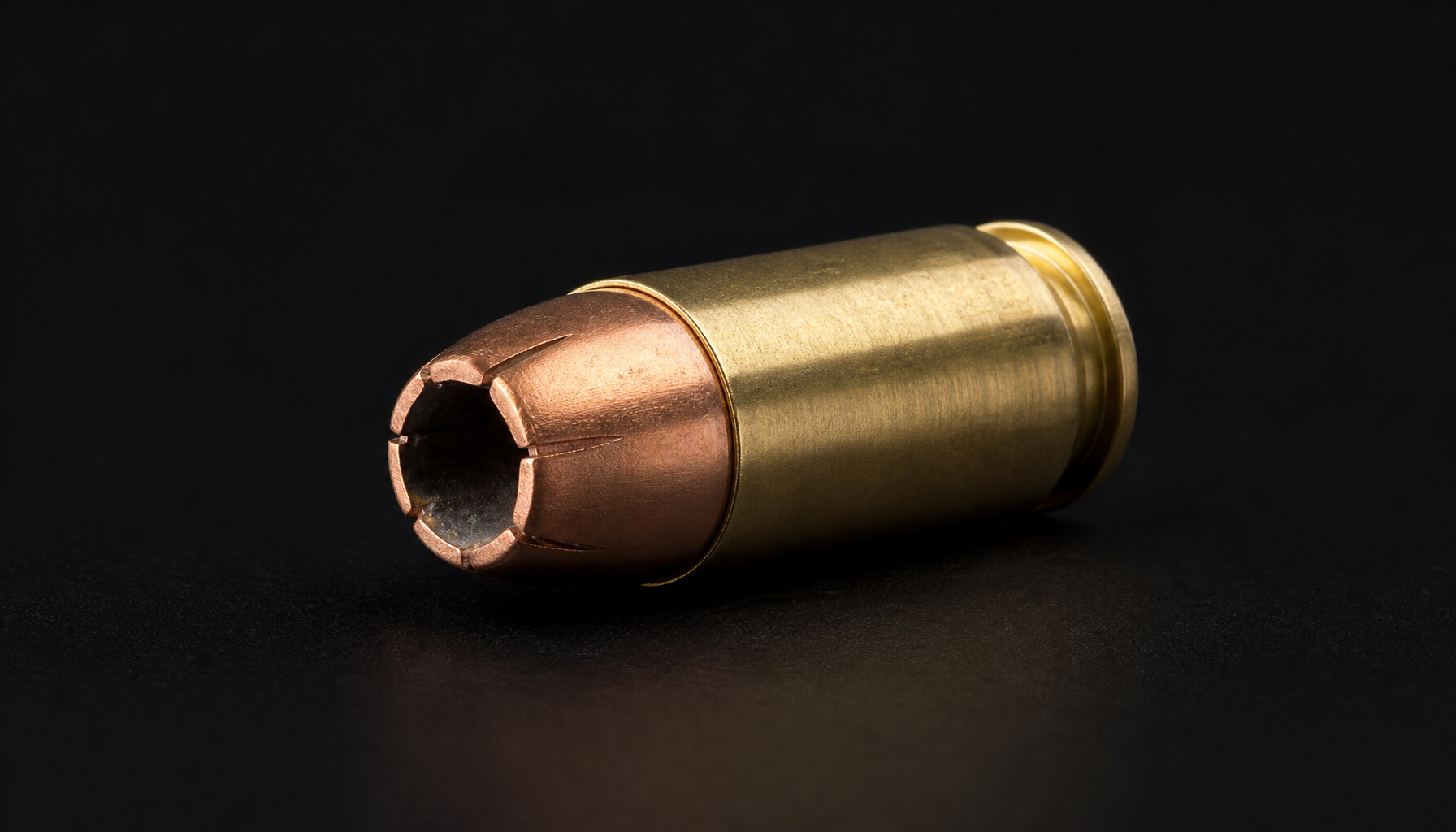
That opened the door for one of the neater pieces of engineering in cartridge history. Smith & Wesson looked at the FBI's downloaded 10mm and realized the reduced charge left empty air in the long case. Squeeze that air out, shorten the case, and you get the same 180-grain-at-1,000-fps performance in a cartridge short enough to fit an ordinary 9mm-sized frame. Teamed with Winchester, they released it on January 17, 1990 as the .40 S&W. Glock, moving fast, had its Glock 22 and 23 in .40 on dealers' shelves before Smith's own pistol shipped.
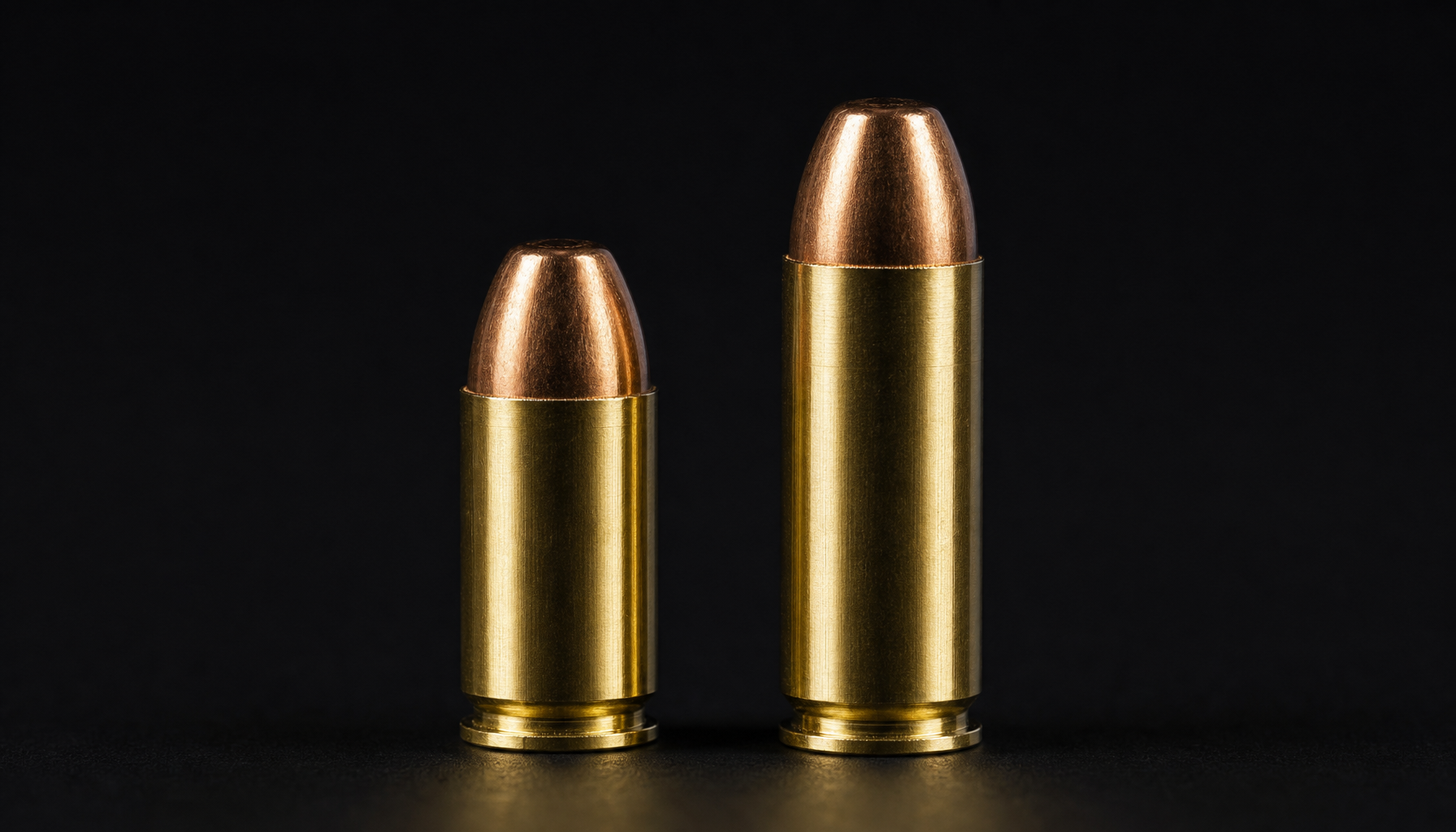
The .40 S&W (1990, left) is the FBI's 10mm Auto (right), distilled into a shorter case.
The .40 S&W did to American policing what few cartridges ever have: it took over almost completely. It offered most of the 10mm's effectiveness with tolerable recoil, in a high-capacity pistol the size of a 9mm. Through the 1990s and 2000s, department after department turned in the six-shot .38 revolver for a polymer semi-auto holding fifteen or more rounds of .40. Capacity roughly doubled overnight; reloads dropped from a slow fumble to a one-second magazine change. A good number of agencies and officers went instead to Browning's old .45 ACP, enjoying a second life in high-capacity form. Either way, the age of the revolver on an American duty belt was over, and it had ended, more than anything, because of four minutes in Miami.
Era
Sidearm & cartridge
Why it changed
~1899–1980s
.38 Special revolver
Simple, reliable, six shots, easy to train
Late 1980s
10mm Auto “Lite” (FBI, S&W 1076)
Miami: needed penetration to the vitals; big pistol
1990s–2000s
.40 S&W & 9mm (many .45 ACP) semi-autos
10mm's performance in a 9mm frame; magazines replace cylinders
~2015–now
Back to the 9mm
Modern bullets closed the gap; more rounds, more hits
What happened to all those revolvers?
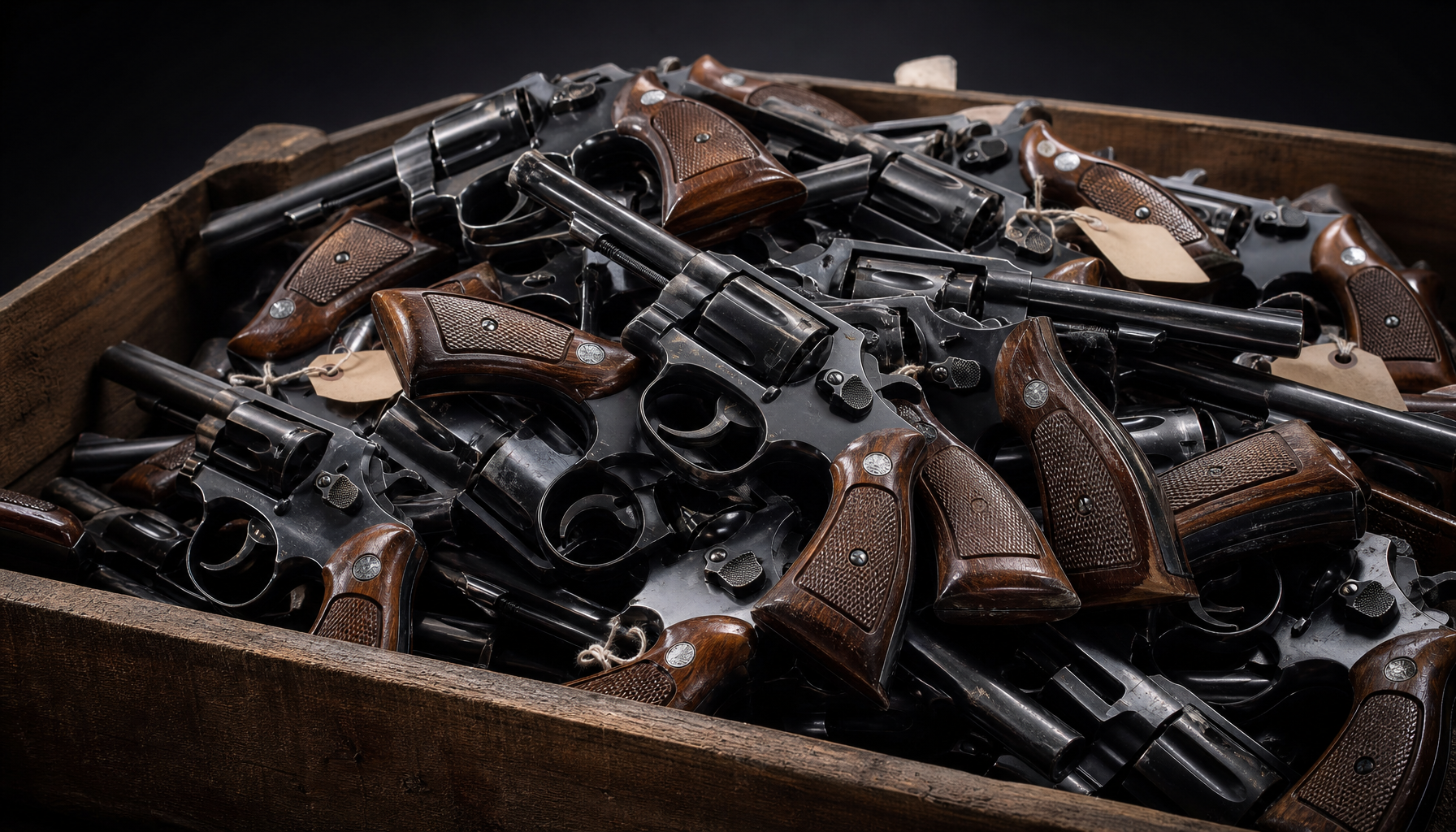
Mostly they were not melted down. Destroying a gun costs money and forfeits its trade value, so when a department upgraded, the overwhelmingly common move was a trade-in: the agency handed its .38s to a distributor as credit against the new pistols, the way a customer trades in a phone. Those revolvers poured back onto the market as cheap, plentiful “police trade-in” guns (the Smith & Wesson Model 10 and Model 64 above all), sold to civilians for a song or exported; a retired American service revolver might live out its days in Australia or Europe. Only a minority were destroyed: federal agencies are legally required to scrap their old guns, but state and local departments are not, and most took the check over the crusher.
The coda is recent and uncomfortable. Because agencies resold rather than destroyed, a 2024 investigation traced 52,529 firearms once owned by police to later crime scenes since 2006, which has pushed more than a dozen departments to finally start destroying their trade-ins.
Police trade-in .38s (1980s–90s): holster-worn service revolvers, retired by the crateful as departments moved to autoloaders.
Part IV · the wheel comes full circle
~2015: the FBI goes back to the 9mm
Here is the twist that makes the whole arc rhyme. In 2014 the FBI published a justification to return to the very cartridge it had condemned after Miami: the 9mm. The reasoning, laid out in a now widely circulated white paper, was not sentiment but data, and it quietly overturned the entire “bigger is better” logic that Miami had installed.
Three findings did the work. First, modern bullets erased the caliber gap. A generation of bonded, controlled-expansion hollow points had advanced so far that, in the FBI's own gelatin protocol, premium 9mm loads now matched or beat premium .40 and .45 loads, with “little to no noticeable difference in the wound tracks” across the three. The property Miami had exposed, reliable penetration and expansion, was now a solved problem in every service caliber. Second, shot placement dominates everything, and placement favors the 9mm: agents shot faster and more accurately with 9mm than with .40 in identically sized pistols, which matters enormously given that officers in real gunfights miss the majority of their shots. Third, the 9mm simply gives you more: more rounds in the magazine, less recoil, cheaper ammunition, less wear on the guns, and higher reliability.
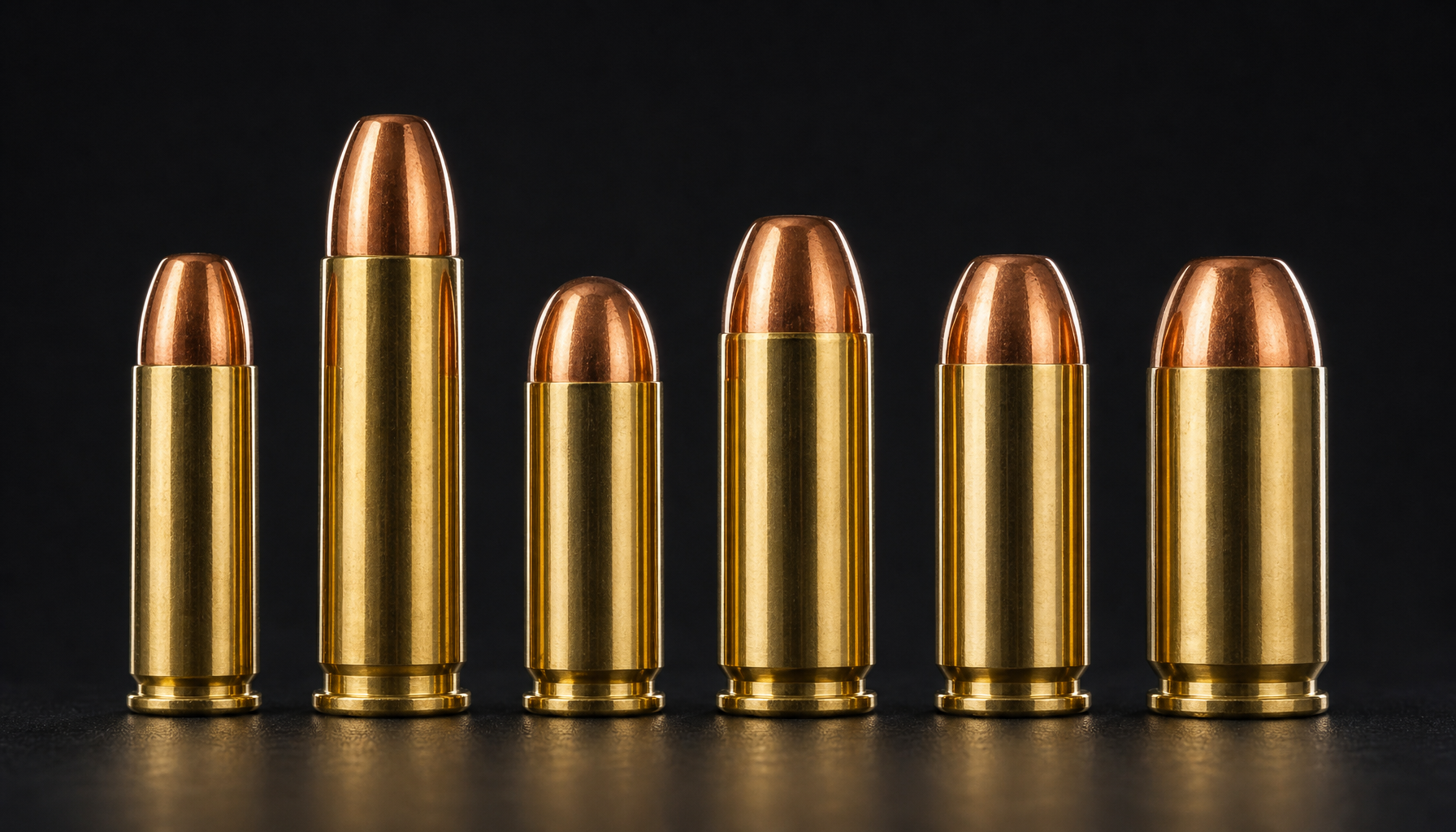
The lineup, left to right: .38 Special, .357 Magnum, 9mm, 10mm, .40 S&W, .45 ACP.
Cartridge
Bullet Ø
Typical load
Velocity
Muzzle energy
Year
.38 Special
.357 in
158 gr
~770 fps
~200 ft·lbf
1898
.357 Magnum
.357 in
125 gr
~1,450 fps
~580 ft·lbf
1935
9mm Parabellum
.355 in
115 gr
~1,150 fps
~340 ft·lbf
1902
10mm Auto (full)
.400 in
180 gr
~1,300 fps
~675 ft·lbf
1983
.40 S&W
.400 in
180 gr
~1,000 fps
~400 ft·lbf
1990
.45 ACP
.451 in
230 gr
~830 fps
~350 ft·lbf
1905
Read down the energy column and the FBI's argument almost makes itself. On paper the 9mm sits near the bottom, a hair above the old .38 — and for eighty years that number was the whole case against it. The Bureau's finding was that the number had stopped mattering: fired as a modern bonded hollow-point, the 9mm penetrated and expanded to the same 12-to-18-inch standard as the .40 and the .45, wound tracks all but indistinguishable. Once the bullets equalized, the numbers above stopped deciding fights — and everything the 9mm still won on (recoil, capacity, hits, cost) tipped the other way. (Figures are representative FMJ loads; premium defensive loads vary. Muzzle energy = bullet mass × velocity² ÷ 450,437.)
By 2015 the Bureau was transitioning back to 9mm, and much of American law enforcement followed once again. The .40 S&W, king for two decades, went into decline almost as fast as it had risen. Put plainly: better bullets, not bigger ones, won the argument, and the caliber the FBI abandoned in the blood of a Miami street came back thirty years later, vindicated.
Part V · three gunfights that rearmed America
Miami had a before and an after
Miami was the fight that changed the police cartridge, but it was the middle child of three watershed gunfights, each of which forced American law enforcement to re-arm in a different way. Together they trace the whole modern journey from the six-shot revolver to the rifle in the trunk.
Before · Newhall, 1970: the reload that came too late
On April 6, 1970, four young California Highway Patrol officers — Walt Frago, Roger Gore, James Pence, and George Alleyn — were killed in a roadside gun battle with two armed men that lasted about four and a half minutes. It was the deadliest day in CHP history to that point, and the post-mortem was brutal for what it revealed about the revolver: officers had to reload under fire the slow way, thumbing loose cartridges into a swung-out cylinder while being shot at. One enduring legend holds that a dead officer was found with his spent brass in his pocket, having tidily emptied his cylinder into his hand the way he'd been drilled on the range; that detail is probably apocryphal, but the lesson beneath it was real and it stuck. Newhall rewrote police training nationwide: the “survival mindset,” shooting from cover, moving targets on the range, felony-stop tactics, and above all the speedloader in place of the old loose-round “dump pouch,” so a revolver could be recharged in seconds rather than a fatal fumble. Newhall didn't change the gun. It changed how officers were taught to survive with it.
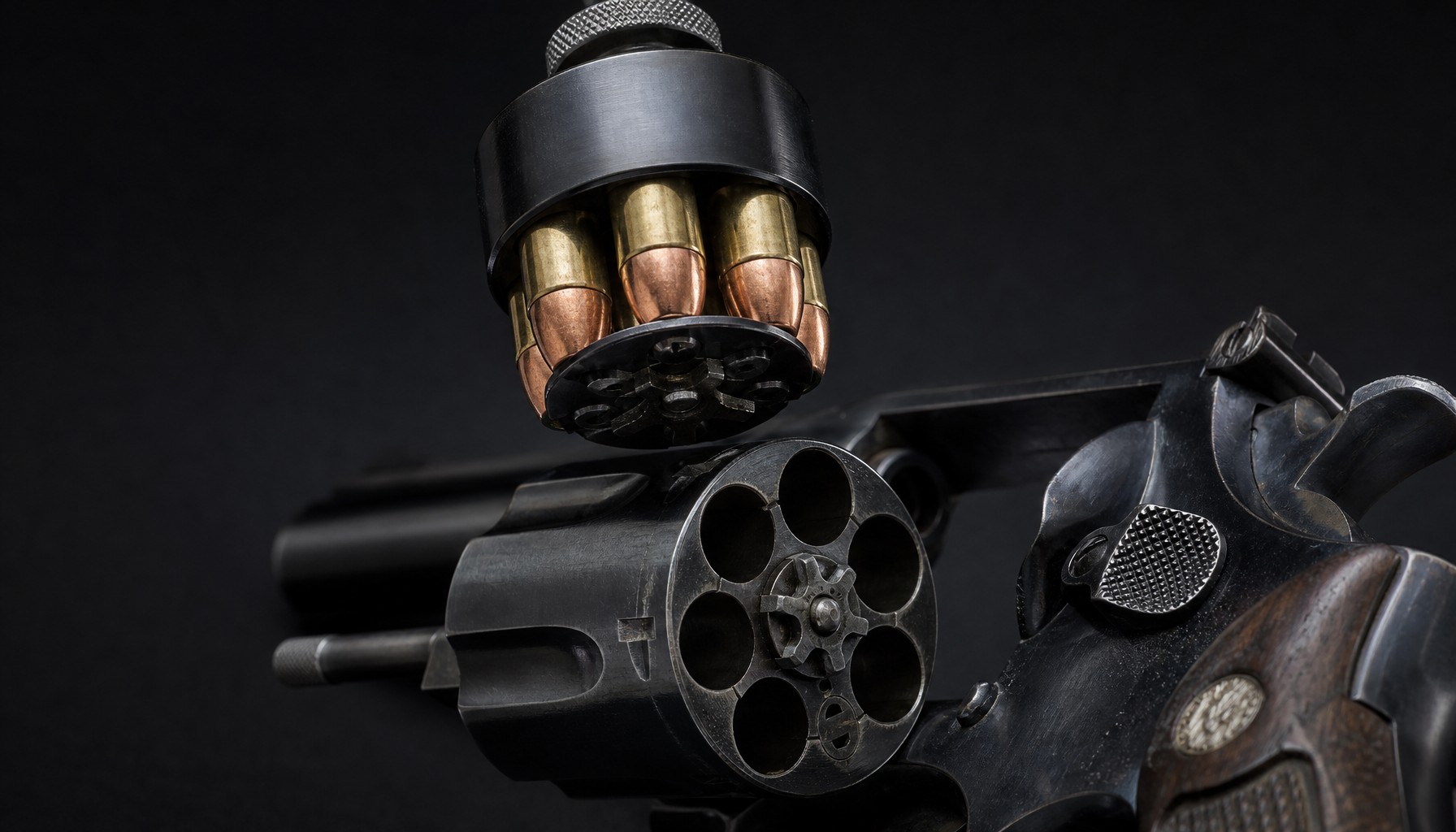
The speedloader: six rounds at once — the lesson of the 1970 Newhall shootout.
The middle · Miami, 1986
Sixteen years later, Miami exposed the limit that training alone couldn't fix. The problem there wasn't how fast the revolver reloaded but what the bullet did when it arrived, and how badly six rounds were outmatched by a rifle and a magazine. Miami is why the cartridge and the cylinder both had to go, and why the polymer, high-capacity semi-auto took the belt. (The full account is above.)
After · North Hollywood, 1997: the day the pistols couldn't reach
On February 28, 1997, two men walked out of a Bank of America in North Hollywood in full body armor, carrying automatic rifles, and turned a Los Angeles street into a forty-four-minute battle. Larry Phillips and Emil Mătăsăreanu wore Type IIIA vests layered with trauma plates and fired rifles — including AK-pattern Norinco Type 56s converted to full automatic — that punched through the LAPD's cars and defeated the officers' vests. The police had pistols and shotguns, and for most of the fight they were simply outgunned; their rounds bounced off the armor. In one of the most remarkable episodes in American policing, officers drove to a nearby gun store, B&B Sales, and borrowed AR-15 rifles off the rack for ammunition that could reach the two men. Nearly two thousand rounds were fired. Both robbers died; a dozen officers and eight civilians were wounded, and, astonishingly, no one else was killed.
The day the police had to borrow rifles
For most of the forty-four minutes, officers with pistols and shotguns simply could not stop two men in layered body armor — their rounds flattened against the vests while the robbers' rifles punched through patrol cars.
So officers ran into B&B Sales, a gun shop near the scene, and carried out AR-15 rifles and ammunition straight off the rack to get bullets that could reach and penetrate. It was an image that shook American policing — the cops out-armed on a city street. Within a few years, the patrol rifle in the cruiser was standard from coast to coast.
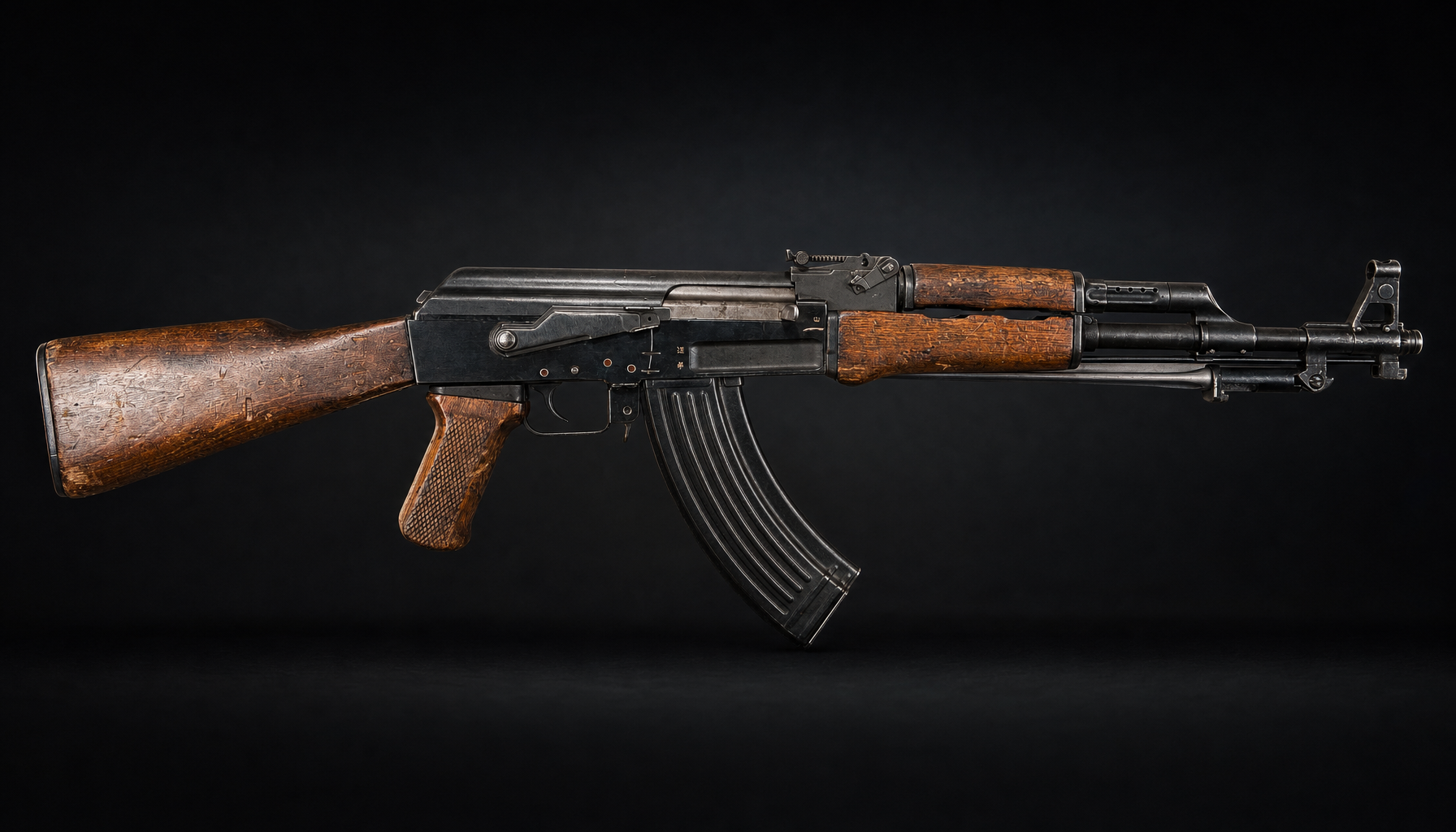
A Norinco Type 56, the AK-pattern rifle used at the 1997 North Hollywood shootout.
The Type 56 is China's version of the Soviet AK-47/AKM, built at Norinco's state arsenals from 1956. Tell one apart by the fully hooded front sight — a distinctive Chinese touch, versus the open sight ears on Russian AKs — and, on many, an under-barrel folding spike bayonet.
Chambered in 7.62×39mm and fed from a 30-round magazine, semi-automatic Type 56 rifles were imported into the U.S. by the thousands until the federal import bans of 1989 and 1994. At North Hollywood the robbers' Type 56s had been illegally converted to full-automatic fire.
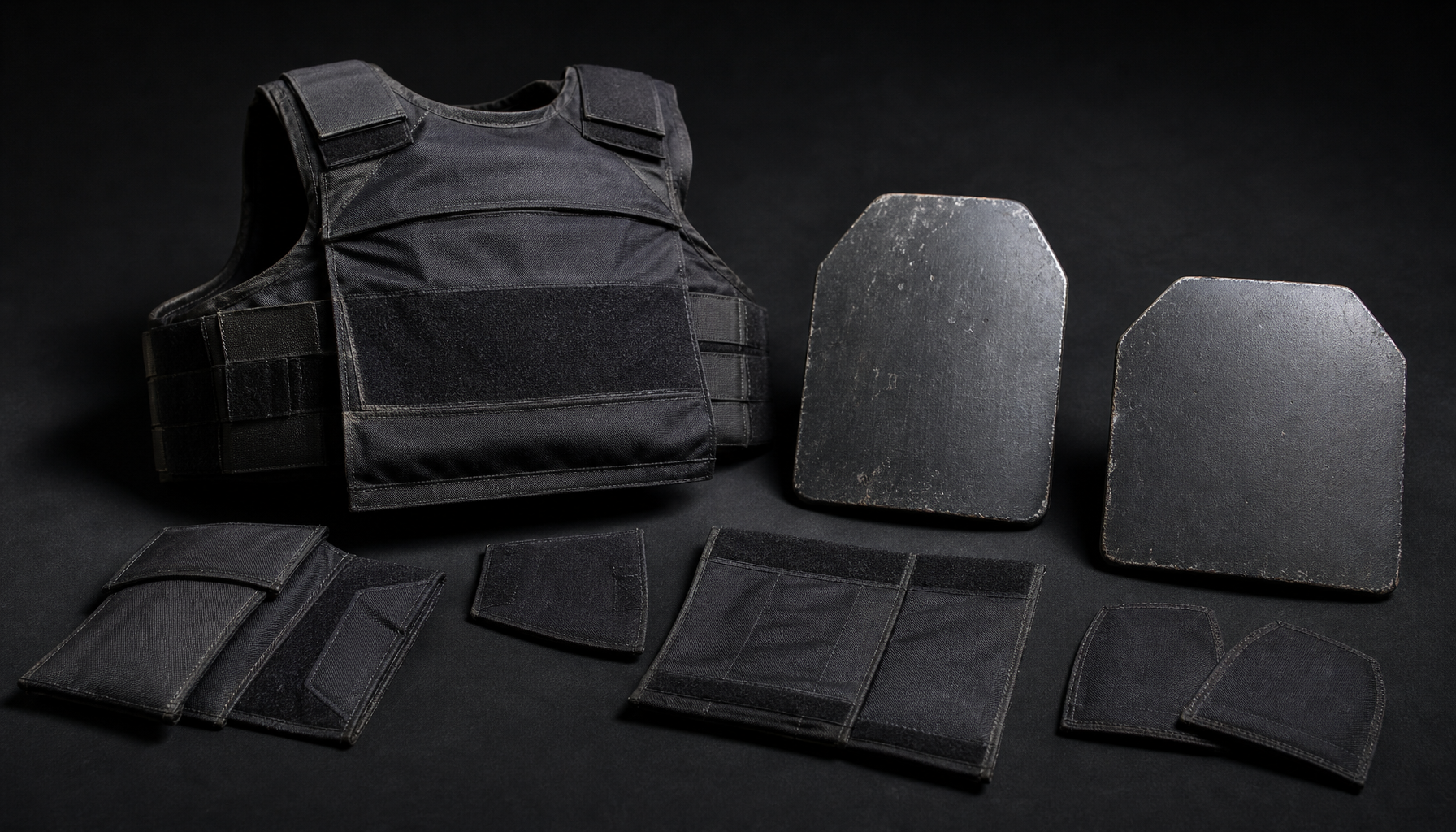
Type IIIA armor with rifle plates, as the North Hollywood robbers wore in 1997.
The lesson was as blunt as Miami's, one tier up: a patrol officer with a handgun could be hopelessly outmatched by a determined man with a rifle and armor. Within months the Pentagon handed the LAPD hundreds of surplus M16s, and departments across the country began stowing AR-15 patrol rifles in the trunks of ordinary cruisers, not just in SWAT vans. The rifle, gone from the police car for the better part of a century, came back to stay.
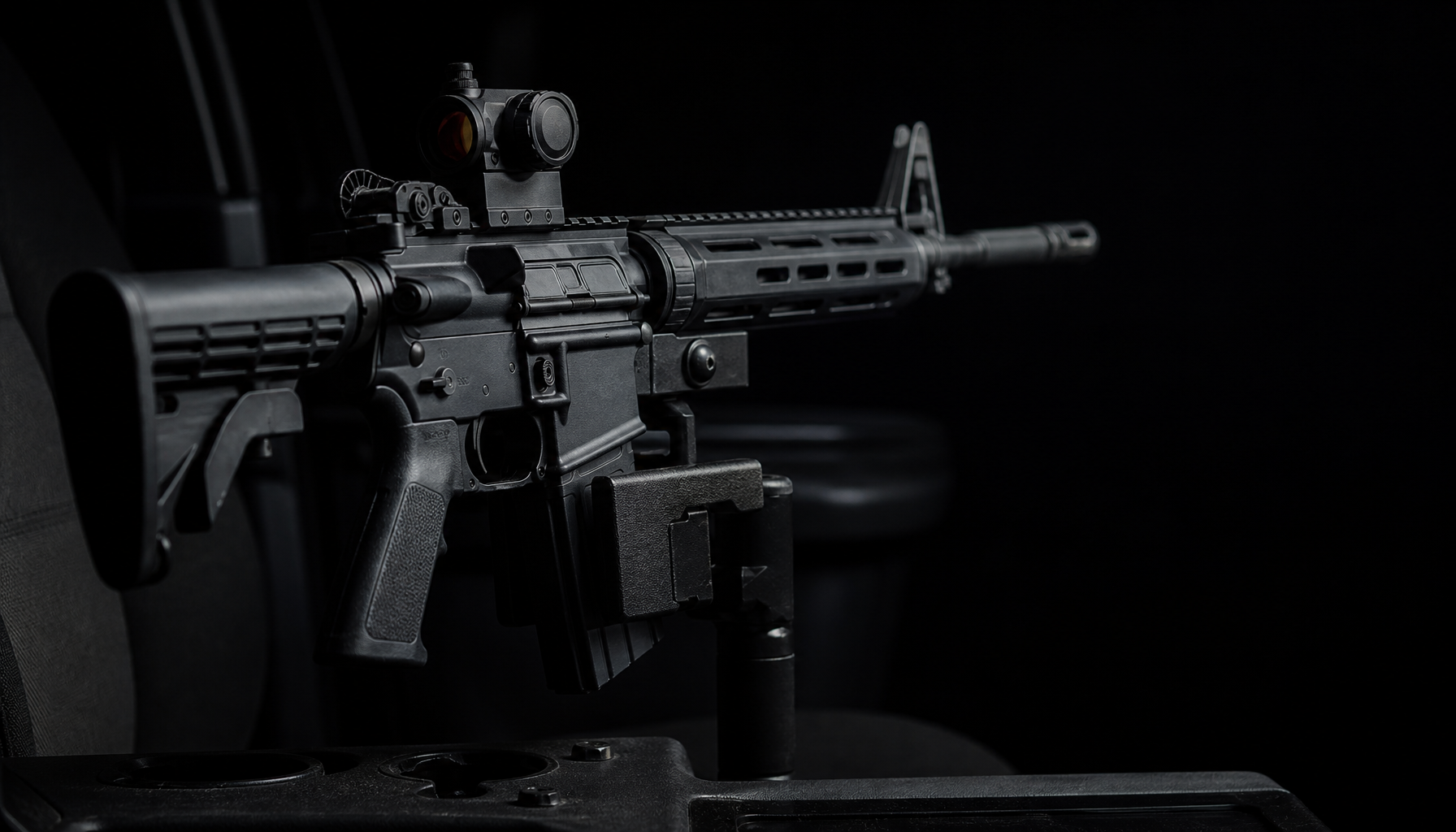
The AR-15 patrol rifle, standard in cruisers after North Hollywood (1997).
Collector's note · AR-15 vs. M16, and the patrol rifle
Eugene Stoner's design comes in two forms: the military M16 is select-fire (capable of full-auto or bursts); the civilian AR-15 fires one shot per trigger pull. “AR” stands for ArmaLite, the company that developed it — not “assault rifle.” Both share the same gas system and 5.56mm cartridge.
North Hollywood is why an AR-15 now rides in so many patrol cars. After officers had to borrow rifles mid-fight, departments nationwide issued patrol rifles so a beat officer could reach a threat a pistol never could.
Three fights, three re-armings: Newhall put a speedloader, and then a mindset, on the belt; Miami put a high-capacity semi-auto on it; North Hollywood put a rifle back in the car. Each began the same way — with officers discovering, in real time and at terrible cost, that what they carried was not enough.
Epilogue · the pistol on the belt today
Where two centuries landed
Stand behind a modern police officer and look at the holster, and you can read this whole book in one object. The gun is almost certainly a striker-fired polymer 9mm — a Glock 17 or 19, a SIG Sauer P320, or a Smith & Wesson M&P — holding fifteen to seventeen rounds, weighing less than a loaded 1911, with no manual safety to forget. It is, mechanically, still Browning's tilting barrel wrapped in Gaston Glock's plastic, feeding the cartridge Georg Luger necked down in 1902. Every ancestor in these pages is present in it.
The military made the same journey. In 2017 the Army retired the Beretta M9 and adopted the SIG P320 as the M17 and M18 — striker-fired, polymer, 9mm, and from the factory cut for a red-dot optic. That last detail is the newest chapter still being written: the miniature reflex sight, once exotic, is now standard issue on duty slides, because a glowing dot puts hits on target faster than iron sights under stress — the same problem, shot placement, that Miami exposed forty years ago, solved one more time.
And the caliber, after two centuries of argument from the .36 Paterson to the .45 to the mighty .44 Magnum, has settled almost exactly where it began for the modern era: a 9mm, roughly the size of Luger's original, chosen not because it hits hardest but because an officer can carry more of it, shoot it faster, and place it better — and because the bullet inside it is now so good that the old power argument simply stopped mattering. Better bullets, more hits, less noise. That is where the handgun's long, bloody, ingenious argument with itself has, for now, come to rest.
The through-line, in one breath
Every leap in this story solved the shortcoming of the last. Ignition made the pistol possible; the cartridge made it fast to load; self-loading made it fast to shoot; polymer and the striker made it cheap and unbreakable; and finally the science of wound ballistics, forced into being by one gunfight, made the bullet itself the thing that mattered. The modern conclusion is almost humble: caliber matters far less than the quality of the bullet and the place you put it.
Popular myths, corrected
Colt didn't invent the revolver (Collier, 1818, and others predate him). He industrialized it with interchangeable parts, starting with the 1836 Paterson.
The metallic cartridge, not the revolver, was the real leap — and Rollin White's bored-through-cylinder patent (1855), held by S&W, blocked Colt from cartridge revolvers until it lapsed around 1869.
The .45 exists because the .38 failed against the Moros; the 1904 Thompson–LaGarde tests set the requirement that produced the 1911.
The 1911 wasn't the first semi-auto (Borchardt 1893, Mauser 1896, Luger 1900). It was the first of Browning's tilting-barrel design that every modern pistol copies.
The 10mm wasn't simply “too much gun.” The FBI spec'd a reduced-velocity load on purpose; the .40 S&W (1990) distilled that load into a 9mm-sized case.
The Glock was never invisible to metal detectors — its slide and barrel are steel. Only the frame is polymer.
Better bullets ended the caliber wars. By 2014 the FBI found 9mm, .40, and .45 nearly identical in effect, and went back to 9mm for capacity and hits.