Complete FOIA Collection — This Book
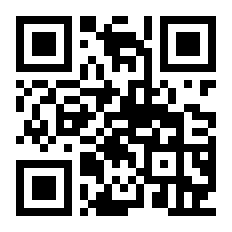
tangentpress.com/tesla/foia/
All four PDF releases, annotated index, key documents identified by page number
Appendix E
File No. 100-2237 — what the government kept, what it released, and what it did not.
FBI File Number 100-2237. Subject: Nikola Tesla. Three Freedom of Information Act releases — the primary release (1980s), a September 2016 release, and an April 2018 release — total approximately 715 pages. All are United States government documents, in the public domain under 17 U.S.C. § 105. Every document reproduced here is exactly as released. Nothing has been altered.
The redactions you see on many pages were not made by the FOIA review process. Multiple pages carry the handwritten notation "Redactions on this page are not FOIA deletions." Those black bars were applied by FBI agents in 1943 — before FOIA existed — to protect informant identities or classify technical content. The government did not add them in 2016. They were always there.
This is a surveillance file, not an investigation file. The FBI did not investigate Tesla's death. They consciously chose not to — documented in their own memos, reproduced below. What File 100-2237 records is forty years of the Bureau monitoring everyone who asked about Tesla after he died: journalists, engineers, Serbian émigré organizations, graduate students, UFO enthusiasts who invoked his name. If you wrote to J. Edgar Hoover asking what happened to Tesla's papers, your letter is probably in here.
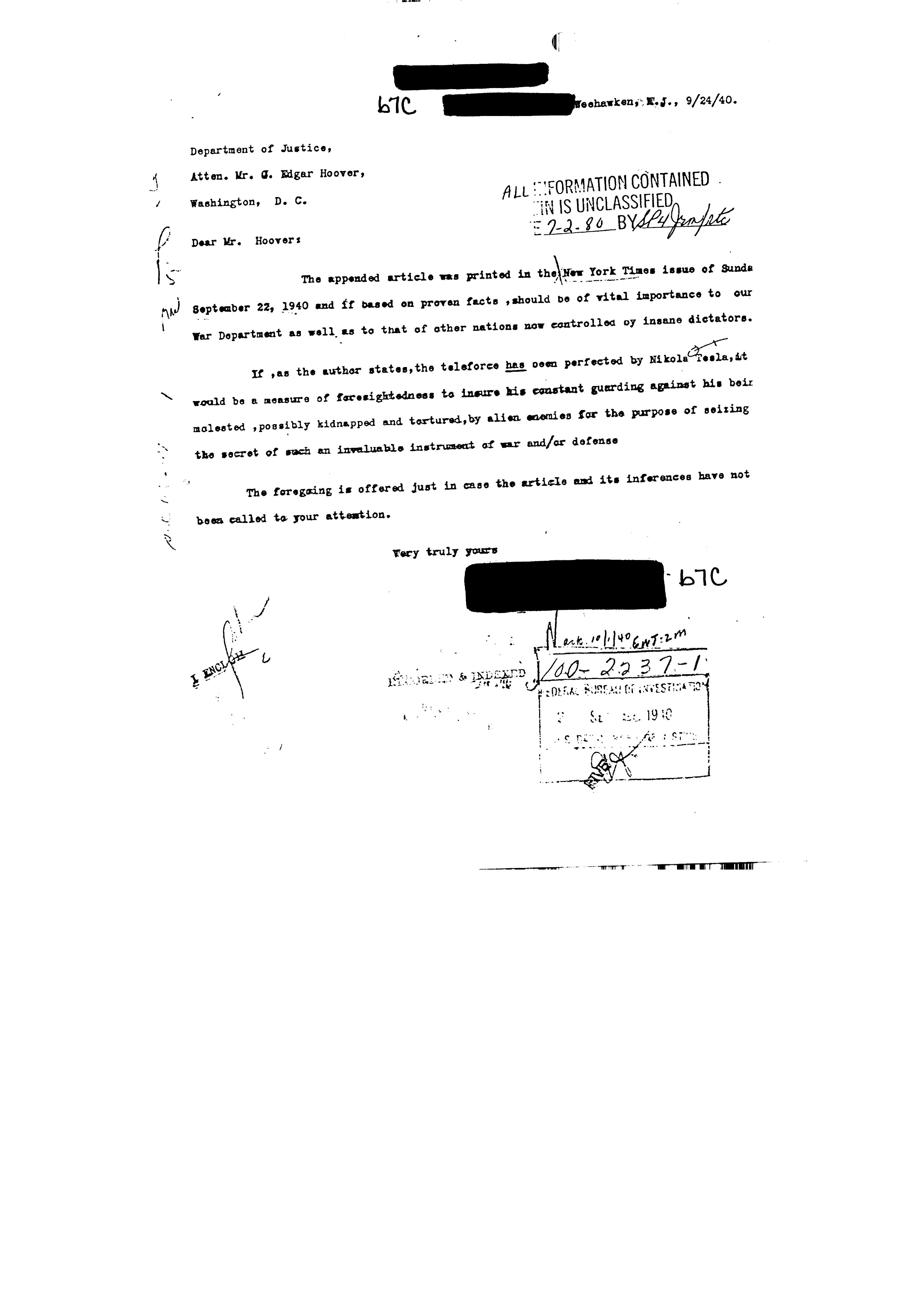
A citizen in Weehawken, New Jersey writes to J. Edgar Hoover about a New York Times article on Tesla's Teleforce weapon published September 22, 1940. His argument:
"If, as the author states, the teleforce has been perfected by Nikola Tesla, it would be a measure of foresightedness to insure his constant guarding against his being molested, possibly kidnapped and tortured, by alien enemies for the purpose of seizing the secret of such an invaluable instrument of war and/or defense."
This is what opened the file. The FBI had Tesla under watch for three years before he died. The redacted name in the signature block is protected by privacy exemption; the FBI file stamp at bottom right reads 100-2237-1 — serial one. The first entry in the file.
A teletype from the FBI New York field office to Director Hoover. Tesla died January 7. This memo is dated January 9. It documents:
The handwritten notation at the bottom reads: "Redactions on this page are not FOIA deletions." The information under those bars was classified in 1943. It has not been released.
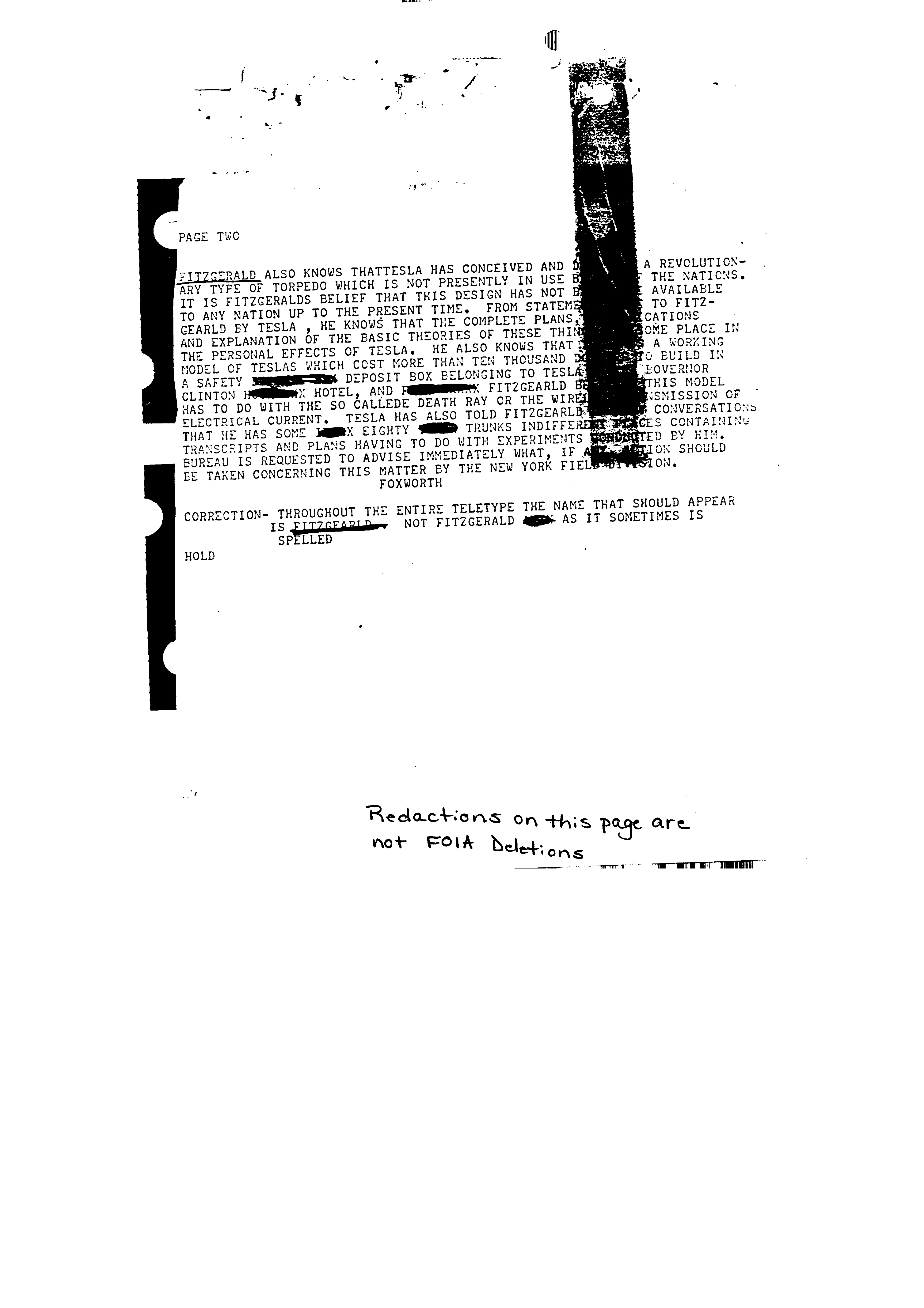
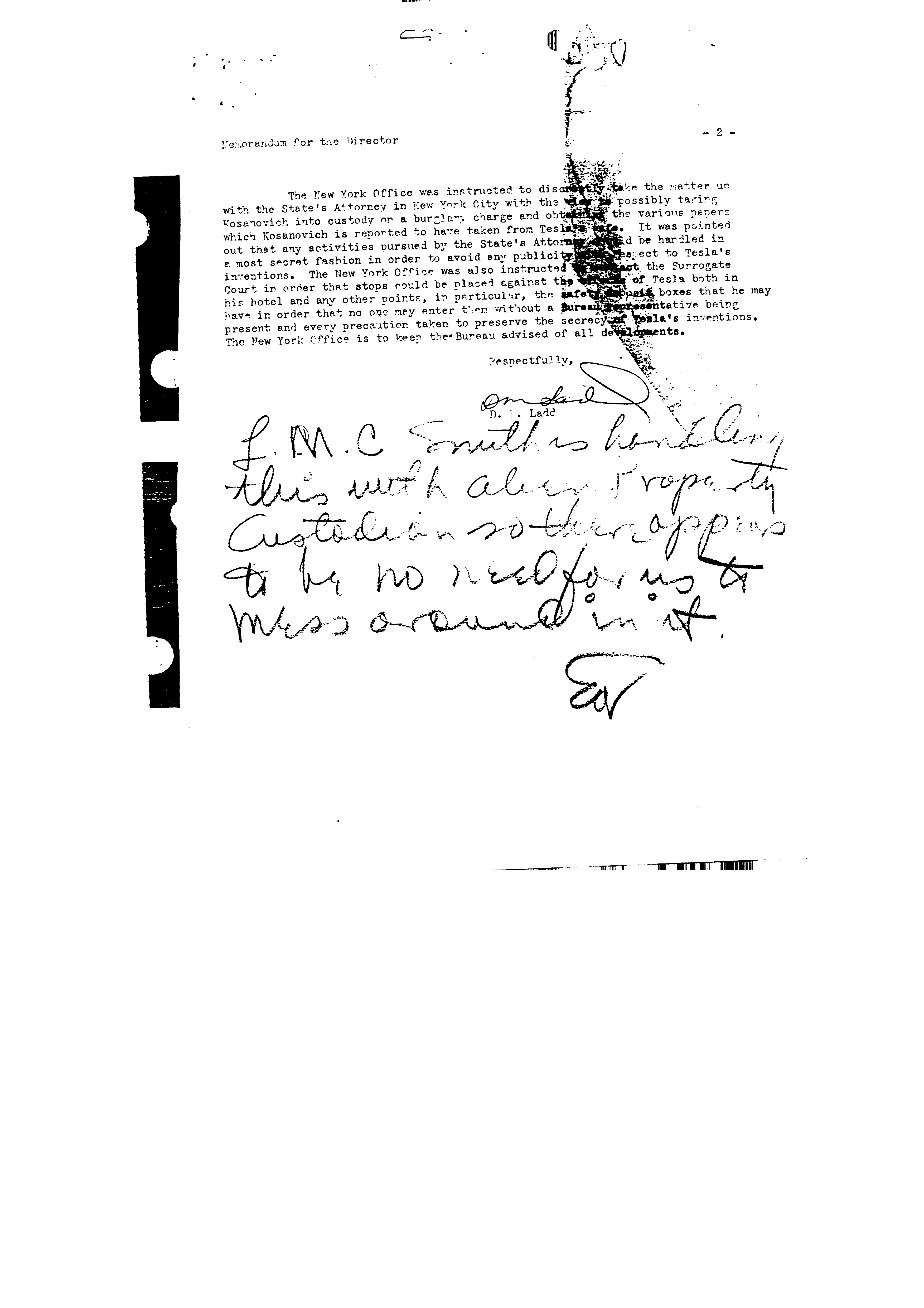
This is the most important document in the file.
A formal memorandum circulates through FBI leadership about Tesla's death and what the Bureau should do about his papers and equipment. It reaches Hoover. At the bottom of the page, in J. Edgar Hoover's own handwriting:
"L.M.C. Smith is handling this with Alien Property Custodian so there appears to be no need for us to mess around in it."
The Director of the Federal Bureau of Investigation — briefed on the death of the man who built the American power grid, who had eighty trunks of technical documents that enemy nations had reportedly tried to obtain — wrote: no need for us to mess around in it.
The matter went to the Office of Alien Property Custodian. The FBI stood aside.
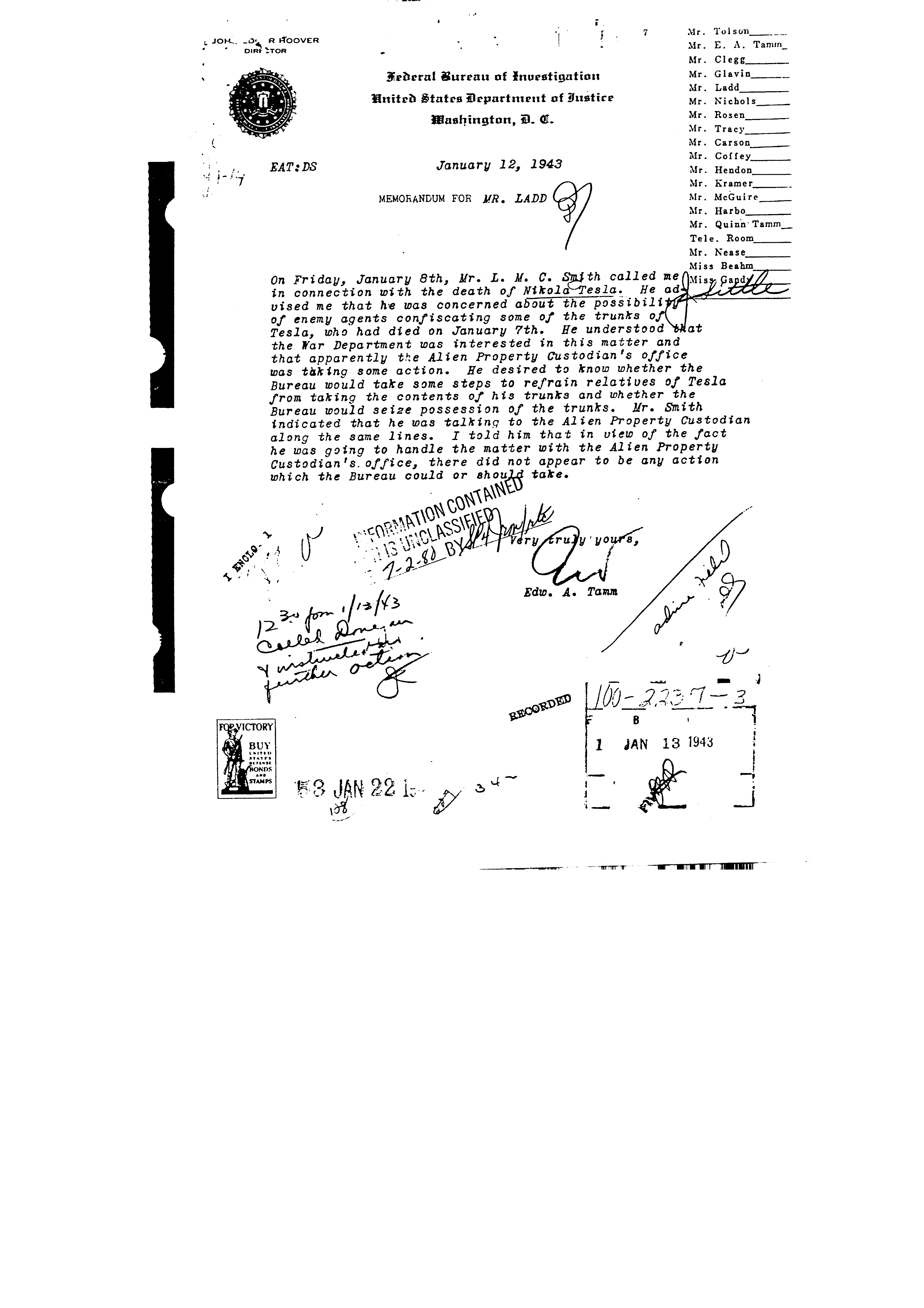
Edward A. Tamm, Associate Director of the FBI, formally documents the decision. L.M.C. Smith of the Justice Department called him about the trunks; Smith was handling it with the Alien Property Custodian. Tamm's conclusion:
"there did not appear to be any action which the Bureau could or should take."
Note the routing slip on the right margin. Every name on it — Tolson, E.A. Tamm, Clegg, Glavin, Ladd, Nichols, Rosen, Tracy, Carson, Coffey, Hendon, Kramer, McGuire, Harbo, Quinn Tamm — is a senior FBI official who saw this memo and signed off. The entire senior leadership of the FBI was briefed. They all agreed: stand aside.
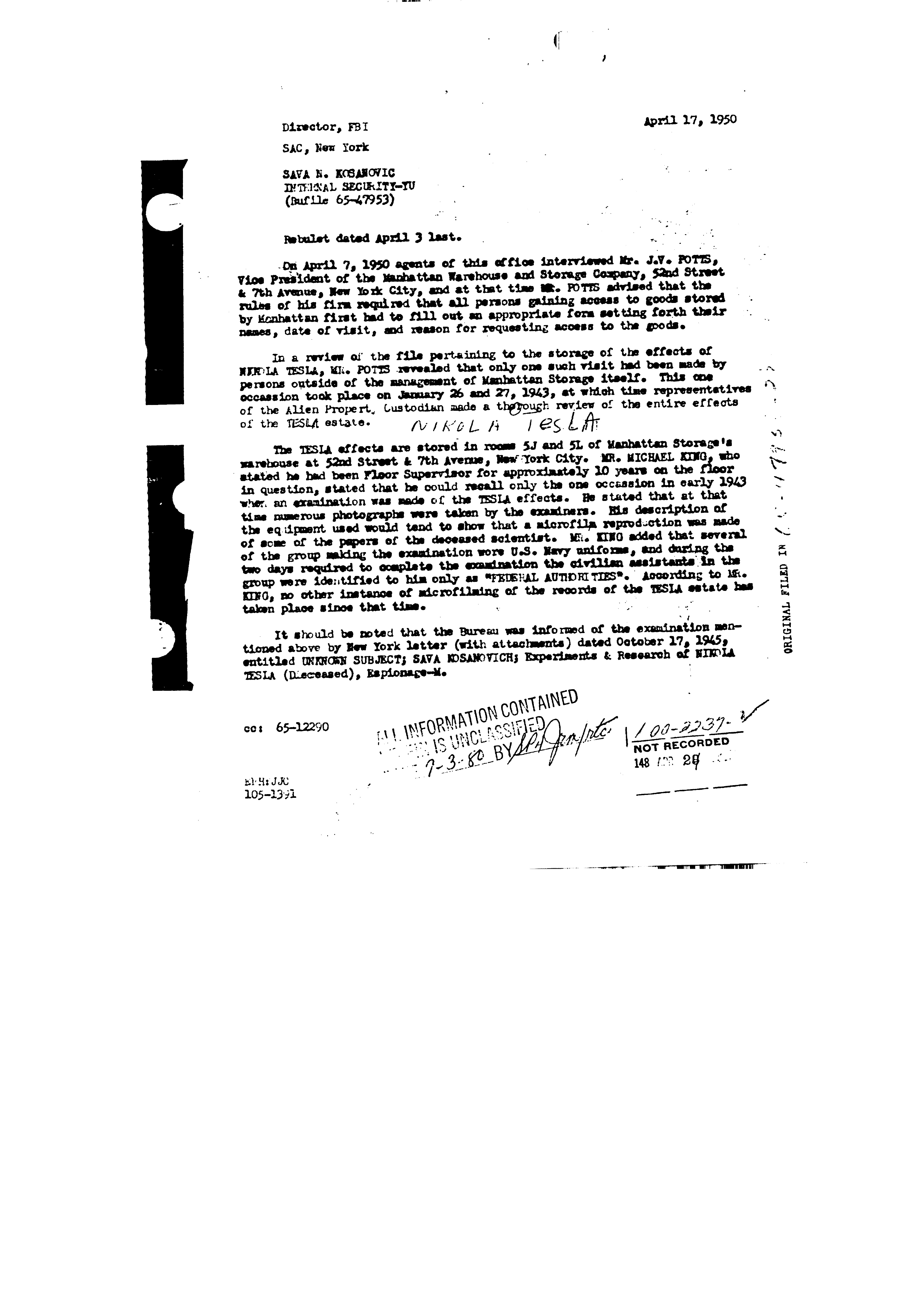
The FBI interviews J.V. Fotts, Vice President of the Manhattan Warehouse and Storage Company (52nd Street and 7th Avenue), where Tesla's property was stored in rooms 5J and 5L. Floor supervisor Michael King confirms the details:
The subject heading of this memo: SAVA N. KOSANOVIC, INTERNAL SECURITY-YU, Espionage-M. Tesla's nephew — the Yugoslav Ambassador — was an espionage subject. The FBI file on Tesla is actually embedded in a Kosanović espionage case.
They don't tell you what Trump's report said. That document is at the National Archives.
They don't tell you what was on the microfilm, or where it is now.
They don't tell you what was in the eighty trunks. The inventory of what the OAP seized and the inventory of what arrived at the Nikola Tesla Museum in Belgrade in 1952 have never been publicly reconciled. The gap is real.
| Source | What You'll Find | |
|---|---|---|
|
FOIA files — this book tangentpress.com/tesla/foia/ |
All 715 pages across four releases, indexed and annotated |
|
Official FBI Vault vault.fbi.gov/nikola-tesla |
The authoritative government source; cite this, not us |
|
National Archives RG131 archives.gov/research/guide-fed-records/groups/131.html |
Office of Alien Property records — where Trump's report lives |
 |
Nikola Tesla Museum, Belgrade teslamuseum.rs |
160,000 original documents; the official Tesla archive |
Recommended reading: Seifer, M. Wizard: The Life and Times of Nikola Tesla (Citadel, 1998), Chapters 41–43. Seifer accessed the Trump report at the National Archives and quotes from it directly. Carlson, W.B. Tesla: Inventor of the Electrical Age (Princeton, 2013), Chapter 18.