Chapter 1
Electricity, magnetism, and the two rules that built the modern world — explained from scratch.
This chapter is not about Tesla. Tesla doesn't appear until the next chapter.
This chapter is about the physics that Tesla mastered — explained the way it should have been explained in high school, and wasn't. If you've taken physics courses, this will be review and you can move quickly. If you haven't, read this one slowly. Everything in the rest of the book is built on what follows.
There are two rules. Two. The entire electrical world — every motor, every generator, every transformer, every radio transmitter, every wireless phone charger — runs on two rules that were discovered in the 1820s and 1830s. Tesla spent his career finding new things to do with them. Once you know the rules, his genius stops being magic and starts being science.
Let's start at the very beginning.
Everything around you is made of atoms. Atoms have a nucleus in the center (protons and neutrons) surrounded by electrons orbiting at a distance. Protons have a positive electrical charge. Electrons have a negative electrical charge. Under normal conditions, they balance out and everything is neutral.
But here's the thing about electrons: in some materials — particularly metals like copper — the outermost electrons are only loosely attached to their atoms. They're free to wander. If you give them a reason to move in a particular direction, they do.
That movement of electrons through a material is electric current.
Three words describe almost everything about how electricity behaves in a circuit. If you understand these three words and the simple relationship between them, you will understand more electrical engineering than most people who consider themselves technically literate.
The easiest way to understand voltage, current, and resistance is to think about water in a pipe. This analogy isn't perfect, but it's close enough to build genuine understanding — and every electrical engineer learned it this way.
In 1827, Georg Ohm measured the relationship between voltage, current, and resistance in wire. His finding:
Voltage equals current times resistance. That's it. This equation governs almost everything in an electrical circuit.
What it means in practice:
Your electric bill doesn't charge you for voltage or current. It charges you for power — the rate at which energy is delivered. Power is measured in watts (W).
Power equals voltage times current. A 60-watt light bulb drawing current at 120 volts uses 0.5 amps: P = V × I → 60 = 120 × 0.5.
This is the foundation. Before we go any further, build this with your hands. Five minutes. It makes the abstract concrete.
The battery provides 9 volts of pressure. Electrons flow from the negative terminal, through the wire, through the resistor, through the LED (which converts some of their energy to light), and back to the positive terminal. The resistor limits current to about 19 milliamps — safe for the LED. Without the resistor, too much current would flow and the LED would burn out in seconds.
Ohm's Law in action: I = V/R = 9 / 470 = 0.019 amps = 19 milliamps. You just calculated the current flowing through your circuit.
Swap the resistor for a 1,000Ω (1kΩ) resistor. The LED dims. Less resistance? Wait — more resistance, LESS current, dimmer LED. Does that make sense now? Narrow the pipe, reduce the flow.
You have felt a magnetic field. If you've ever held two magnets close together and felt them snap together or push apart, you have felt the force that fields exert. The field itself is invisible, but its effects are completely real.
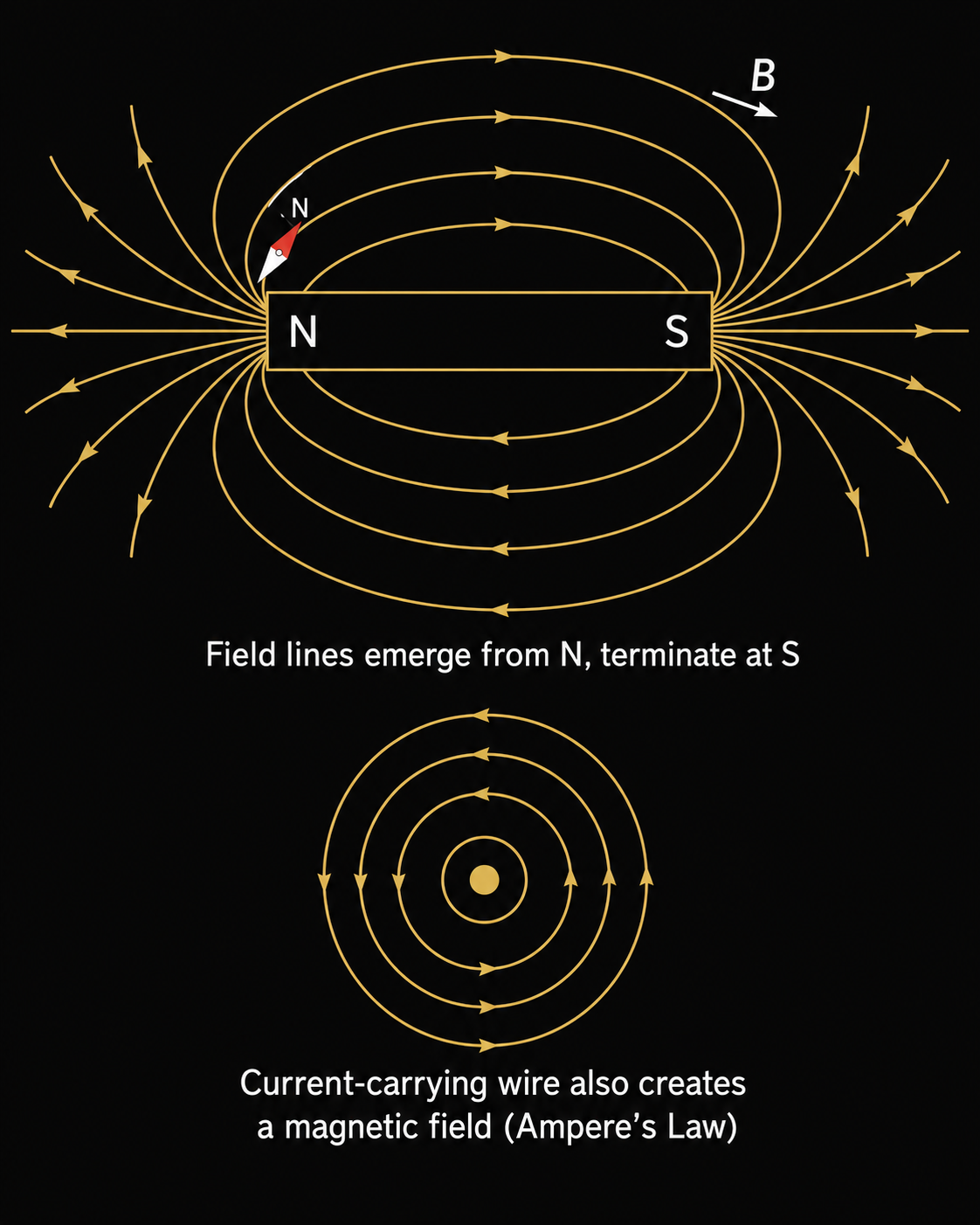
A magnetic field is a region of space where a magnetic force exists. The field has both strength (how powerful it is) and direction (which way it pushes). A compass needle is a tiny magnet, and it aligns itself with whatever magnetic field surrounds it — including Earth's. The needle points roughly north because Earth has a magnetic field with a direction, and the needle follows it.
Make the invisible visible.
The lines are denser near the poles (stronger field) and spread out at the sides (weaker field). The lines always form complete loops — they leave the north pole and return to the south pole. They never cross each other. They never start or end in empty space. This is one of the four fundamental rules of electromagnetism, and you just confirmed it with iron filings.
On April 21, 1820, a Danish physicist named Hans Christian Oersted was giving a lecture. He had a compass on his desk and a wire carrying current nearby — and when he switched on the current, the compass needle moved.
He stopped the lecture. He switched the current on and off several times, watching the needle swing each time. Then he went back to his laboratory and spent the next three months figuring out exactly what was happening.
What he had discovered: a wire carrying electric current creates a magnetic field around itself.
Not just near magnets. Not in special materials. Any wire. Any current. The magnetic field wraps around the wire in circles, like a coil spring seen from the end. The more current, the stronger the field. Reverse the current, and the field reverses direction.
This was not a small discovery. This was the first evidence that electricity and magnetism — which had been studied separately for centuries — were connected. The same force. Two faces of one thing.
The practical consequence arrived almost immediately: if current creates a magnetic field, you can make an electromagnet. Wrap a wire in coils around an iron nail and connect it to a battery. The coils concentrate the field. The iron amplifies it. The result is a magnet you can switch on and off — and whose strength you can control by changing the current.
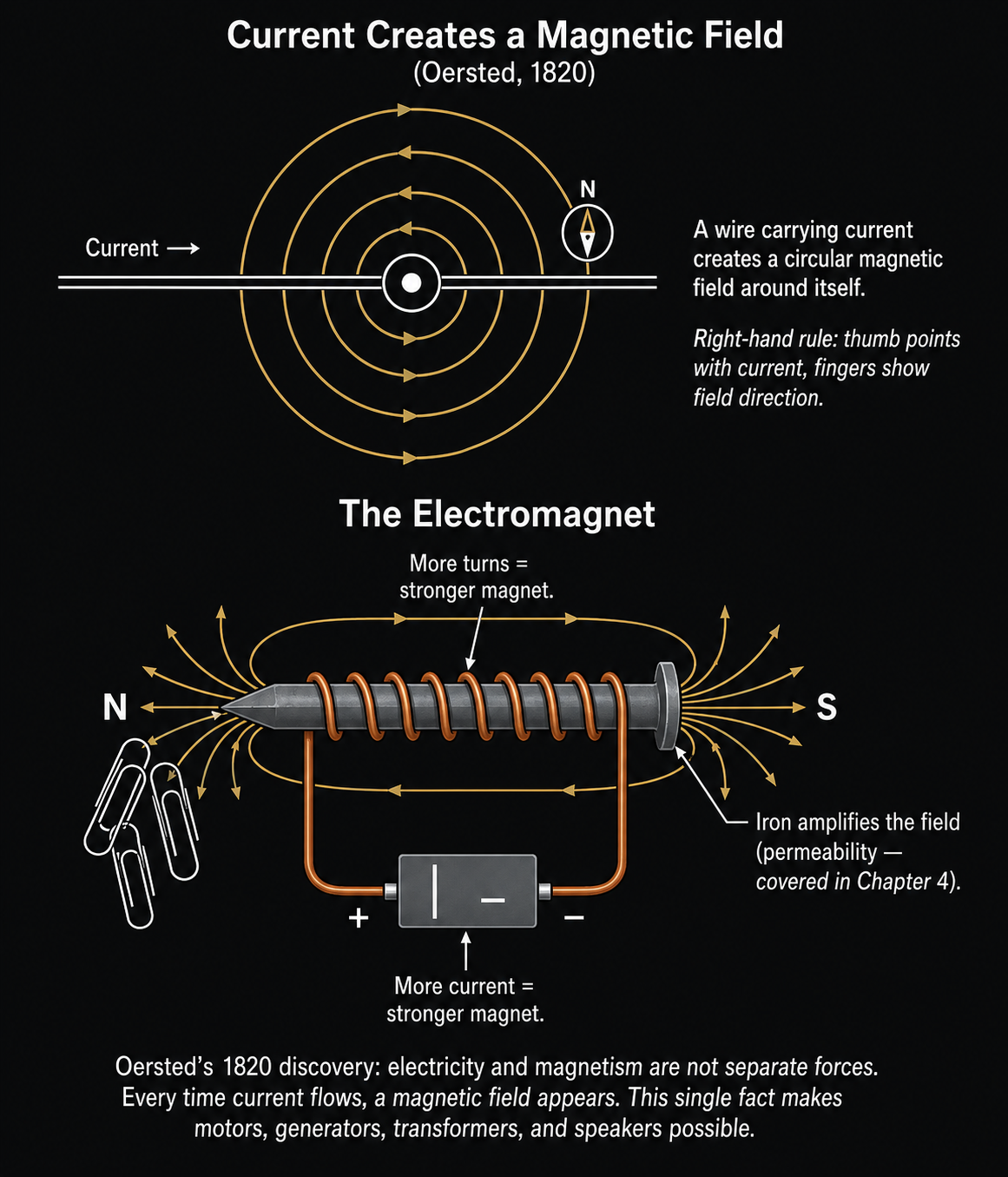
This is Oersted's discovery in your hands. Ten minutes, $3 in parts, and you will have built something that was not possible before 1820.
Current flows from the battery through the wire. The current creates a magnetic field in each coil. Because all the coils are wound the same direction, all their fields point the same way and add together. The iron nail concentrates and amplifies that field (iron has a property called permeability that multiplies magnetic field strength — this will become important in Chapter 4).
Try this: add a second battery in series (positive of first to negative of second). More voltage, more current, stronger magnet. Ohm's Law, electromagnetic edition.
Also try: reverse the battery. The nail is still a magnet — but the poles have swapped. North became south. This is the reversibility of electromagnetism, and it is fundamental to how motors work.
Eleven years after Oersted's discovery, an English scientist named Michael Faraday asked the obvious follow-up question: if electricity creates magnetism, does magnetism create electricity?
The answer, after months of failed experiments, was: yes — but only if the magnetic field is changing.
Faraday's key experiment in 1831: he wound two coils of wire around an iron ring, one on each side. He connected one coil (the primary) to a battery. He connected the other coil (the secondary) to a sensitive current meter. When he switched the battery on, the meter twitched. When he switched it off, the meter twitched again — in the opposite direction. But while the current was flowing steadily, the meter read zero.
This was the crucial insight: a steady magnetic field creates nothing. A changing magnetic field creates a current.
This is the most important experiment in the book. No battery. No power supply. The electricity comes from a moving magnet — and nothing else.
When the magnet was moving INTO the coil, the magnetic field through the coil was increasing. That change created a current. The LED lit.
When the magnet was moving OUT, the field was decreasing. Change again, but in the opposite direction. Current again, but reversed. LED lit from the other end.
When the magnet was still, the field was constant. No change. No current. LED dark.
This is Faraday's Law of Induction, and you just confirmed it on your kitchen table with a magnet and an LED. The entire electrical power industry runs on this principle. Every generator at every power plant on Earth is doing exactly what you just did — but with much larger magnets, spinning continuously, so the field never stops changing and the current never stops flowing.
Try this: move the magnet slowly. The LED is dimmer. Move it fast. Brighter. Faraday's Law: the faster the field changes, the more voltage is generated.
Step back and look at what we have:
Rule 1: Current → Magnetic field
Rule 2: Changing magnetic field → Current
These two rules form a complete loop. Electricity makes magnetism. Magnetism (when changing) makes electricity. You can cycle between them. And if you cycle between them in a clever enough way, you can build machines.
A generator: spin a magnet near a coil (Rule 2) → electricity comes out
A motor: run electricity through coils in a magnetic field (Rule 1) → rotation comes out
A transformer: use Rule 1 to make a changing field, use Rule 2 to pull electricity out at a different voltage
A radio transmitter: oscillate current back and forth very fast → the rapidly changing field radiates as electromagnetic waves
A wireless phone charger: Rule 1 in the charging pad, Rule 2 in the phone
Everything Tesla built: every single thing, without exception
Nikola Tesla arrived in New York City on June 6, 1884. He was 28 years old, spoke six languages, and had been living with these two rules since he was a student in Graz, Austria in the late 1870s. He understood them the way a chess master understands the rules of chess — not just what they say, but what they mean, and what they imply.
What he understood that other engineers had not yet seen: the two rules could be used to create a motor with no brushes, no commutator, and no mechanical contact between the stationary and rotating parts. A motor that would spin because of a mathematical property of alternating currents — a property he had visualized completely in his mind two years earlier, in a Budapest park, while reciting Goethe.
You don't know what a commutator is yet, or why its absence matters. You don't know what alternating current is. Those are the next two chapters.
But you now know the two rules. You have seen them work in your hands. You are ready to understand what Tesla understood — not as magic, but as a logical consequence of physics that a brilliant mind followed further than anyone had followed it before.